MG Metro 6R4
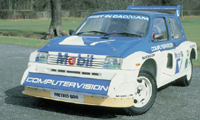
MG Metro 6R4
Of the 200 manufactured to comply with Homologation requirements a ‘Clubman’ version was offered for sale to the rallying fraternity at an ‘off-the-shelf’ price of £35,000, whilst the full ‘International’ Rally specification car cost £47,000 and these prices were excluding VAT.
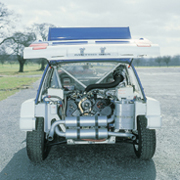
‘Clubman’ and ‘International’ specifications meant that there were two versions of the 90 degree V6 2994cc engine with the ‘International’ engine producing up to a hefty 410bhp and the ‘Clubman’ a more modest 250 bhp. Although engine modifications were available to transform the Clubman power unit to International specification through Austin Rover Motorsport. The engines were built alongside the Rover production engines at Austin Rover’s Coventry engine plant. The choice of a normally aspirated design instead of turbocharging had considerable benefits; in particular the immense torque available ensured an instant throttle response throughout the whole rev range. Figures quoted were 270lb ft @ 6500 rpm for the international and 225lb ft @ 4500 for the Clubman. This was in stark contrast to the characteristics of turbocharged engines which ‘in those days’, generally had inherent throttle lag and poor low speed torque, not to mention problems with underbonnet heat dissipation. All of which were considerably reduced with normally aspirated engines. The engine was coded V64V (vee formation, 6 cylinders with 4 valves per cylinder) and it was the first engine ever designed specifically for international rallying, instead of being derived from a standard production car unit. The 3 litre was of oversquare design in 90 degree V6 configuration with a symmetrical crankshaft and uneven firing. The block and heads were made of cast aluminium incorporating design features in their structure that made them light but rigid. The block had dry liners of iron alloy. The valves (4 per cylinder) were directly operated by twin overhead belt driven camshafts. At the bottom end of the engine, the cast aluminium dry sump contained the engine oil as well as the short cross shaft between the rear differential and the left hand drive shaft coupling together with the separate lubrication system for the shaft. The rear differential casing bolted to both the block and the sump making a very rigid unit.
Because the engine was mounted ‘in reverse’ the water pump migrated to the same end as the twin plate AP clutch. The specially designed pump, like so many ancillaries was belt driven. The alternator, capable of delivering over a kilowatt of steady power, was mounted in the vee at the rear of the engine block and the lightweight starter motor had an output two and a half times that of a conventional one. There was a digitised fuel and ignition control system devised by Lucas Micos with two different sets of fuel injection hardware. On the ‘Clubman’ 6R4 there was a single butterfly controlling the air intake but even with this and the Lucas processor, 250 bhp was easily attainable. The other system on the ‘International’ specification car was a full six butterfly, six venturi induction manifold which gave between 380 bhp and 410 bhp dependent on the requirements of the particular rallies. The whole engine ready to install in the 6R4 weighed in at 140 kilograms and apart from the oil cooler and radiator there were no other additional ancillaries.
Worthy of mention is the original prototype engine that was fitted to the 6R4. This was a pushrod V62V engine which achieved far more than was ever expected of it. The V62V was produced very quickly because Austin Rover needed an engine of the right size and weight to power the prototypes. The first engines were made literally by slicing two cylinders out of the well known Rover V8 engine and welding the pieces back together again before final machining and assembly. A special crankshaft had to be designed but pistons, valves, rocker gear, pushrods, connecting rods and all other external components were from the Rover unit. Induction was by a pair of down draught, three barrel Webers for simplicity. In this form the engine produced around 235 bhp. These engines powered Metro 6R4s throughout 1983 and 1984, first in private testing and finally on actual events for which they were never intended.
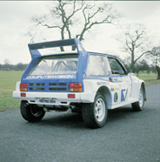
The MG Metro 6R4 was built in Austin Rover’s Longbridge car plant. The differences between the standard Metro and the 6R4 were many with the most obvious in the bodywork. The car was some 70mm wider with consequent increases in front and rear track spanning 1510mm at the front and 1550mm at the rear. Wheelbase was lengthened by 90mm to 2391mm, with most of the increase at the rear of the vehicle. Road wheels were also increased in diameter from 340mm to 390mm which gave greater advantage when shod with 16″ tyres. Another constraint was the fact that most of the advanced development in construction and compounds of tyres was only available with the larger tyre sizes. Consequently the Metro was persuaded to grow a little to accept them. The wheel arches were enlarged to accommodate the bigger wheel and tyres with the 12″ ventilated discs taking advantage of the extra space inside the wheel. Major external changes were the incorporation of a high rear wing and low front wing to aid stability and extensive modifications to the bonnet and front and rear wheel arches took full opportunity of increasing the vertical wheel movement.
The 6R4’s suspension was fully adjustable for camber, ride height and castor angle and incorporated Bilstein gas-filled struts which were clamped at their lower end into cast alloy hub carriers. The road wheels were designed by a British company, Dymag who had earned a good reputation in the Formula One field. The purpose designed transmission centred on a five-speed gearbox feeding its power to an epicyclic centre differential through a pair of step-off gears. An AP twin-plate clutch provided the link between engine and gearbox and a conventional prop shaft fed the power forward to the front differential while a shaft ran past the engine sump to the rear differential mounted on the side of the engine. This shaft was splined to facilitate rapid differential changes should it have proved necessary. There was a short cross shaft taking power to the left wheel through the engine sump. FF Developments viscous couplings were used in the centre of the 6R4’s four wheel drive system and were used on both front and rear differentials.
There was little to differentiate externally between the Clubman and International 6R4’s with the only detectable difference being the inclusion of an underbody aerodynamic diffuser on the International car. What was less obvious was the fact that Kevlar was used to construct the wheel arches on the International version giving greater strength with weight saving, whereas on the Clubman car they are made from fibreglass. A test carried out by ‘Autocar’ magazine showed staggering performance figures for the Computervision 6R4 with a 0-60 mph time of 3.2 seconds, whilst the Clubman version was not far behind with a figure of 4.5 seconds. ‘Autocar’ stated that it was the fastest accelerating, wheel driven car that they had ever tested. The MG Metro 6R4 put the MG name once more in the forefront of International Motorsport, albeit only briefly as these ‘supercars’ were soon to be banned by FISA as they were deemed to quick for their own good!
 |
 |
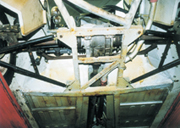 |
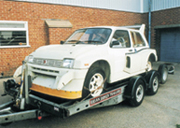
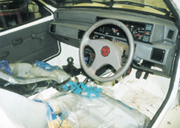
An unregistered but ‘as new’ from the factory Clubman specification MG 6R4 with only 6 miles on the speedometer can be seen at the MGOC HQ at Swavesey. This 6R4 has never been used in action nor in fact, used at all, it has spent most of its life on display at the Donington Grand Prix Collection. The competition car is virtually as it left the factory, the shell is painted white and the extensive fibreglass body panels are still in base coat awaiting a paint job and the application of all the necessary racing logos and decals. The seats are still partly covered in protective clear plastic and the perspex rear screen still has the backing paper attached. The body has been extensively wax protected particularly on the underside just as it left the factory. The engine has been run but not for some time and although the car is complete mechanically it will require some preparation for use. Here is a 6R4 that would form the ideal basis of a very exotic road car or a useful competition car. The unused 6R4 is now available for sale, if you are interested in acquiring a truly unique part of Austin Rover’s competition history then please contact the Club HQ.
Now available from the MGOC Regalia Department
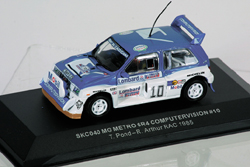 MG Metro 6R4 model car Based on Tony Pond’s 1985 Lombard RAC Rally fully detailed with all decals Scale 1:43
Catalogue no 4251 only £24.00 plus
£2.00 p&p
Telephone
01954 234008 or
purchase from the web www.mgownersclub.co.uk