The truth about ADO70
The Mini-based ADO70 could have been a ‘New Midget’ – but instead the project soon ran into the sands. Jon Pressnell tells the behind-the-scenes story of this MG might-have-been
“A good opportunity that went sour” is how former BL designer Paul Hughes describes ADO70, the Mini-based coupé he styled, and which was built in 1970 by Michelotti. As we know, nothing came of this Italian-made one-off, which at one stage was considered as a potential replacement for the Austin-Healey Sprite and MG Midget.
But could things have been different, had a clash of personalities not intervened? That might be slightly overstating the case, but the story Hughes tells makes it clear that ADO70 entered the ring with one hand tied behind its back.
“ADO70 was my baby, as far as the styling was concerned,” says Hughes, who had joined the new Cowley styling studio in 1968, fresh from Ford. Previously responsible for detailing on the MkI Escort, Hughes worked under fellow ex-Ford men Roy Haynes and Harris Mann, the latter becoming studio chief after Haynes left BL in 1969.
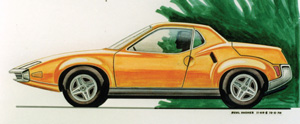
1. The chosen Paul Hughes proposal for ADO70 was pert and crisp; it dates from March 1970
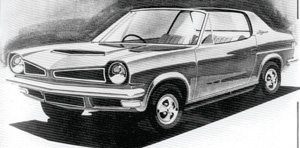
2. The peaked prow with its two-part grille was certainly more dynamic than the final front
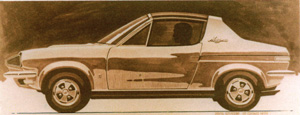
3. Hughes felt his rear-end treatment had been needlessly changed
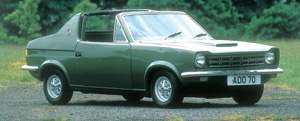
4. Mini 10in wheels and standard 7in headlamps were styling constraints imposed on ADO70 by management
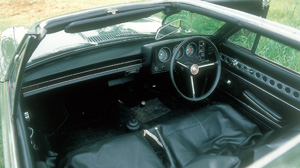
5. Mini 1275GT instruments and wheel are used, but the door furniture is Italian
“We had a styling competition, what we called a ‘wallpapering’ exercise , over about three days, in which every designer in the studio was asked to submit as many designs as he could in the time, two, three or maybe four renderings,” recalls Hughes. “We were given the brief of using Mini mechanicals to design as sporty a vehicle as we wanted. It didn’t have to be a 2+2 or a four-seater, it could be a two-seater. Management then came in and selected their favourite, and mine was the one they chose.
“Once this had been done, Harris Mann came to me and said ‘Can you do a front three-quarter view and a rear three-quarter very quickly for Robin Owen to take to Michelotti to build the actual prototype?’ I remember saying to Harris ‘Now my design has been chosen, shouldn’t I be the one to supervise it?’ But I didn’t push this any further, and Rob drove a Clubman down to Turin, armed with my sketches, and stayed there, keeping an overall eye on the design of the final vehicle.
“Three months later he returned with a completed car, built from the Clubman. From beginning to end the project took four months maximum, including the building of the car. I don’t think it passed any safety checks or anything.”
This was typical of the quick-fire way in which Michelotti worked. Rob Owen produced a series of sketches, the Mini, a 1275GT development hack, was set on a surface plate and stripped to its floorpan, and over a week a wooden buck was built by local sub-contractors, after which the body was formed by hand from sheet steel, around this pattern. Meanwhile, Owen was sketching the interior, using as many off-the-shelf Mini/BL parts as possible, so that Michelotti’s trimmer could make up the necessary elements.
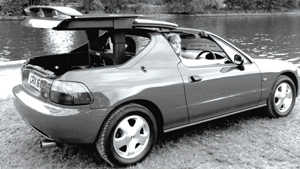
6. “That’s the car it wanted to be like,” says Hughes of the targa-top Honda CRX
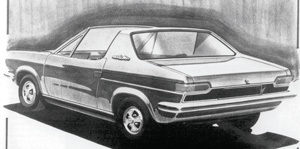
7. At the same time as ADO70 was underway, Hughes was providing renderings for the mid-engined AD021
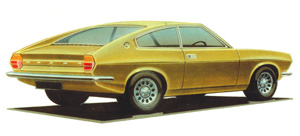
8. Hughes was also involved with the proposed Marina-based MG coupé, which carried ‘Magna’ badging
The finished ADO70, complete with a targa-style T-top with two removable roof panels, was not the car envisaged by Hughes: “There was a degree of friction between Rob and myself. Rob was about seven or eight years older than me and when I came to join BMC in 1968 I was put into a position one level above him. He never quite got over this. He didn’t want to work on somebody else’s design and he used every opportunity he could to deviate from it, in the details.
“Just look at ADO70’s grille and compare it with what I sketched. The grille it ended up with is virtually the grille he put into the Allegro, it’s pure Rob Owen. I sensed his resentment, and I felt he was using any opportunity he could to put his stamp on the design.
“But I couldn’t do anything about it. I was very busy, and in those days we didn’t have international phones that would have enabled me to ring Italy and say ‘How’s it going, Rob?’ or whatever. When he came back with the car, I queried what he’d done and he said ‘I couldn’t do it the way you designed it’ or something like that.
“The whole thing is very square. It’s much squarer than the original, which had a degree of softness in the shape. My later sketches were a little bit squarer, and perhaps he used these as a justification for going as sharp as he did with the lines, but he changed the back end to something very reminiscent of a MkIV Zodiac, around the back window, and having done that he then criticised the car for that approach. I thought that a bit unfair. If I’d been in Rob’s shoes I wouldn’t have taken such liberties with the design.”
Perhaps, though, changes needed to be made to make the design more practical for production? Hughes questions this.
“The surfacing was certainly productionfeasible. But I think one of Rob’s excuses was that this wasn’t the case, and that this gave him carte blanche to make changes.”
Whatever the shortcomings of the final product, ADO70 was duly considered, seemingly with a degree of scepticism, as an alternative replacement for the Spridget and Spitfire after the ADO 21 project for a mid-engined ‘Spridgefire’ successor had moved up-market. Given the codename Calypso, there was talk of it being built in Italy by Innocenti, and later of it being tooled by Karmann; launch was envisaged for 1973.
But barely had the completed car returned from Italy, in October 1970, than BL managers turned their backs on it, a likely bill for over £8m to put it into production possibly focusing minds a little. Maybe, too, they suddenly woke up to the reality that the A-series engine did not have a long-term future in US, where, in any case, the idea of a front-drive MG might not have gone down too well. There was also one other factor which, quite literally, weighed against the little Mini-based coupé, as Paul Hughes recalls.
“When the car came back to Longbridge, somebody got into it and did some test driving and found the performance wasn’t anywhere near what it should have been,” says Hughes. “They came to the conclusion that it was far too heavy. But they weren’t taking into account that it was leaded up to the eyeballs just to make a styling model. But they said it was too heavy, and that was the end of it. It just died.”