Revival of an Old Friend – (Part 6)
Having mentioned before that the engine’s power was adequate I would point out that there were no additional specific power producing modifications within the recipe. There would be some gains however, from the improved efficiency of the injection manifold and the RV8 style exhaust manifolds. The exhaust having been assessed elsewhere seemingly gives around 12 to 14 additional BHP, which seems entirely reasonable. The possible gain from the improved airflow of the injection system was more difficult to assess since the lowering could well have a small impact on that. Having now the experience of the changes, the increase is probably very similar to the exhaust gains. This means around a 12% power increase, which is not much on a four cylinder MGB but on a 223bhp V8 it is more than enough to feel the difference.
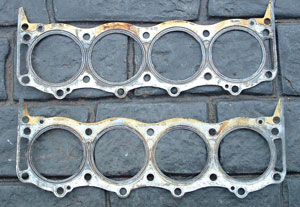
Less then 10,000 miles shows the start of combustion gas leakage into the Vee witnessed by the golden colour to the gaskets on the upper sides of some cylinders
Whilst the engine was out of the car and although it had only done relatively few miles I still stripped it down for examination and replaced gaskets and seals as a precautionary measure. There was also a background thought in looking at a specific V8 issue that the fleet of Range Rovers I was then driving had been using some development composite gaskets for several years before these became standard fit.
Accompanying the test composite gaskets was the removal of the four outer head bolts on the original style 14 bolt head arrangement. The reason I learned from Land Rover engineers was that the four outer bolts could create a tilt on the way the heads were clamped down and the result was combustion gas leakage into the centre of the Vee. The composite gaskets were there to provide a more flexible seal between head and block, and the removal of the four shortest outer head bolts was there to remove the uneven loading. It seemed to work on the test engines and the changes were later adopted on all the later V8 engines. Not that the change to composite gaskets is all a bed of roses as there are other considerations and changes that need to be made, such as compression loss, inlet manifold misalignment, and gas seal between inlet and heads.
I didn’t go the composite route but I did note that at just less than 10,000 miles use my engine was displaying the signs of combustion gas leakage into the Vee. The images of my removed gaskets have the tell tale dark staining of this gas escape from several cylinders. The head and block faces were checked and confirmed flat so when rebuilding the engine I didn’t torque the four outer bolts up, just taking the slack out of the bolt and adding a touch of thread lock to ensure they stayed put. Personally I didn’t like the four empty holes per head and felt the bolts would fill them best, but I decided not to tighten them in order not to develop any ‘tilt’ on the head. I also kept with the original metal shim gaskets but applied a thin coat of Wellseal on both sides before fitting. So far it seems so good and it may be this has added a little to the performance gains achieved.
Transmission
When first converting to V8 I had a second hand SD1 5 speed LT77 series gearbox that had a dubious history but subsequently gave good service, which in reality meant that it didn’t break and the gear change wasn’t so baulky it enabled gears to be engaged (those with experience of the standard SD1 gearboxes will understand this).
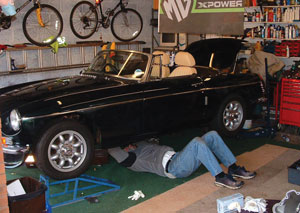
With a 5 speed gearbox the unusual bonus is being able to change the gearbox from underneath without removing the engine
However, by the time I started the refurbishment it was showing very clear signs of age, with lazy synchromesh on second and third gears. This was not of concern since keeping an ear to the ground, I had bought an ex test gearbox that had reputedly not been used in a car, just on the back of an engine on a test rig, and the external condition reflected this with a level of cleanliness more common with new items.
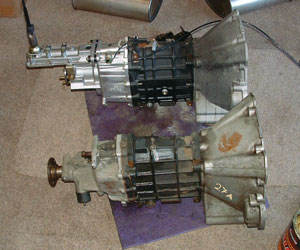
LT77 (SD1) gearbox lower with remote gearchange removed, and complete new R380 gearbox above. Note bulkier R380 rear housing displacing gear lever and mountings, together with a slightly fatter bell housing that caused issues (see text)
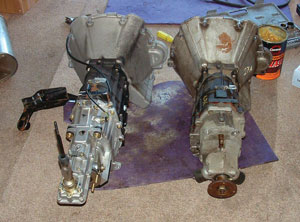
Rear views of LT77 right, and R380 left
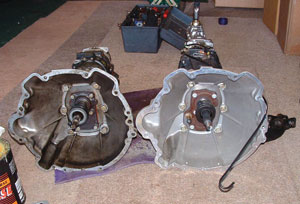
Front view of LT77 left and R380 right
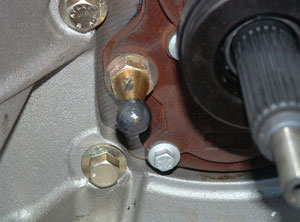
Close up of correct 50mm pivot pin
I took a calculated risk by just accepting the information given, and I did not open up the gearbox to confirm before fitting. Unfortunately whilst the overall condition was very good, for whatever reason there was absolutely no effective synchromesh on third gear, so this gamble did not pay off and it turned around and bit me. The consequence of all this is that I cut to the chase and bought one of the last new R380 rear wheel drive format gearboxes.
There is widespread information that says all the external parts that bolt to the LT77 can be swapped straight onto the R380, and this is true, so clutch housing, clutch release, gearchange extension, speedo drive and gearbox mountings all fit. What is not such common knowledge is that fitting an R380 in place of an LT77 in the car is by no means a straightforward bolt in change. The overall length of the gearbox between front face and propshaft flange is the same so all this fits in without a problem, but the rear extension housing is bigger on the R380 and this moves both the mountings and the gearchange extension rearwards around 25mm. In addition as I was using a complete assembly with a new clutch housing I noted the new housing was slightly bulkier.
The consequence of these small changes created a few choice words when I came to fit this gearbox in my car as this was not initially anticipated. The advantage of using the LT77, and R380, gearbox is that you can actually remove and refit the gearbox from under the car, something that is not possible with normal MGB gearboxes without damage to the body. That said the first issue was that my transmission tunnel was modified with the early LT77 clutch housing as a template and whilst the new gearbox clutch housing would fit the space, negotiating it into that space was baulked by the shape of my modified tunnel, so additional small mods were needed.
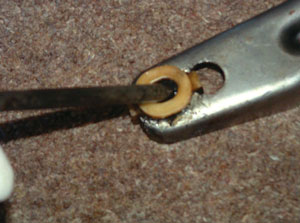
LT77 and R380 have the same plastic clip to locate the slave cylinder pushrod into the clutch pivot lever. It is very brittle and should be warmed in hot water before trying to fit. To remove warm with a hairdryer first
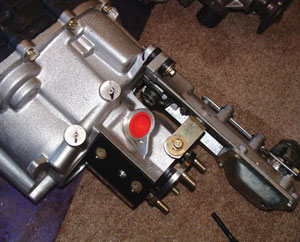
Close up of rear housing of R380 which when compared to the next picture…
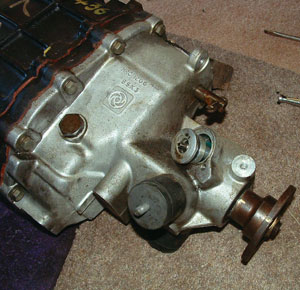
…of the rear of the LT77 the difference is obvious as the propshaft flange for both gearboxes is in the same place!
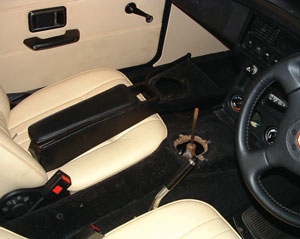
Aside from the need to modify the gearbox mounting to fit the R380 the gear lever had to be re-engineered to get it to emerge in the centre of the hole into the passenger compartment as shown
Having got the front end into position the next expletives of the alternative English language were generated when the position of my modified MGB gearbox cross-member was clearly too far forward and trying to occupy the same space as the gearbox tail housing, with the mounting rubbers being that inch or so rearwards. Now once again the specific original conversion of the car to take the LT77 gearbox meant the captive threads within the steel plate inside the chassis channel were in the wrong place. Oh golly gosh, how inconvenient.
Two cups of tea and a bacon sandwich later and the job to firstly locate and mark the new mounting positions was followed by the reasonably straightforward, in principle, operation to drill new holes for the four cross-member to body bolts. Then to drill out the spot welds that hold the steel plate, that carries the thread into which the cross-member to body bolts screw into, to the base of the chassis section allowing it to be moved back into the new position. That is far simpler to say than do when somewhat constricted under a car that is off the ground on axle stands, even though these stands are big ones so higher than the norm.
Not that it ends there as the new bulkier shape of the rear housing of the R380 demanded further minor modification of the gearbox cross-member, bearing in mind that when I converted the car in the mid 1980s it was to fit just the early LT77 gearbox.
Now having surfaced for air and cleaning out all the muck that manages to always drop into your eyes, ears and other strange places when under the car, the last modification was the gear lever position which was further back than with the LT77 and so my modified LT77 lever now exited the hole in the tunnel and through the centre console close to the rear most edge. The availability to engage first, third and fifth gears was not exactly an ideal situation, so out with the hacksaw, I chopped up the modified lever and modified it further with additional offset to bring the lever out of the centre of the hole.
All of these changes were not rocket science jobs, but it grates when they are not planned for and extends into the following day. Indeed what grates most is not anticipating the difficulties and relying on your previous general knowledge of the LT77 and R380, and assuming that because the LT77 parts fit the R380 that they are externally identical, rather than checking. These issues aside, which I hope will be of use to others following a similar route, the change to the R380 was a revelation when driving and certainly the expense and effort was worthwhile.
Compared to the gearbox change the axle, which I had rescued from a seriously accident damaged and burnt out BGT V8 in 1984, suffering only a very bent half shaft, needed no attention at all, although I added new outer bearings, seals and a coat of paint for good measure. Twenty years after that axle was recovered it continues to work silently and smoothly.
The propshaft also needed no attention, although being made by a company who specialise in high load power take offs for heavy load industrial equipment, the joints were high torque capacity rather than the more usual lower capacity vehicle types, so continued reliable service of the propshaft is anticipated.
Roger Parker