MGF Heater Fan Resistor
One of the advantages of a modern MG, especially over a classic model is that the heater has real substance and is not just a dial on the dash that promises a lot but delivers very little. An attractive attribute of the modern MG heater (aside from the many cars with air conditioning) is an effective fan, usually with four speeds, that can deliver either a gentle breeze or a force ten gale.
One other factor with the modern cars is that there is often a requirement to be able to run the fan on the slowest speed to get any air movement in the car, because ram effect is generally poor.
The heater fan motor is a very simple device with just a power feed and an earth. The variable speeds that can be selected for the fan are achieved by reducing the voltage that reaches the motor. The three subordinate slower fan speeds, positions one, two and three are achieved by directing the power feed through a resistive coil to reduce the voltage that reaches the fan motor. The fastest speed (position 4) is a direct connection so the motor runs on the cars normal operating voltage. The most common fault on the MGF in particular is for the slowest fan speed position one, to fail first as this is the speed most frequently used. Therefore, if your fan doesn’t work on position one or position two speeds but does on the others, then by far the most common reason for this failure is a breakdown of one or more of the resistive coils in what is commonly called the ‘resistor pack’.
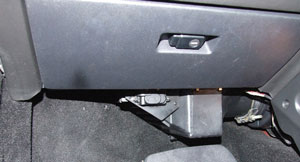
1. MGF passenger footwell, air con fitted to this car – the square box
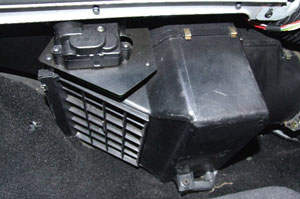
2. Air con evaporator with air hose to heater on right
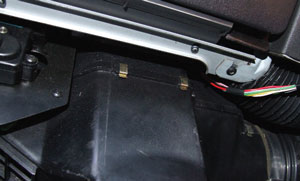
3. Glove box and support strut removal
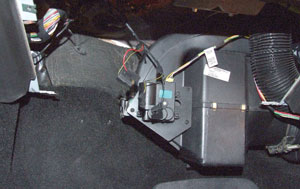
4. Glove box removed giving access to air con or heater air feed duct
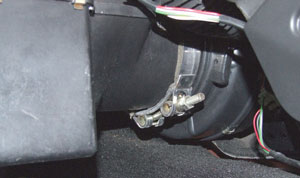
5. Clamp shows where the air duct connects to the heater or air con model
The ‘resistor pack’ should always be suspected first before any thoughts on switch failure, and it is worth noting that the exact same principle is used on the MG Z saloon’s fan control, although the cars with air temperature control air conditioning have a more complex fan control with greater speed asjustment than the four basic speeds. Although the format for changing the ‘resistor packs’ on these cars follows a very similar path too.
Changing the pack on the MGF is relatively simple except when your car is fitted with air conditioning, and then it becomes a very difficult job indeed, as there really is no easy access. The guinea pig MGF used for this feature was actually fitted with air conditioning from new, so it was necessary for the air conditioning system to be depressurised and evacuated as the evaporator unit (the bit that gives the fridge effect) that sits in the air flow into the heater unit had to be removed, and that also meant the two high pressure inlet and outlet connections that come through from the underbonnet area had to be disconnected. The need to collect the refrigerant and on board lubricant in a responsible and ecological way demands professional involvement, although once this has been done, ‘resistor pack’ replacement can be seen as a job for the enthusiastic, reasonably skilled and also very flexible owner to complete, and then have the air con system refilled.
Most cars do not have the complication of an air con system and so the job of replacing the ‘resistor pack’ is quite straightforward. The glove box has to be removed and this is easier by removing the support strut onto which the lower hinge of the glove box screws. Removing the two end screws holding the support strut and a further two screws inside the lid apperture will allow the whole thing to be removed from the car and give you clear access as shown in the images.
Outside air is drawn in via the left grille at the bottom of the windscreen, incidentally this is one area where rainwater often gets into the car’s footwell. It is then transferred via a 90-degree duct into the side of the heater assembly where the fan is located. On the cars with air conditioning this duct is replaced by the bigger evaporator unit that carries the heat exchanger inside to cool the incoming air and also the intake to re-circulate air in the cabin. Both duct and evaporator use the same mounting to the car but the additional difficulty with the evaporator is that the pressurised air con pipes come through the front bulkhead and are bolted to the evaporator’s heat exchanger.
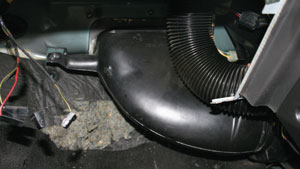
6. MGF without air con has ducting held in place by 10mm nut
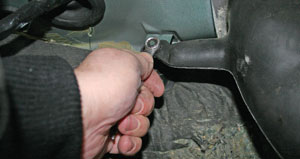
7. Undoing the 10mm nut which holds ducting place on an MGF without air con
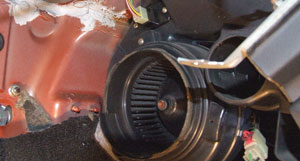
8. Heater fan resistor with one electrical plug and fixed to body by two screws Air duct or air con unit removed and showing heater intake and fan blades and above is the fan speed resistor
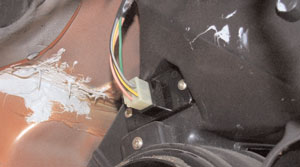
9. Heater fan resistor with one electrical plug that is fixed to body by two screws
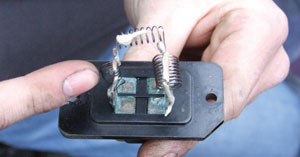
10. Heater fan resistor coils. Small coil broken
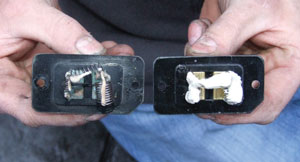
11. New and old resistor pack
The guinea pig car’s air con system had already been evacuated so it was a practical route to continue with the removal of the evaporator, which as indicated was a real fiddle. By contrast the removal of the non-air con system duct between the intake and heater is simple (photos 6 and 7). After removal the side of the heater assembly is exposed and the fan can be seen inside the now exposed air intake (photo 8). Directly above on the body of the heater can be seen a multi wire electrical plug connected to the resistor pack, which is held into the body of the heater by two self tapping screws. Replacement is simply a matter of unplugging the electrical connection, removing the two screws, lifting out the old unit and dropping in the replacement. Bought new these resistor packs have a quoted retail price from Xpart of £37.19 plus vat and are listed under part number JGM 100060.
Commonly the cause of problem is a broken wire in one of the coils, usually the thinnest one as was the case with the MGF shown. It can be possible, with a degree of commitment, to repair these and return them to near normal use. If wire has to be replaced though the actual resistance value may not be quite the same as the original, which can lead to the fan operating at a very slightly different speed. Worthy of consideration as it could save well over £40.
As this degree of strip down involves exposing the point where many cars suffer from rainwater ingress, the air intake through the bulkhead. It is prudent to examine this area for signs of water ingress and consider either adding some sealant, or ideally stripping the intake ducting further and replacing the seal. Up to 1997 cars did have a seal that was not as effective as it should have been and this was addressed with an air box that had an improved seal. However, this was not a total solution as further changes occurred in 2001 and then in 2003 with a change that did address the residual leak problems.
Roger Parker