MG News
Some time has elapsed since the last MG News feature, and for good reason, there has not been a great deal to report on, but that situation started to change during Christmas 2007. On Boxing Day, in Beijing, Shanghai Automotive Industry Corp. (SAIC), and Jiangsu Yuejin Automotive Group, the parent company of Nanjing Automobile Corp, (NAC) the owners of MG, finalised a merger deal which had begun with a letter of intent in late July 2007. The presence of Chinese Vice Premier Zeng Peiyan indicates the importance the Chinese Central Government places on the deal.
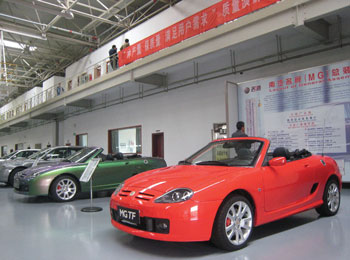
Chinese MG TFs on display
SAIC was China’s biggest car maker in 2007, with sales of 1.34 million vehicles, including 915,000 passenger cars and 429,000 commercial vehicles, somewhat greater than that of NAC and in effect this was a takeover by SAIC. The new SAIC-NAC group is expected to have sales exceeding 2m units before long, and NAC’s Chinese capacity is set to triple. This also means that MG is now owned and controlled by SAIC.
It has been clear since NAC announced that they would welcome a partner for their MG operation, the lack of resources was an issue. By resources I do not specifically refer to finance, although money is a big element in any project, but also physical resources which includes skilled and experienced personnel. NAC was the unexpected winner of the assets of MG Rover back in July 2005, and in awarding the tangible assets to NAC, whilst the intellectual property (IPR) had been bought earlier by SAIC, Price Waterhouse Coopers (PWC MG Rover’s Administrators) created an illogical competition resulting in two separate companies following a parallel course with like products.
In conversation I often compared this asset sale to the sale of an Airfix model kit on eBay. But rather than selling it all as one entity the seller has split the instructions and the kit of parts, so that one person would buy the instructions (SAIC) and someone else (NAC) would end up buying the actual model. The illogical result of this approach is that the buyer of the instructions then had to make the kit of parts, and the buyer of the kit of parts then had to work out the instructions. PWC clearly had specific obligations to meet in regard to their duty of achieving the best value from the MG Rover assets, but the resulting two and a half years of duplicated activity will be something historians will certainly question.
Whilst the illogical situation clearly generated some competition between the two companies it was unsustainable and thus the recent merging is wholly logical. The actual streamlining and removal of duplication will of course take time which will be creating more uncertainty for the short term, but already senior SAIC management have made statements that indicate clearly MG and Longbridge have a much brighter and more active future.
Of course not everything that has happened during the last two and a half years has been wasted and the achievement that NAC have made demonstates some very significant advances, not least the building of the brand new MG factory in Nanjing with a production capacity for 200,000 cars, 250,000 engines and 50,000 gearboxes. Once these facilities are honed, the capacity of these facilities is sure to feature heavily in the future growth of MG. Unfortunately though in the recent twelve months the rate of progress has been slowed due to a variety of factors including the merger developments and the arrival of the TF in UK showrooms is the most obvious victim of these delays. This has led to much speculation, as would be expected with the modern media world, varying from reporting delays to comment that the TF will not return. Certainly the former is the accurate reporting and whilst a specific date will be released in due course. As we were going to press the lateset information indicated a May 2008 introduction of the TF in China, to be follwed up to three months later by the UK launch.
Some reasonable questions have been raised by MGOC members and the most often repeated is, Why has it taken so long to restart producing a car that was in full production until April 2005? The questioners are usually making the assumption that the car only needs to be built to the same specification and with parts that applied up to April 2005, and from that perspective the delays would seem odd.
Unfortunately it’s not simply just a restart of production but a need to re-engineer certain aspects of the car to meet current standards. Then there’s the additional requirement for the rest of the car to show that it continues to meet the standards it previously did for continued certification. Not a full programme of testing but still time consuming, and far from a simply switching the production line machinery back on to watch the cars pop out of the end. The fact that the NAC TF is very similar to the preceding MG Rover car clouds the fact that one NAC manager indicated that around 70% of the car is new. That is from the perspective of being provided by new supplier and therefore needing validation that these parts are all made correctly, to the required standard, and in many cases checked for legal compliance too. All these factors give a little insight to some of the delays.
The combined strength of the new companies is now very significant and should bring about the end of the obvious, and wasteful, competition between them with their respective variants of the MG ZT and Rover 75 platforms, although in sales terms it appears that SAIC’s Roewe 750 has sold in greater numbers in China. How the two models will be integrated, as logically they should, will be interesting to observe.
How will all this change affect what happens in the UK initially and elsewhere in the traditional MG markets later? The answer to that is largely unknown and whilst by the time you read this there will probably have been some formal announcements, the overall effects will still be taking shape. SAIC’s Chairman, Chen Hong, is quoted as saying, “We will continue to promote the MG brand on the overseas market to boost our exports,” He further said that SAIC would revive production in Britain of the MG brand as early as possible including research, production and marketing operations.
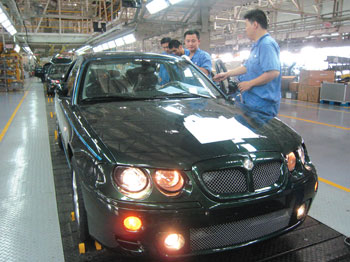
MG 7 production line
With the resources available to SAIC these comments provide considerable optimism that this will be seen in a reasonable period of time. New model plans are clearly matters being discussed behind closed doors but it’s common knowledge that the IPR that SAIC bought in late 2004 from MG Rover included much work on many aspects of new and updated models that MG Rover had the skills to design, but did not have the resources to take into the metal. Much of that work was really exiting and whilst the third anniversary of MG Rover failure occurs this April, this has not been a completely dead period as any observer of the Shanghai Motor Show 2007 will have seen with the Roewe W2 concept displayed, widely speculated to be connected with development done within MG Rover and since by SAIC.
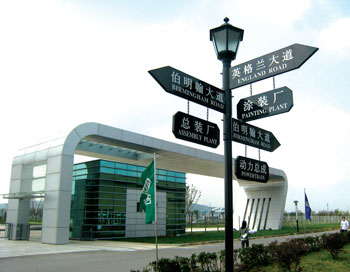
Familiar names for brand new MG factory setting
After MG Rover failed and all 6100 employees found themselves redundant, SAIC and Ricardo set up a joint venture. This was based in the Midlands and employed many former MG Rover engineers as clearly such a valuable asset that these people represented, would not remain available for long. Plus, the added advantage of keeping an established team together is obvious. (Ricardo for those who do not know them, describe themselves as, ‘a leading provider of technology, product innovation, engineering solutions and strategic consulting to the world’s automotive, transport and energy industries’. With, it has to be said, a great deal of justification perhaps illustrated by developing the JCB Dieselmax engines for that world speed record car.) This joint company, known as Ricardo 2010, would continue the developments towards new SAIC models and in time the ownership would transfer solely to SAIC, which is what subsequently happened, and it is now known as SAIC Motor UK Technical Centre.
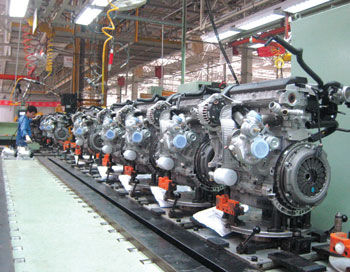
MG 1.8 engines being produced in China
Ironic as it seems, this company will relocate back into Longbridge which may result in certain staff members returning to the desks they occupied up to April 2005, brushing the dust away and switching computers back on, a touch of Déjà vu. A situation that will generate some very different emotions I am sure for the people involved. The other irony is that what is now being formed is much what MG Rover was seeking to achieve in their goal of a joint venture with SAIC, there was validity then and that remains the same now.
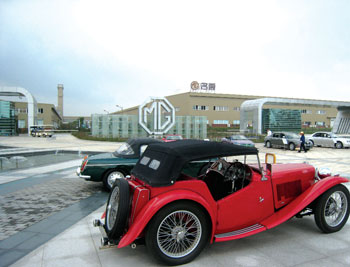
Very modern factory, yet NAC are well aware of the MG brand’s heritage
The problem remains that there has been a loss of three years and of course all other car manufacturers have moved on, quite significantly in many cases. So starting from the position of 2005 with regard to all the products is no longer viable. ZR and ZS models would need far too much development to make sense in their former markets that new models would make better use of that investment. Outside the former markets where these cars were sold will be different, especially emerging markets where models like the ZR (MG3) could well be attractive for long enough to generate adequate sales.
MG ZT is better positioned as it was a much newer design and still has a fair degree of development potential. Even so the loss of three years is precious time out of the sales life of the car in it’s former markets and therefore any facelifted version will need to include much more than just a new fascia, trim, instruments and widescreen TV. It would need some more fundamental improvements starting with a more powerful and possibly larger capacity diesel model, one that doesn’t use any more fuel but goes faster, further and cleaner. The same need for change applies to the petrol models, although here it would be better to concentrate on more efficiency from an uprated V6 to achieve the performance levels of the ZT 260 V8s. These improvements would need to apply to the top of the tree mainstream FWD models, rather than a rare one off special, and would probably be achieved using forced induction to improve performance using less fuel and giving lower emissions. However it must be acknowledged that the 260’s rear wheel drive platform was extremely competent and still has a lot of development potential. Even with these sort of changes to raise the stakes compared to previous MG ZT models that three year gap will still hurt the period where such a revamped model can be sold in adequate numbers.
There is one other very important area the new company needs to look at, this relates to previous MG (and Rover) models. It is of course in the supply of spare parts which has seen some ups and downs, and at times doubling the normal average of insurance write offs due to lack of new body panels. Protecting the residual values of those MG products already on our roads has a direct relationship to selling new cars because the way potential buyers perceive residual values is a very important aspect in the mind of car buyers. Naturally Xpart has responsibility in this area, but many of the parts which have been difficult to obtain at various times, have often been parts needing the support of the car company to obtain, body parts for example.
MG enthusiasts will remain loyal to the marque and will support the MG car company only if its products respect the rich history of MG, are modern, forward looking designs that are at the very least, competitive with contemporary rivals, although ideally they should be better. There needs to be a viable product plan that looks further into the future than the maximum three to five years that recent history has provided, if MG is to become a leading world renowned brand rather than just the rich historic one it is predominately known for today.
In the short term the restart of TF production can be likened to the introduction of the MG RV8 back in 1993. This was the production of essentially an older design of MG to place MG back in the ‘new car’ sales listings and raise the profile of the MG brand prior to when the then ‘new’ MG sports car arrived, which was the MGF. Once the TF has retaken its position in the ‘new car’ sales lists we all need to be told that the product plan includes a ‘new’ MG sports car(s) to replace the TF and carry the MG flag boldly into the future.