Revival of an Old Friend – (Part 2)
Part 2
Last time I gave a resume of the first twenty years of ownership of my MGB and the changes done in that period. These changes have been previously published in Enjoying MG but perhaps the main one was how I converted the car from an original 1960s chrome bumper to EFi V8 with 5 speed gearbox and associated modification to suit. The feature has been available for many years on the Internet http://www.mg-cars.org.uk/v8_conversions/rogv8.html and there is absolutely no point repeating it when the vast majority of readers can access it directly. If you can’t then please let me know and I will post you a copy. All that I shall cover from here will be what has occurred since this original feature was written and like the original feature, I will split it into simple sections, starting with…
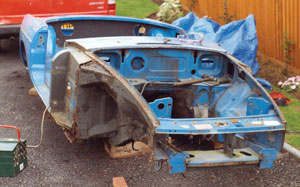
The donor 1978 MGB bodyshell ready to yield difficult to fabricate panels
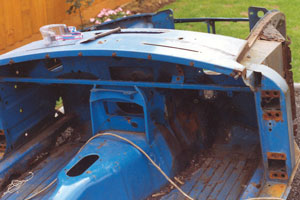
Donor body passenger compartment view
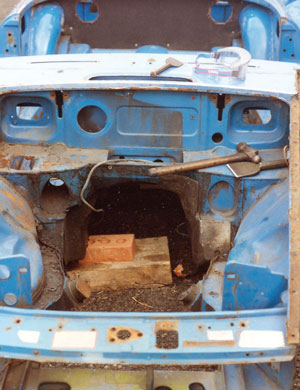
Donor body engine bay view
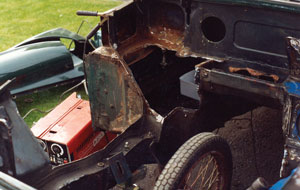
1968 body changes well in progress showing right side inner wing sections and bulkhead corner removed. Note use of Honda 90 wheel as means of keeping the shell mobile at the front
Engine bay
This was the main area of the car that prompted the car coming off the road for tidying up and was started in 1993 with the removal of the modified Lucas Federal Airflow Meter fuel injection system and passing onto Roger Williams. Roger is the author of a number of popular MG books, including ‘How to Give Your MGB V8 Power’, (copies available from Club Regalia along with his other MG books) and in fact, this specific injection system is shown on the front cover the first edition of that book.
Removal of the injection system had a twofold purpose, the first was to allow me to fit a newer Hot Wire injection system that benefits from much finer control of fuelling, and the second, was to provide an impetus to get the job going. However, a rather large fly appeared in the ointment shortly after in the form of a non-driveable car and an impending house move. Further dismantling of the car would only create far more work when the move arrived, so this was one of the many additional delays.
As anyone can appreciate a new house generates many household jobs that demand more immediate attention. After several months, the guilt complex sets in and a day’s work on the car is the antibiotic to that. This relief lasts for a while before the next dose is needed, but at least when you’re looking at a strip down, visible progress is quite easy to achieve. On the other hand, items removed from a car take up twice the space when out of the car than they do when in, and a single car garage does not offer the best combined storage and work area.
Fortunately, the new house provided additional outside space that was a real bonus with the next part of the process. This came when I was offered a 1979 MGB roadster bodyshell with terminal corrosion, but many panels within the engine bay were sound and ideal to be vultured to replace my home made engine bay panels. Technically interesting but cosmetically poor, was an accurate description of the original underbonnet view of my car in V8 spec. The donated body was a very late one dating from the 1978/80 period when the dual circuit braking system was standard for the UK market. This means a different bulkhead mounting aperture and as I was removing other parts around this panel, adding this to the transplant list was logical, plus it matched the plans for a modified braking system. Finding a late pedal box assembly with both master cylinders to use was fortunately also quite simple (this is the set up with the direct acting servo and dual circuit master cylinder hung on the front of the servo).
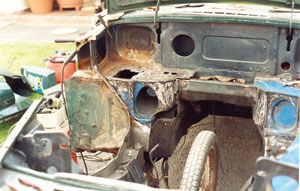
Continuing body progress showing right side inner wing sections and bulkhead corner removed and donor bulkhead panel being trimmed to the final shape before welding. Tell tale blue paint from donor 1978 shell showing left side panels already in place.
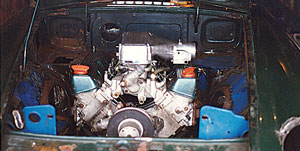
Engine trial fit with new injection manifolds to check bonnet (hood) clearance. Note blue panels showing where donor panels have been let in and also the RV8 exhaust holes have been created and reinforced. (Circa 1996)
Another planned change to the car included the possibility of using the front inner wings, or at least part of them, from the donor shell. The reason for this was that the originals were certainly ‘battle scarred’ following some 1970s experiments with holes for Weber carb cold air feeds and similar crude additions (yes we all do them at some time). There was also some surface rust in the top flanges where the outer wing bolts on.
Ultimately from the donor I removed the bulkhead corners, part of each inner wing, radiator support panels and face level vent cold air feed panel (see later for why and how). I also took the opportunity to renew the outer triangular shaped box reinforcements, these were not available as separate panels in 1980 when I did the big body rebuild, and whilst sound I wanted them to look more original. I also added a new rubber bumper oil cooler tray and support panel for the under slung cooler mounting. Being as the car is chrome bumper I also incorporated a cut out to allow the original chrome bumper mounting irons to be used. Later I created additional ducting underneath to channel air direct from the lower spoiler air intake to the base of the radiator, thus forcing air to pass through the oil cooler and lower part of the radiator for improved cooling.
When I originally did the V8 conversion in 1980 the range and availability of replacement panels was nothing like as good as it is today, and fabrication was often the only viable option. These 1990s changes may sound and look quite drastic, but in reality went very smoothly. Where part panel sections were replaced the edges were seam welded to reinstate the original strength. Once dressed up the join is invisible from inside the engine bay and under the wings it’s hidden once again by plastic wheel arch liners.
Roger Parker