More Power to your Elbow (part four)
Last time we paid some attention to the way in which bolt on modifications can be applied to the non VVC K series engine found in MGs (and other cars) and achieve some worthwhile gains without too much effort or really heavy expenditure. The results though were falling well short of the quite stunning gains seen with similar modifications on the pre 2001 MGF VVC featured in the March 2005 issue under this series title.
This time we take a look at the modifications that are definitely under the heading ‘for serious owners only’. The point being that to be able to make a non VVC engine work at the same level as a VVC needs considerable investment in time, money and effort. In short for those most wanting power from their road car the VVC route is the simplest and ultimately the cheapest route.
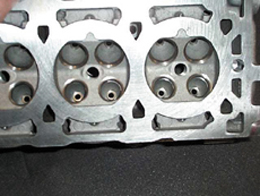
1 Rough standard MPi head casting, note the reflection around the seats of the smaller exhaust valve seats is a ‘step’ of head casting where the machining for the valve seat inserts has left this step which impedes gasflow. Just one area where the standard heads leave much to be desired
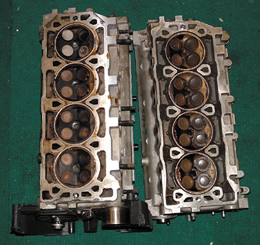
2 Standard heads, Mpi on the left and WC on the right. Together here to illustrate the obvious valve head size differences between the two, look at the gaps between inlet and exhaust valves to see this more clearly
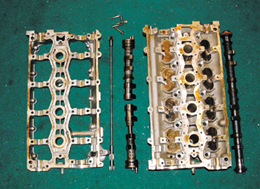
3 WC head with top carrier and cams removed to illustrate the much bigger journal sizes for the WC cam(s)
Remembering that my overall modification plan was quite clear, in achieving the best possible wide ranging power and torque increases, without any compromise to the normal low speed and town driving characteristics, or idle, this immediately puts any thought of cam changes in the ‘pending’ tray. A decision reinforced by a bad experience on trying a pair of so called first stage cams on the Club MGF that allegedly needed no other changes, but in reality turned the car into a lame three-legged dog needing a constant drink. Nevertheless there are some cams that do allow normal operation, but for simplicity I shall deal with all cam aspects later.
Previously I have illustrated the standard K series head is restrictive and to relieve this presents several options. The first was to look at using a VVC head, but that meant converting the VVC back to solid cam operation and when I was first looking at this aspect, these conversions were only just being developed and costly. The next was to use one of the special ‘Motorsport’ heads, which were factory head castings, essentially a mix of VVC ports and valves with normal MPi cams. The problem here was the very high cost of a head. Lastly was the route I first followed in using an easily available standard MPi head and have it comprehensively modified.
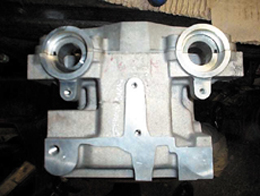
4 Front face of stripped head showing bolt hole pattern for Manual cambelt tensioner. Which is different to image below
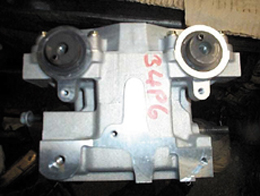
5 Front face of stripped head showing bolt hole pattern for Auto cambelt tensioner, which should be compared to image above
Not all heads are the same
There was one small hiccup in the choice of standard head and this was not in the commonly referred to differences between pre and post 1995 heads, the later ones being better. No, this was in the different cam belt tensioners and my MGF at this time was using the relatively new auto belt tensioner, rather than the manual item that was common to all previous engines including the VVC. Of course second hand heads were all of the manual type of tensioner. The MGF change to the auto tensioner occurred in late 1998 and the early head doesn’t have enough thickness or ‘meat’ in the casting to be drilled and tapped to take the different pattern of bolts. Later heads not only have the meat for the auto tensioner fitting bolts, but retain the extra material to take the earlier manual tensioner bolts too. Incidentally this extra material is actually inside the waterway inside the head.
I was looking for a route with the least complications, the prospect was to buy a new style casting, or go with an old style casting with a change of tensioner and timing belt. Fortunately the cam and crank wheels are the same for both types of belt, even though the later belts are some 3mm wider at 26mm. The cost of a new manual belt and tensioner being far less than a new head was something of a clincher in the decision making process.
It’s very well to talk about having the head modified, but in detail what is a modified head, or what should those modifications consist of? This is where you find diversification in the detail suggested by specialists, which confuses owners and is the cause of many arguments between owners with modified cars on a ‘mine is better than yours’ basis. Some specialists also get involved in such childish discussions and it does nothing but damage to all involved.
The bottom line is that in the detail of modifications there is room for diversity. Because the way in which the engine works is so complex that one set of modifications may work better than another in one area of the rev range while a different set of modifications will work better at another point in the rev range. Most people mistakenly focus on the maximum power gains and make judgements based on this narrow area. Remember my previous comments about having a good spread of power and torque that is better able to move our relatively heavy steel bodied road cars?
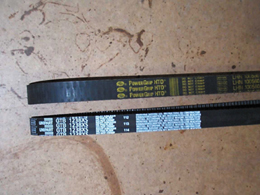
6 Not only are there two cambelt tensioning methods, but there are specific belts for each. The Manual tensioner, Mpi to 1999 and all WC, is 23mm wide and a different length to the Auto tensioner belt, 1999 on MPi only, and is 26mm wide
Modified but retaining standard valves
The first spec of head I tried was a careful clean up of the standard head retaining standard valves etc. This is the most cost effective and as usual I had Peter Burgess do the work which he describes as an Econotune spec. With the engine remaining standard apart from an ITG Maxogen induction system the car delivered an extra 22% more power than standard, the lions’ share of which would be from the head modifications. There is an added benefit here in that the Maxogen and the head modifications really do complement each other. As a result the power and torque gains are quite linear and this makes the car feel much stronger and as rapid as cars with much greater peak power, but with less mid range.
Idle speed and general smoothness are notably improved as the detail smoothing work on the ports and chambers, plus some port matching, help to even out the firing pulses in all the cylinders and this has more benefit than a full engine balance. Fuel consumption is also generally unchanged, although it is subject to greater fluctuation depending whether the greater efficiency is being exploited through use of the extra performance, or smoothness being enjoyed with gentle cruising. It has to be said that there is the potential for returning consistently better fuel consumption, though I doubt many would be able to always drive in ‘economy mode’, but with £1 per litre or higher petrol prices I’m sure it could help focus concentration.
MPI head with VVC inlet valves
For my own MGF the goal was to achieve the widest possible range of improvements, but retaining at least the same standard level of driveability from idle speed upwards and keeping the engine management standard. This meant retaining the original camshafts and not going too wild in the head modifications.
On the back of this and other experience, Peter decided to experiment with the next head and add reshaped VVC inlet valves, which are 31.5mm diameter, up from 27.5mm, but retaining the standard 24mm exhaust valves. An odd route I thought initially, but actually not as odd as it first appears. Generally naturally aspirated engines operate with larger inlet valves and the exhaust valve averaging about 80% of the head size of the inlet. In standard MPi form the exhaust valve is somewhat oversized at around 87% of the inlet valve size. The relationship between VVC inlet and MPi exhaust is actually 76%, so it’s much closer to the average than at first appears.
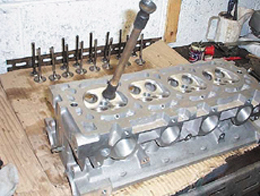
7 Here is the heavily modified MPi head with WC inlet valves (valves lined up behind head) and in the foreground the inlet ports hint at the weilding done to allow these ports to be opened out upwards to fully match the WC alloy inlet and gasket
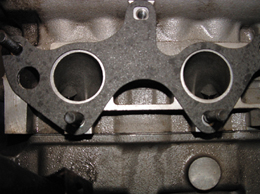
8 A WC inlet manifold gasket against an MPi head which when also looking at image 9 indicates the significant difference in size and the efficiency sapping mismatch that will occur between manifold and head if nothing is done to overcome it
Fitting VVC inlets requires larger valve seat inserts be fitted into the head and then a fair degree of careful work to open the ports and achieve a shape commensurate with the needs of this engine spec and material in the head. One aspect was to concentrate on modifications that promoted good flow within the 8.8mm lift of the standard MPi cams. It would be pointless to create the main flow improvements occurring at 9mm or greater valve lift as the cam never opens the valve that far.
Another aspect of this conversion was that I intended to use the VVC alloy inlet (but 48mm standard throttle as this was pre arrival of the 52mm one). I had noted from some other home modified cars that there was little gasket contact between the manifold face and the head face. The issue was that the VVC has a much larger hole for the inlet and the gasket reflects this. In addition the port for the VVC is some 3mm higher than the port on the MPi head I was using. The combination of this and a serious port mismatch was not desirable.
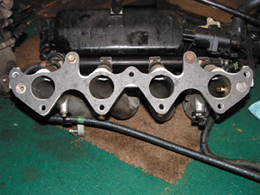
9 The same WC inlet manifold gasket as used in image 8 against the standard alloy WC inlet manifold. Even here the match is not perfect and additional detailed port matching here adds to the overall efficiency
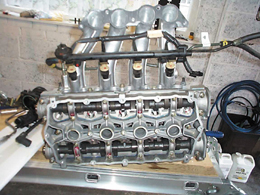
10 The WC inlet valves modified head nearly complete with alloy WC inlet lower half fitted. Further detail port matching is applied to the joint between the upper and lower halves of the manifold’, here the lower half gives an indication of the grinding work done to this area. Note too that the original MPi fuel rail and injectors are being reused, but some slight modification to the fuel return pipe is needed to cater for the different manifold
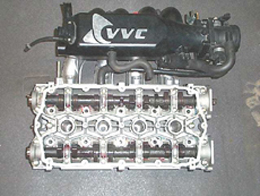
11 All finished and ready to be refitted. Not visible here is the new cam belt tensioner, a suggested change to accompany any cambelt change today, and the steady bar that fits between the underside of the heavier than plastic inlet and the engine block
The solution was quite extreme though and involves welding additional alloy to the top of the inlet ports on the head. This added material allowed the ports to be fully matched between the head and inlet manifold and also allowed the gasket to fully seal. In addition it allowed a slightly more downdraught line to be adopted for the port to the valve and overall enabled more in the way of mimicking the VVC port. A significant degree of other detail work was done and the results were awaited with great interest, although Pete had his usual laid back confidence.
Assembly was exactly as a standard head and the conversion to the alloy inlet involved a few minor additions to the fuel return pipe and adding the required manifold support stays, not seen with the original and much lighter plastic manifold. The conversion to the earlier manually adjusted cam belt added the need to remove the original belt and fit the newer one, but this was no more work than would be needed in any normal routine belt change. I would add here that anyone working in this area must check the adjuster bearing for wear if it is to be re-used and if there is the merest hint of roughness of play, renew it. Failure will cause serious engine damage and it is a simple change at this time.
Once the head and manifold were refitted and running with an ITG Maxogen the power was measured and was found to be 31% above the power the same car delivered in standard form, or just below the level of the 160 VVC engine. With the standard cams it was so incredibly smooth and pulled well in high gears from just above idle. In fact the smoothness was such that driving in traffic was difficult as the engine could neither be heard or felt and this made it surprisingly difficult to be consistently smooth, so a Janspeed system was added to raise the sound, but not make noise. The change incidentally was worth just 2% in added power.
One aspect that became clear was that this specification was just about at the limit of the standard MEMS 1.9 system to cope with adequately and that any further power enhancements that worked would need the engine management mapping to be tweaked to keep a happy balance. The inflexibility of this system to non factory alteration left little option but to consider its replacement with an aftermarket ECU and this was a road I specifically did not want to travel with this car. However it is with another and next time is when I shall cover the experiences when travelling down that road.
Roger Parker