A tale of two Classics – TF and an MGB
I decided to buy a classic car while reading a copy of ‘The Automobile’ in my dentist’s waiting room.
A 1929 Bentley was out of the question and a Model T beyond my technical ability, I needed an affordable car that was easy to maintain with a good spares back-up. I did my homework and decided on a rust free, pre-1973 MGB Roadster which had to be mechanically sound, but in need of some improvement.
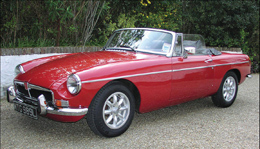
The search began in September 2001, when a Teal Blue Roadster advertised on Nutley Sports and Prestige Centre’s website caught my eye. Unfortunately it had been sold, but they had a Tartan Red 1972 Roadster which had been restored in the early nineties and modified to take unleaded petrol. I saw it the following day and my first impression was favourable. The body and paint-work were excellent, but the chrome, rostyle wheels and interior trim had seen better days. It had no service history, but it was exactly what I was looking for!
EMGC in nearby Uckfield inspected the car and a few days later their report dropped on the mat – MTG 989L was a sound, rust free car, having been rebuilt on a new heritage shell using all the original parts. They fixed a couple of minor defects before I set off, full of enthusiasm, to collect my first MG.
MTG 989L was a sound; rust free MGB, having been rebuilt on a new Heritage shell using all the original parts
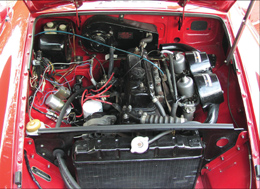
Well presented engine bay
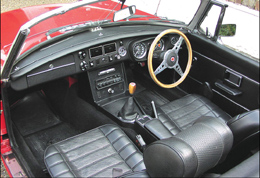
Original MGB interior is spacious by comparison to the traditional TF
The drive home was a big disappointment. The steering kept pulling to the left, the engine lacked power and stopping had to be planned well ahead as the brakes were ineffective. When I got home I drove it into the garage, closed the doors and walked away with an uncomfortable feeling of regret.
My enthusiasm returned the next day, when I joined the MGOC and ordered a set of reference books, including the Haynes MGB Restoration Manual, Original MGB by Anders Ditlev Clausager and Lindsay Porter’s MGB Step by Step Service Guide.
Following the Step by Step Service Guide slavishly, I carried out a 6000 mile service, re-centered the track rods and took the car to the local tyre centre for a wheel alignment. I then installed Lumenition Optronic electronic ignition and fitted a stainless steel exhaust. The car was now performing like a real MG should. Over the following year all the chromium parts were replaced or replated, the interior retrimmed and new carpets fitted. A new hood, tonneau and five new Minilites complete with165/14 radials completed the renovation.
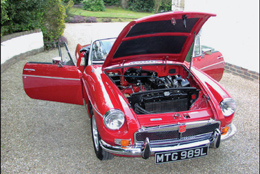
Good attention to detail on the MGB
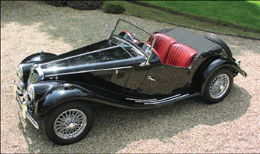
The classic lines of the TF have evolved into a well-proportioned traditional sports car
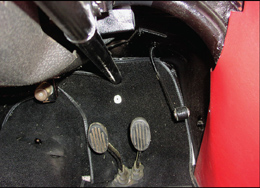
The TF footwell is cramped
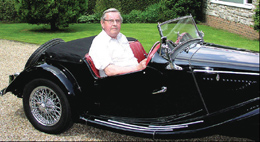
John at the wheel of the TF
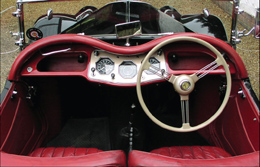
TF’s upright seats have a limited fore and aft travel which forces the driver into a sit up and beg position close to the 16.5″ steering wheel
It was time to improve the handling with new rear springs and Spax shock absorbers, a stiffer 3/4” Anti-roll Bar and V8 bushes. Once a set of braided steel brake hoses, new callipers and Green stuff pads had been fitted there was little more I could do without spending serious money on the engine, which was running faultlessly.
The MGB had been a large part of my life for two years when a close friend offered to buy it for the amount it had cost me.
At first I was reluctant to part with the car, but it got me thinking about a new challenge.
Owning an MG TF has been an ambition since 1955, when a cadet pilot on the same course as me was given a TF for his eighteenth birthday. It was the obvious choice, but MG only built 9,600 TFs, with just 1,057 destined for the home market. Locating a good one would require a lot of money, a lot of luck, or a bit of both.
After a series of disappointments and wasted journeys I was about to give up the search when a 1954 TF with only 16495 documented miles appeared on Terry Bone’s web site.
The next day I became the proud owner of a Black TF 1250. The car had been stored for seven months, but it started easily and ran smoothly. This time I did enjoy the drive home, even if the brakes were somewhat below par.
Following my dentist’s advice, I joined the MG Car Club, purchased an assortment of Whitworth spanners and ordered another set of reference books, including Anders Ditlev Clausager’s Original MG T Series, the Workshop Manual and The New England MG T Register T Type Restoration Handbook, which turned out to be the definitive servicing guide.
HFE 411 was Birch Grey until 1979, when the owner resprayed it Black. Apart from the red carpets, mohair hood and side-screens and a wire wheel conversion carried out in 2001, the car was in its original condition, and only the interior was showing its age.
After my experience with the MGB, I carried out a 6,000 mile service, which included replacing of all six wheel cylinders and the installation of electronic ignition (Pertronix Ignitor LU-146P12). The time-worn instrument and dash panels were dismantled and resprayed, black OE spec carpet fitted and the interior was refurbished using an NTG kit. The leather seats were treated with MG Red Gliptone Scuffmaster and conditioner. The original wiring loom was retained, but relays were added before installing halogen headlights and the pair of auxiliary lights that came with the car. Security was improved with a pair of hidden ignition and battery isolation switches. While the bumpers and overriders were being re-chromed, MGB spring pans and front wishbone arms with drop-link mounting holes were fitted, together with a 3/4” anti-roll bar. The short TD/TF Drop Links came from Brown & Gammons.
The original 4.875:1 crown wheel and pinion is not suited to modern traffic conditions and cruising at 60 mph with 3,900 rpm in top gear can be wearing. Fitting an MGA 4.3:1 C W & P reduces the engine rpm by 500 with the added benefit of a useable first gear. This work, together with an unleaded head conversion, was completed in February 2005 by Robin Lackford Motor Engineering in Cowfold.
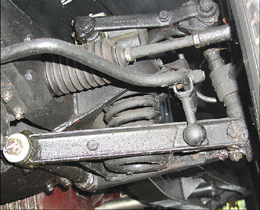
MGB spring pans and front wishbone arms with drop-link mounting holes were fitted to the TF, together with a 3/4″ anti-roll bar
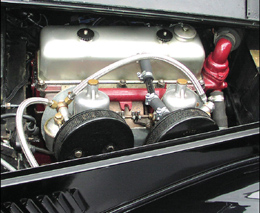
The 57bhp XPAG engine is are extremely reliable and easy to maintain
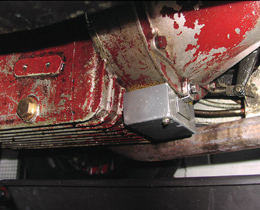
But the XPAG unit can leak oil, notably from the rear crankshaft seal, so John fitted a Peter Edney oil collector to catch most of the drips
How does a 1972 MGB compare with a 1954 TF 1250 in ownership terms? Both cars weigh 900kgs and share the same Alec Issigonis designed independent front suspension with hydraulic lever-arm dampers and half-elliptic leaf springs at the rear. The MGB, which benefits from syncromesh on all four gears, front disc brakes and a hydraulic clutch, is the more relaxing car to drive. Despite the TF’s sharper steering and better feedback from the chassis, the slow short-shift gearbox and sharp clutch needs getting used to before it can be driven smoothly.
Like all classic MGs both cars are best enjoyed on winding B roads with the exhaust bark from their low revving OHV engines echoing off trees and hedgerows. The 57bhp XPAG and 95bhp B-series engines are extremely reliable and easy to maintain, but they do tend to leak oil, notably from the rear crankshaft seal in the 1939 vintage XPAG engine. (I fitted a Peter Edney oil collector to catch most of the drips).
Both cars were used regularly all year round, but only the MGB is suitable as a daily driver. The TF’s pre-war origins are highlighted by the upright seats with a limited fore and aft travel that forces the driver into a sit up and beg position close to the 16.5” steering wheel. The footwell is narrow with closely spaced pedals and an awkward dip-switch above the transmission tunnel. However, these shortcomings are easily overlooked once a driver is familiar with the car. However, the low suicide doors, lack of seatbelts and the diminutive size can frighten nervous passengers. By comparison the MGB feels modern, comfortable and secure.
Due to the low annual mileages the same (shortened) service intervals were used on both cars. The TF’s box-section frame chassis and open mudguards make it more accessible and the starting handle is a real benefit when adjusting the tappets and timing.
MGBs need regular waxoyling to keep rust at bay, but replacement parts are cheap and are widely available. On the other hand, while rust is not a problem, TF parts are expensive and only available from the limited number of suppliers. The ash frame body tub is vulnerable to wood-rot if moisture is allowed to take hold, although new tubs are available for £3,500.
Running costs for both cars are reasonable due to low depreciation, cheap insurance and road tax exemptions. During my time with the MGB I replaced far more parts than was necessary because had I turned into a perfectionist, but I feel the end result justified all the expense, resulting in a car that was a real pleasure to drive, looked good and has been the subject of many complimentary comments.
Overall the TF has cost twice as much as the MGB, but being a relatively rare and sought after car it should appreciate in value. Again, I spent more than was necessary on a car that might be described as cold, cramped and sluggish, or downright dangerous, but the TF radiates enough charm and character to outshine its failings. Small children love it, adults warm to it and the driver has a permanent grin on his face.
www.nutleysports.co.uk
www.terrybone.co.uk
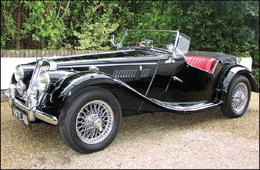
Classic TF handsome from any angle
By John James