MG ZT 260 – 10,000 mile running report
MG ZT 260 – 10,000 mile running report
I am a sucker for V8s, especially when mixed with a compact and responsive European chassis so the presence of the ZT Xpower 500 V8 at the launch of MG Z saloons was of considerable interest. The projected prices though deflated the interest like a pin in a balloon.
During November 2003 with MGOC colleagues Richard Monk and Richard Ladds, I was able to drive the ZT 260 in saloon and touring form, back to back in absolutely awful weather conditions. With bits of tree over all roads, gales and horizontal rain, not the best of test conditions. Even so, the two cars handled the conditions with great aplomb and impressed me immensely.
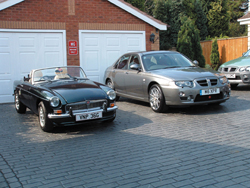
Perfect pair, V8 powered MGB alongside V8 MG ZT 260
That V8 experience was enough to ensure the replacement for my ZS was going to be a ZT 260 saloon. The saloon choice was partly driven by it being slightly more responsive and cheaper. As I finance all of my cars completely out of my own pocket, and not having the need for the ZT-T’s extra space, the saloon it would be. Fuel consumption was obviously a consideration, but I felt the official figures could be beaten in my type of use, plus overall mileage should be low enough to live with the extra fuel costs.
The next decision was whether to go for a then available 03-model year or wait for the face-lifted 04 models. Style is important and initially I favoured the older style, however, the deciding factor was that I wanted cruise control and the electronic traction control (TC), not available on the 03 model year cars. Adding traction control may seem a small point, but like ABS, it’s there for when you need it. Also it will be one of those expected features by the time I come to sell, so not having it will affect residual value.
Cruise control is another item that could assist future resale value, but in this case, I specifically wanted cruise for all of its practical reasons. These two options confirmed the decision to go 04-model.
Other options I sought led to the SE spec route being more cost effective, which included the extras I wanted, plus some others I wouldn’t have added had I been given the choice. The prime one was a sunroof, which becomes rather redundant with the ATC air con, although it does lighten the cabin when the visor is withdrawn, useful on dismal winter days.
Xpower Grey was my chosen colour along with substituting the standard SE black leather seats for part leather with red Alcantara centres, a combination I had with a previous MG TF. The decision to go with Alcantara centres is based on experience of full leather seats that can provide less ‘bum’ security when ‘enjoying the handling’. Whilst not ‘Velcro-ing’ your backside to the seat, it does a pretty acceptable impersonation.
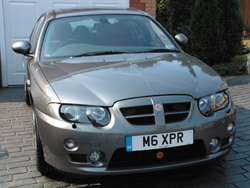
Imposing front end treatment with revised design for 2004
Delivery occurred on 23rd April 2004 and the biggest immediate driving surprise was the quite unexpected and very clear improvement in refinement with 04 models, even though I felt the older 03 models were perfectly acceptable. Based on my 03 model year car experience I did feel that the V8 set up would not be suitable for a Rover V8 version, but I had to immediately revise that thought with the 04 model ZT 260.
Electrical Problem
Since delivery, the car has averaged approx 1200 miles per month and overall; has been superb, however it has let me down on one occasion. This was not actually that simple and the circumstances raise a number of pertinent questions, but not specifically MG Rover problems. In August, at just under 5000 miles, the 260 didn’t react normally to the remote disarm signal, refused to turn over and just remained immobilised. The main battery level was also very low, at 11.41volts, but this was a symptom not a cause.
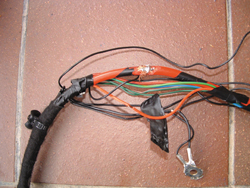
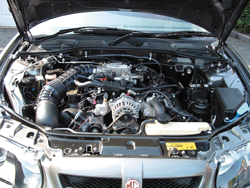
Wiring bodge that caused serious problems
Two issues were present; one a slight water leak from a sunroof drain tube that allowed water to penetrate the Body Control Unit (BCU) and this had created the immediate problem in the internal vehicle communication network. This was simply solved but wasn’t the main problem, which was that the insurance company had insisted on added security. Standard Thatcham Cat 1 security was not regarded as sufficient by the insurance company and they required further protection before activating theft cover. They provide a list of approved products that then have to be fitted by an industry-accredited installer. I chose and ordered the device, including fitting, from a very well known equipment manufacturer.
Unfortunately this additional equipment had been fitted so badly that it not only kept many vehicle systems live when they should have been switched off (battery drain) but the manner of the fitting was only one stage up from the ‘get two wires and twist the ends together mode’. The nature of this disturbance to the vehicle electrical system actually left it in a state where shorts were quite possible, which significantly increased the potential risk of fire. These problems did not visibly manifest themselves, and regular longer runs kept the battery charge above the consistent drain. Until I had a lesser period of use, the battery reserve dropped, and the other problems arose and provided the need to look closely at the car, when all became horribly visible.
The troubling part of this episode is that the system was installed by a Thatcham and VISB trained and accredited installer as required. The vehicle owner is not allowed to have any involvement in the installation. The procedure is intended to provide the owner ‘comfort’ in knowing that the installation is approved by the insurance company and that the security product manufacturer approves of the standards of installation by his appointed installer. In my case about as much comfort as using a prickly pear for a cushion.
The defective installation involved cutting into main battery cables that left damaged strands which then had additional wiring loosely wound round and secured with a spot of solder. This left loose strands of wire able to penetrate through the few wraps of insulation tape used to cover the mess, and with body parts close enough to provide a direct short to ground. Another wire had also been damaged by exposing the core in search of a specific circuit again covered by a couple of wraps of insulation tape. The final connection had been made into a wire that back fed to a number of circuits and kept them live 24/7. This poor fit didn’t stop the new equipment from working, just compromised the rest of the car.
Repercussions of this botch went far and wide; requiring replacement of a whole section of the car’s wiring loom and the associated major vehicle strip down needed to do this, plus the fitting of a new security system, which was closely supervised. The car and the additional security system have worked just fine since. MG Rover was exceptionally helpful during this period and the equipment supplier has, at my suggestion, provided a reasonable financial donation to a Children’s Hospital Charity, in lieu of the extensive non-costed work done to rectify the car.
A major concern here is one where the vehicle manufacturer spends millions of pounds developing the vehicle and ensuring its electrical systems comply with international standards, yet here is a gaping hole allowing unchecked poor standard of after-market work to seriously affect the reliability and safety of the original systems. Does the insurance industry or the after-market equipment have any system in place to do quality control checks of the fit of such equipment? I haven’t seen or heard of any, you have to rely on the integrity of the individual installer.
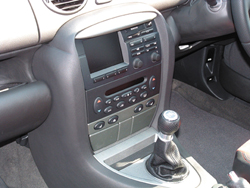
260 centre console
I wonder how many other owners suffer problems, electrical or otherwise, and blame the car and manufacturer when the problems are a direct result of the way some of these additional items have been fitted, or that the item itself is incompatible?
Good Swimmer
Anyway, this debacle aside the car has been almost perfect except for one short-lived minor issue. This was with the Satellite Navigation (Sat Nav), which did throw a wobbly and lose sight of satellites soon after the main problem was sorted, and I have suspicions this was connected to the disturbance involved. The problem became obvious when driving along a dual carriageway in Warwickshire but the Sat Nav showed me swimming around in circles at the deep end of Rutland Water. If so then the 260’s waterproofing was superb.
Interestingly the Sat Nav soon settled down on its own and remains fully functional and of very considerable use. I use it in conjunction with the Trafficmaster alert system, now a common sight in many MG Rover cars. In the ZT, the information displayed is more detailed than with the smaller units seen in the ZR, ZS and Rover sister models. I first used it when negotiating the M25, an area guaranteed to bring up alerts, and it was indeed useful to both see the nature of the delay, slow traffic, very slow traffic or stationary traffic. Where the Trafficmaster information becomes even more use is that usually there is enough warning to escape well before the congestion area, and so although you may travel more miles in a diversion, however with the able assistance of the Sat Nav, this is invariably quicker.
I use the cruise control frequently and this no doubt helps improve overall fuel consumption. It also eases longer journeys and enables you to set a speed that allows you no need to worry about fixed and mobile speed cameras. This blends well with the very comfortable interior and makes long distances easy. A sensible cruising speed allows me to save my petrol for roads and tracks where I can extend the car and enjoy it.
A small observation, but one anyone moving up to a 260 from any of the front wheel drive ZTs will find, is that the change of heating system from an air blend type to a water blend type gives a slower initial response from cold. Sometimes there is a slight tendency for glass to mist up during the first few minutes from a cold start, which the auto function does not contain. This is not an issue as the dedicated demist function clears this very quickly. However once the initial warm up has occurred the auto function keeps everything firmly under control.
Foot off clutch
A characteristic with the ZT 260, which may give others a problem, isn’t actually a fault. The new rear wheel drive transmission tunnel does not leave any space to the left of the clutch (obviously right hand drive cars only). Many drivers will leave their foot hovering above or just on the clutch pedal. Cars with cruise control have an inhibitor switch connected to the clutch that disengages cruise if you depress the clutch. This also has an inhibiting role when trying to engage the cruise control so if the cruise fails to operate or suddenly disengages – make sure your left foot is not touching the clutch pedal. Rest it under the clutch and if this is uncomfortable then perhaps a few days treatment with cod liver oil will free your joints.
Cruise control is smooth and effective at maintaining the chosen speed, irrespective of road attitude. Perhaps it’s a trifle slow in initially accelerating back to a previously selected cruise speed, but then a simple additional boost on the accelerator is more than enough to overcome this.
As the miles have accumulated, the engine has noticeably sharpened up in its response and it appears faster. More importantly, the gearbox operation, initially sometimes heavy and occasionally obstructive, has lightened and become noticeably smoother. Engaging first gear has been the most sensitive to baulking but this too has eased very significantly.
I have the standard ICE deliberately having not selected the uprated sound system, mixing quality sound systems in a noisy vehicle environment has always been difficult to understand. I like to have a background noise though, and especially like to receive the traffic news that tells me there is a queue, 10 minutes after I joined it. Interestingly I have noticed that the FM radio reception is not as good as found with many cars with the common telescopic type aerials, rather than the integrated window element type of the ZT. I wonder if this general or specific to my car, as I haven’t a wide enough experience here to draw a conclusion.
Costs
Not surprisingly the main cost in the first 10,000 miles has been fuel and adopting a thicker anorak I can report that for 10,065 miles I have fed the car a total of 1995.2 litres of standard unleaded. I have on occasion used super unleaded and Optimax, but didn’t see any significant difference. To your calculator batteries, that works out at 22.93mpg, just over 1 mpg above the official combined average consumption. I actually feel that to be reasonable with regard to the size of the engine and available performance, and about 9mpg less than I was seeing with the ZS 180 with similar use.
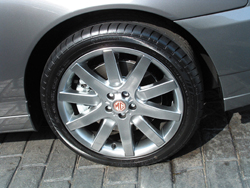
Other costs have been two oil and filter changes that have to be done at 5,000 mile intervals and two new rear tyres needed at 10,100 miles. Here at least the Continental tyres now used are considerably cheaper than the same size Michelins that were standard fit up to 2003. In fact having driven the same cars with both I feel the Continental is a better all rounder.
In Summary
I am very satisfied with my car. It ‘s a great drive with a very wide range of talents, quiet solid refined cruiser to responsive and rewarding sports saloon on those more demanding roads that beg you to ‘drive them’. It is not an M5 type super car, simply a brisk and an easy performer, indeed the phrase ‘not what it does but the way it does it’ suits the car well, and as a package delivers more than the sum of its individual parts.
Is it a performance icon in the making? No, a performance icon already made.
Roger Parker