ZS 180 Running Report
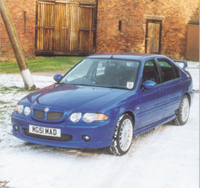
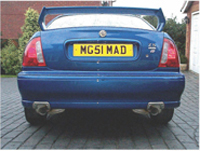
Much has happened since the Press launch of the ZR, ZS and ZT model MGs in Cardiff, even though it was only July 2001 but certain experiences have remained indelibly imprinted in my brain. One was leaving the built up areas, restricted roads and traffic behind, as we headed into the Brecon Beacons on a very warm sunny July morning. The demo ZS 180 simply flowed with throttle, steering and brake inputs in a classic sporting way. My words at that time were, ‘I have just got to get myself one of these!’ As a result, MG51 MAD, this number providing an accurate reflection of its owner, was delivered on 1st September 2001, and has since covered 1000 miles per month.
MG ZS 180 impressive in any driving conditions
Expected by many outside MG Rover to be the ugly duckling of the Z range, the ZS has actually turned out to be the one with a Swan’s attributes, especially in 180 form. Once again, the old but proven theme of a relatively large engine in a compact body works well. Expect the V8 ZT models to follow this too.
On delivery, my ZS 180 displayed the same positive attributes as the test cars had done, except that the Trophy Blue paint had two very small white spots on the top of the boot lid beneath the rear spoiler and a stain in the lacquer of one wheel. Both items promptly dealt with by the dealer, Trinity Motors of Hinckley.
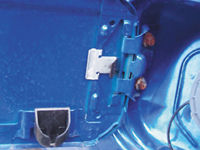 Rusty fuel flap bolts
As the miles passed and initial bedding in had enough time to be completed I was aware of a rather sensitive throttle action, especially when cold and at times when you are trying to hold a steady speed in a low gear. The throttle over sensitivity being such that this was often impossible to achieve, at least not with any smoothness. I did actually note this characteristic on other V6 engined ZS and ZT models, although it wasn’t quite as pronounced as with my car. A session on the Testbook diagnostics was arranged and I accompanied the car where nothing erroneous was found. It was suggested that covering a few more miles may ease the problem as the car had done less than 2000 miles, this seemed a sensible approach.
During the following month I noted that the engine oil level had dropped and needed just over half a litre to bring the level back up to the max. It also takes quite a time for all the oil to return to the sump so I suggest any V6 owner should allow a good half hour to elapse after stopping the engine before checking the oil level to get an accurate indication. Clearly if the level is really low then this will be obvious, but in circumstances where you are rushed and need to top up, then only do so to about half way between the min and max marks.
Another issue that became clear with my car, and which has been confirmed by other owners and with Longbridge feedback, is that long fast runs during the first few thousand miles will see a disproportionately high rate of oil consumption. So a full sump at the start of a long fast journey may well need topping up en-route if a worryingly low level is not to be reached. This applies mainly to Continental type runs, but it is worth bearing in mind for other long journeys and fuel stops should include a quick oil level check.
 |
 |
Oil consumption remained at the approximate 1500 miles per pint level until just over 7000 miles when the engine passed a watershed in the way it ran. This sudden change was almost certainly due to a session on a rolling road. However, what was apparent was that the engine gained an extra degree of sharpness and from that point to a few miles short of 12,000, which coincided with 12 months and the annual service, no more oil top ups were needed. In fact, this has continued with the next 3000 miles.
Having mentioned the first service, it is worth noting that there is quite a degree of competition between dealers in respect of the pricing of the standard services. I certainly found it was worth trawling around the dealers to obtain quotes that varied from £194 down to £154. Since the work is the same and should be to the same standard, I not surprisingly chose the cheaper route, which by chance was also my preferred dealer.
When we come to view what has actually gone wrong with the car then there is very little. In warranty terms the driver’s door glass one shot facility would stop the window a couple of inches short. This was addressed at the first service but the solution lasted only a few days before returning to the original condition. I expect the runners were lubricated and the few days use wore away the effects.
The throttle action I have mentioned, and very recently this suddenly developed into a more worrying sticking throttle, something that I know other owners have experienced. Being impatient, I dealt with this myself as it involved a thorough clean of the throttle body and idle air bypass valve. I also adjusted the throttle cable to ensure that the intended lost motion in the linkage at the throttle body was correct as this had become tight and could have added to the effects of the sticking throttle. The result of 30 minutes of cleaning and adjusting has alleviated the problem and nearly eliminated the previously mentioned throttle sensitivity.
The only other actual failure has recently been the driver’s door mirror-heating element, something that you become very aware of in autumn and sod’s law always dictates it’s the one you need most. A spare mirror glass was not on the dealer shelves, but contrary to some rumours still circulating, the Parts Company delivered one in a few days that was then fitted whilst I waited.
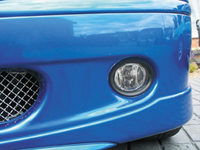
There are a few other items to note during the last 15 months. One has been a broken nearside front fog lamp (£28 and a stock item) which was a little awkward to access, needing the front panel to be removed.
The seating position whilst offering good support was a little low on the front edge for me. As the driver’s seat height adjustment offers no separate front and rear adjustment I compensated for this by adding two 10mm spacers and longer bolts to the front seat frame mounting. This raises the front of the seat and gives my thighs more support.
The rear spoiler (big wing 4 door model) has come in for much comment. Some do not like this but I feel that it is an integral part of the car’s character and helps provide a clear visual separation from Rover 45 with boot spoilers. It does have drawbacks being so big and one is the interference with rearward vision. Being as I am also qualified to drive articulated and other goods vehicles you learn how to use mirrors and as such I found no problems of note, even though the spoiler does cut through the middle of the mirror line. I do actually find an advantage in night traffic as the spoiler is a great headlamp blocker, so that those annoyingly miss set headlamps of the following car are obscured by the spoiler.
Less acceptable though is the ease at which the boot lid closes on the back of your head when your removing items from the boot. Initially I didn’t have any problem, whereas other owners have had bruising experiences, and then asked me about mine. Looking at the springs that assist boot opening, I can’t see a quick and easy solution to increasing the tension of the torsion bars.
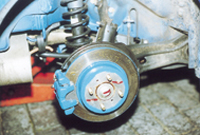
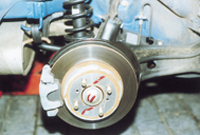
I have also noted a couple of elements of corrosion, not serious, just cosmetic and annoying. The most obvious of which is the ease at which the non-friction areas of the brake disc and calipers corrode. Not an issue if the wheel used is of a design that means you can’t see the brakes behind, but where you can, as is the case with the MG wheels, it becomes an eyesore very quickly. I have found in the past that for most operating conditions smooth Hammerite paint is effective and cheaper than caliper paint and their blue is remarkably close to Trophy Blue. It may look a bit ‘Posey’ to paint the calipers and non-friction areas of the discs, but the aesthetics are much better with than without.
The other little grievance was with the two bolts that retain the fuel filler flap to the body. The heads of which went red with rust, something that my patience and significant spares in the garage ensured was corrected in a spare couple of minutes. Nevertheless, with the heads corroding within 6 months and half of one winter it does indicate an unsuitable component being used in this area.
Overall fuel consumption has been very close to the official figures quoted for the model. Up to the 14000-mile mark, the average has been a creditable 30.22mpg, although when broken down a little more the first half of this recorded an average of 29.4mpg. A small but still measurable improvement was achieved when a non-standard air induction system was fitted, and I expect that the greater mileage and the way the engine ‘crisped up’ at just over 7000 miles will have also influenced things. (That induction change is to be covered in a future tuning feature.)
The only other consumable used was just the driver’s wiper blade. Tyre wear is turning out to be much better than some of the other powerful FWD cars I have owned and at 15000 miles the front wear is pretty even across the tread and has between 4 and 5 mm left. In view of the fact I do use the chassis capabilities I am impressed with the all round performance of these Michelin Pilots and feel that the higher than average replacement cost may actually be justified. I do however avoid that particular tyre destruction ‘use’ that is called the ‘track day’. Although, I don’t mind wearing other people’s tyres out on such events!
I can’t leave the ICE area unmentioned. I am a comparative heretic in ICE terms and make no apology to preferring the cylinder symphony to some other music. However, I do use the radio for background noise and specifically listen for traffic reports. The original fit Kenwood KRC 379R is a user’s nightmare with insignificant little controls that are difficult to master when stationary and a safety hazard to attempt changes on the move, and I don’t carry the mandatory 6 year old for instant programming. For this reason it was evicted very early on for a cheap and cheerful JVC unit which has much simpler controls and just happened to be sitting in the garage. I do have a Kenwood 5090R in the TF, which is certainly better but still flawed. Oh how nice it would be to return to the set up we had on our old Rover 218iS, with the integrated clock/radio display and steering wheel controls.
I will finish with a positive point, and this is, the solid way in which the car was screwed together. Having worked with Jaguar, Land Rover, Ford and BMW in connection with creating specialised law enforcement vehicle specifications, I have been exposed to a wide range of their cars. When I first took delivery of the ZS a casual comment by someone was that it appeared to have some 3 series qualities, which was a compliment. I am biased, but others noted how well the car was put together and how quiet and refined it was. Some though found the ride a bit too firm for their liking. Over 12 months on and I am still getting positive comments from passengers who comment on the lack of any rattles or squeaks. In addition, nothing has fallen off, nothing has broken and trim in the heavy wear areas is wearing well, especially the driver’s seat.
The press reception was universally very positive for the ZR, ZS and ZT ranges. Many authors questioned how the cars would stand up to use over time and would the rosy image remain after 12 or more months? Well my experience has been a very positive one, and generally, those owners that I know have shared similar experiences. Would I buy another, yes but taking things easy during that bedding in period before the engine hits that sweet spot would be boring.