The MGB Phenomenon
For many years the MGB held the title of ‘the world’s best selling sportscar’ and when production ended in 1980 it had reached a total of 512,243 units. During an eighteen year production run the MGB enjoyed an enduring popularity which remains undiminished to this day.
The MGB did not have a power advantage over its contemporaries, nor was it a sports car that was head-and-shoulders above its rivals in any particular. However like the MGA before it, the MGB had a number of qualities which worked well in combination to give it a distinct and lasting appeal. How then did the MGB evolve?
Design influences
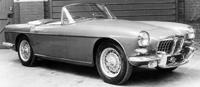
Plans for the MGA’s successor were first contemplated only months after its launch in 1955. First proposals were based on retaining the MGA chassis just substituting a re-designed body to keep down the development and production costs. A number of proposals were considered but significant influence for a replacement came from a commissioned design exercise, the Frua-bodied MGA. This was a one-off hand crafted special from the Italian design studio Frua of Turin. Built on an MGA chassis it looked great, like a smaller scale Maserati and it had an exceptionally strong body, unfortunately it was also extremely heavy.
The weight penalty of a separate chassis was a strong influence on the choice of a monocoque or unitary design, a body shell that incorporates the chassis components in one single unit. The Austin Healey Sprite launched in 1958 had proved that a monocoque open sportscar could be rigid and still light enough to give lively performance from a very modest engine.
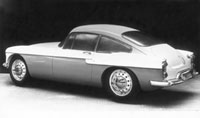
EX205 shows a crossover stage between the MGA and the eventual design of the MGB and you can already see some of the B’s design cues, in particular the scalloped headlights along with wind-up windows and external lockable door handles.
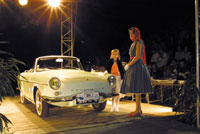
Following on was EX214 which displays many of the distinguishing features of the MGB, smooth straight sides divided by a thin chrome trim line, a squared off boot, A40 tail lights and wrap around bumpers. The front end, still more MGA than MGB remained an unresolved area. However, it is explained in David Knowles’ excellent book ‘MGB’ (published by MBI) that Syd Enever found inspiration on a visit to the Geneva Motor Show where he saw the new Renault Floride and Caravelle. These cars featured deeply scalloped headlights with a chopped off front end and Enever reputedly liked the treatment so much that it greatly swayed the final design of the MGB. Apparently the official quote about the design of the new MG was that it was derived from the record beaker EX181.
Final Design
Don Hayter produced the final designs, changing the shape of the rear wings and re-shaping the tail lights to made the lines flow evenly from front to back. The front end was chopped back with a chrome grille that was subsequently wider and slimmer than that of thehe MGA.
When EX214/12 emerged it was clearly recognisable as the definitive MGB shape. It was coded ADO23 and the process moved on to the production of a quarter scale model. Then a prototype was built and this was given the chassis number ADO/370 on 23 March 1960. The prototype was made at Morris Motor Bodies of Coventry.
A number of experiments were tried to equip the new MGB with independent rear suspension and although a lot of work was done, the final decision was to stick with a live axle and half-elliptic springs. However, in order to improve ride and handling the spring anchorages needed repositioning further back and to accomodate this the body had to be lengthened by an inch.
Development of the ‘B continued even during the actual launch, where a change to the radiator grille badge was necessitated due to police comments on its reflectivity. The Red reflective background was hurriedly changed to accommodate a new frosted backing with non-reflective Red paint.
Engine
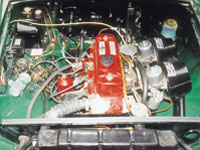
Originally in the early planning stages it had been envisaged that the B would be powered by the 1588 B series engine in conventional and also in twin cam form. The twin cam had proved to be wonderful in application but something of a a disaster from the maintenance point of view and after excessive warranty claims it was sadly withdrawn. So the choice fell to the 1622cc engine but following testing it was revealed that with this unit the MGB would be slower than the A it was due to replace. Fortunately BMC had decided to increase the B series engine in size to 1798 cc in order to use it in their new Austin/Morris 1800 saloon due for launch in 1964. It was agreed to supply these engines for the B in three main bearing form although the saloons were due to have a five main bearings. An oil cooler mounted in front of the radiator was standard on all export MGBs from the start of production but remained an option on UK cars until the five main bearing engine was adopted.
In 1964 the smoother 5-bearing engine became available and was fitted in the ‘B’. This new engine was slightly down on power and the competitions department continued to use the three-bearing unit.
Launch
Production of the MGB increased steadily over the coming months ready for the launch at the Earls Court Motorshow on 20th September 1962, alongside the MG 1100 and the updated Midget which had an increase in engine size from 948cc to 1098cc. The MGB was a hit with the motoring press with many positive and enthusiastic reviews. Both the ‘Autocar’ and ‘The Motor’ carried detailed spreads on the new MG, with ‘Autocar’, stating that the MGB Roadster was, “…an altogether superior car to its predecessor”. The MGB proved a worthy successor to the MGA; it was an updated vehicle which offered improved comfort and versatility without alienating the traditional sports car customer who favoured the MG image.
Production was heavily dependent on the services of factories other than Abingdon, such as ‘Pressed Steel’, which developed the body shells for the MGB. Many factories both within the BMC empire and outside of it played a role in the production of the MGB.
During the first full year of production (1963), Abingdon saw a 75% increase in the number of models built. This figure was again bettered in 1964 with a total of almost 38,000 Bs being produced, nearly 30,000 of which were exported, most to the United States.
On the road
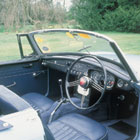
Although the MGB’s performance was respectable enough in 1962 it was the fine combination of its dynamic qualities that appealed so much. The MGB was a sweet handling and predictable car to drive, although it would break away on a corner when provoked it would always do so in a progressive way, allowing adequate time to correct. The MGB chassis was easily capable of dealing with the performance available, the steering was sharp and responsive, the brakes effective and the car solidly built.
 |
 |
In January of 1963 overdrive operating on third and top became an option on the MGB in the UK which improved flexibility and fuel consumption.
Overall impression of the B was a British sports car of great charm and quality, an image it retained throughout its extended production life. It also has to said that the MGB ‘looked right’ and even today it still does not appear out of date when parked in a line up of modern cars.
MGB GT
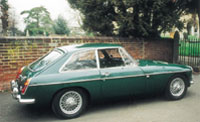
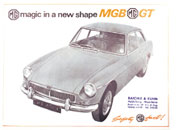
John Thornley was great admirer of the lines of the grand touring coupes of the 50s and 60s in particular the Aston Martin DB2/4 and he wanted to build a similar bodied MG. First attempts to create a closed coupe on the MGB base did not quite capture the right aspect. So Pininifarina of Italy were commissioned to design a coupe body and they came up with closed coupe with much deeper more raked windscreen and a rear-opening hatchback. In the Pininifarina prototype the rear quarter-light windows were frameless and the door handles were pull type. In final production form the BGT acquired frames for the rear side windows and push button door handles. The BGT was launched at the 1965 Earl’s Court Motor Show where it was very well received. John Thornley said of the BGT “We’ve produced a motor car now in which no managing director would be ashamed to turn up at the office.”
American Legislation and the MGB
Sports car sales in North America had always been a vital aspect of the survival of MG so when new automobile safety legislation began to emerge for the American motor industry MG had to take notice. The Chevrolet Corvair built by General Motors had caused a scandal with its appalling safety record, which in turn had given rise to Ralph Nader’s book ‘Unsafe at any Speed’. Automobiles and safety had become a very big issue in the States and new legislation was introduced starting with the Clean Air Act of 1963 which was designed to reduce vehicle emissions and then in 1966 the National Highways Traffic Safety Act to deal with traffic accidents. This was to have a major impact on car manufacturers and MG had to rapidly comply with these new demands in order to stay in the US market.
A number of features were quickly introduced, an energy absorbing dashboard was devised for the American specification cars, while the long eared wire wheel knock-ons were replaced with octagonal style spinners, seat-belts and head restraints were fitted along with a collapsible steering column. Extra mirrors on the doors, and wing mounted repeater flashers were also necessary. Even an extra windscreen wiper was required. But all this was a mere hint of what was to come.
Rubber Bumpers
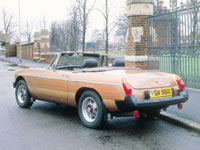
American safety legislation grew ever more restrictive and for 1974 all MGs sold in the US had to be fitted with bumpers that would withstand a 5 mph impact without damage to the lights, indicators, steering or brakes. To meet this standard both MGB and BGT had to be fitted with moulded polyurethane bumpers over a steel armature. Not the best solution but in the circumstances an effective compromise. Along with the bumpers came an increase in ride height but most devastating for a sports car was the loss of engine power as a result of even tighter emission standards. Even worse was that the assessment for these emissions was based on vehicle weight. The MGB just squeezed into one class but the heavier GT was rated in the next class with even tougher requirements. Faced with producing two different engine specifications it was decided to drop the MGB GT in the states; there was also the consideration that its withdrawal might help the sales of the TR7.
The Final Phase
Amazingly, despite a chronic lack of investment and development the MGB still had a strong following and continued to sell in America and at home despite having been progressively robbed of its original performance. Then the economic policies of Margaret Thatcher’s new Conservative government caused the value of sterling to rise against the dollar and unwittingly made MGs more expensive in the States. By this time British Leyland had grown to become a huge unwieldy and loss making corporate mess.
In September 1979 MG celebrated fifty years of production at Abingdon and immediately after the week of celebrations was concluded BL announced the closure of the factory and the end of MG production.
In the final analysis it seems that it was the fixed attitude of British Leyland’s management that brought about the demise of the MG and the MGB. Many senior managers were ex-Triumph men whose sympathy was with the new TR7 and remote from anything to do with MG. Whilst they have subsequently denied this, history shows a clear Triumph badged product investment bias to the detriment of MG. For example when closure of Abingdon was announced BL claimed that that every MG built was losing them money, what was not mentioned was that every other Leyland car being built was also making a significant loss. It is a reflection of the enduring appeal of the MGB that it remained a strong seller right up the end despite being outdated through lack of investment and under-powered in its emission control form.
MGB Forever
The design of the MGB was so well conceived that for many of us the closure of the factory did not mark the end but only served to increase our admiration of this excellent sports car and our determination to keep MGs on the road. Considering that the last new MGB left the line at Abingdon on 23 October 1980 a properly maintained MGB or GT can serve as a practical everyday car which will still provide its owner with a rewarding and entertaining drive. Those of us who grew to love these cars can only feel vindicated that it was the MG sports car image that the newly formed MG Rover company wanted to reclaim at the launch of its new operations.
 |
 |
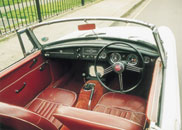 |
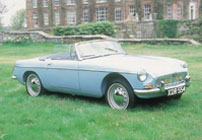
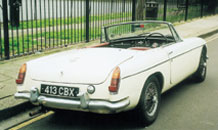
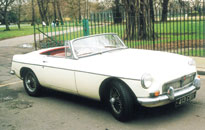
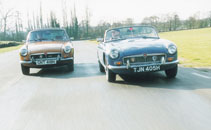
The white MGB in the photos belongs to Bob Mallett a regular customer of West London Classics. Bob has owned the B for fifteen years and uses it every day. Bob’s MGB was built in 1962 but first registered in 63 and despite its 40 years the car is in original condition throughout. Some years ago the B was part restored and an overdrive gearbox was fitted but in all other respects the car is as it left Abingdon. It is very unusual to see a B of this age in daily use and it is even more unusual to see such an original car surviving so well despite the cut and thrust of central London traffic.
 |
 |
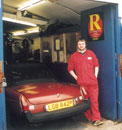
Tucked away in a quiet street near Ravenscourt Park is West London Classics a company that MG specialist Carl Robson started in November 1988 and has been looking after classic MGs, Triumphs and Austin-Healeys ever since. Carl can provide servicing and general care of your MG and with body shop and paint shop facilities on the same site. West London Classics can also provide a full restoration service or as Carl puts it ‘all your classic car needs can be catered for’. Carl is adamant that the MGB is the ultimate classic sports car that can still be used everyday with its unrivalled durability along with comprehensive availability of spares.
 |
 |
 |
 |