Immobilised MGF
Occasionally reports are received from owners of MGFs to the effect that their cars have become immobilised and the remote fob (and in some cases the spare as well) fails to unlock the car. Operation of the key in the driver’s door allows access into the car, but without the ‘emergency access key code’, the car will not mobilize and so can’t be driven. Often after recovery, and before any diagnostic work is done, the car will respond to the remote fob and all works perfectly normally. Diagnostic checks show no faults and the reality is that there probably aren’t any.
Microwaves
The reason for this problem is rather interesting and relates to our high tech society and the number of sources of radio transmissions that must be ‘micro waving’ us all! In the MGF’s case though some connections have been found to the car being parked within the proximity of one of these sources and the common ones are communication transmitters and even high power commercial kitchen microwave cookers.
It has been reported that if the car is sufficiently close to one of these power sources the transmissions can be strong enough for the security system to regard them as ‘scanning transmissions’ a situation that the system is designed to react to. In this case it locks out any inputs from radio signals and this block will also include the signal from the genuine remote fobs. Once the transmissions have ceased and a period elapsed for the system to return to normal the receipt of the genuine radio signal from the remote fob allows normal operation. An aspect of this problem that has caused some MGF owners confusion is that the mere presence of a transmitter means nothing, it is only when the transmitter is actually in operation that the problem can occur and unless you have monitoring equipment, that is not easily determined.
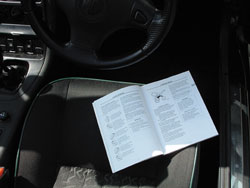
All the instructions are in the handbook
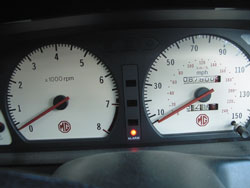
Alarm light on
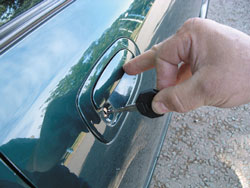
Insert key (the alarm fob has been removed to make the position of the key more visible)
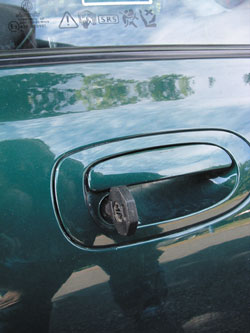
Upright position
If you are unlucky enough to suffer from this immobilisation problem, it is at best inconvenient. However, there is a clear escape route and all MGF owners have it available, although it does need to be tested to prove it does actually work. This is the ‘emergency access key code’ a four digit pass code that is entered into the car’s security ECU via turning of the key in the driver’s door lock. The code is given to the first owner on a credit card sized ‘security card’ along with radio code, if that applies. How many owners have said ‘OK thank you’ when given the card and the purpose explained, and then filed it away with the vehicle documents only to come out when you sell the car? For some members not checking the operation of the access code when they first took up ownership has proved to create problems at a later date.
Setting the code
Let us imagine a hypothetical example code of 2-3-4-2 and how to enter this into the alarm ECU. First insert the key into the driver’s door lock, turn the key clockwise to lock the car, then return it to the vertical position. Now turn it fully anti-clockwise to the unlock position and return it to just past the vertical position, say the equivalent of five minutes past the hour position. This extra movement beyond the vertical is different to many handbooks as it takes into account the possibility of some wear and free movement in the lock mechanism. Repeat this anti-clockwise turn for a second time, this then inputs the first number (2) to the alarm ECU.
With the key returned to the vertical position you now need to input the second digit and this is done by turning the key to fully clockwise to the locked position and then returning it to the vertical position (but this time with the extra small movement equivalent to five minutes to the hour). You carry out this clockwise turn sequence three times to the locked position and this sends the second number (3) to the alarm ECU.
The third number is input by turning the key in the same way as the first digit input,ie to the unlock position but this time four times, and it is followed by the final number input to the locked position twice. Finally turn the key once more anti-clockwise to the unlock position to unlock the door. Once done the code 2-3-4-2 will have been input into the alarm ECU and should then re-mobilise the car. This is confirmed by the amber light on the instrument panel going out. If the code is entered incorrectly a warning bleep will sound when the key is turned to the final unlock position. If this happens open and close the driver’s door which will cancel the error and allow you to enter the code once again. Should you make three incorrect entries you will need to wait at least ten minutes before the system will allow any more attempts.
It is well worth testing this out in the comfort of your own drive and if it does not work after several attempts then there may be a fault within the system and the only recourse is to have this investigated. Unfortunately, this needs the facility of the MG Rover Testbook diagnostic equipment to access the system.
This description is not all encompassing for all models, so if any difficulty is experienced inputting the emergency access key code then visit your local MG Rover dealer to overcome whatever inconsistency has been discovered.
Instances have occurred where the incorrect code has been given to the owner and this is almost certainly an error on the part of the original selling dealer when writing down the code on the security card. With a potentially longer ownership list and unknown previous activity there is also a possibility that ECU’s may have been changed.
The possibility of the system being isolated due to outside transmissions is fortunately uncommon, however you are much more likely to suffer this type of problem at some location that is far away from home due to failure of the handset remote or the internal battery going flat, the latter problem being quite common. All things considered here is an even stronger reason to get out on the drive next weekend and test the system.
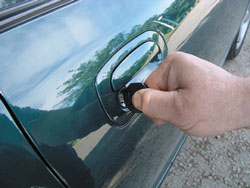
Key in the 5 minutes past the hour position to allow for any wear or free movement in the lock mechanism
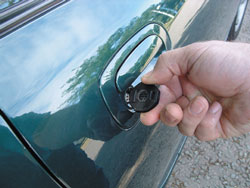
Turning to the ‘lock’ position
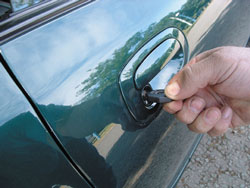
Turning to the ‘unlock’ position
Roger Parker