MG XPower SV – Looking under the skin – Part 2
Design
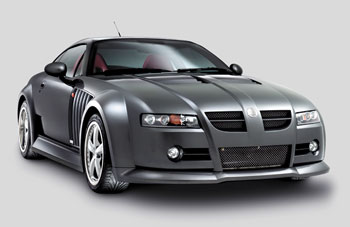
Clearly much in the original Mangusta was very good and would carry over, but even the better bits often came in for some changes. Weight was the first target and this was set at 1450kgs. Weight is the biggest killer of performance and is brilliantly demonstrated between a standard MGF 1.8i and a Lotus Elise, both using exactly the same engine. The Lotus being much lighter accelerates considerably quicker. The reality is that the actual weight of an SV is quoted at between 1490kgs and 1540kgs, not immediately thought of as light in Elise terms, but put in perspective this is 230 to 280kgs lighter than a ZT 260, itself no slouch with less power!
Reaching such a competitive overall weight even though the equipment levels remain high demands very detailed work on weight management, way beyond the level of an Atkins diet! One of the major contributors to overall vehicle weight is the body and for the SV the body is made predominately from carbon fibre composites with specific strengthening frames added in steel, such as the doors side intrusion bars and a full FIA spec roll over cage built into the main structure.
Carbon fibre is better associated with aerospace and high level motorsport applications such as Formula 1. However, it has also been used in some exotic road cars like the McLaren F1 and Ferrari Enzo. Carbon fibre is also feeding into many daily aspects of our lives (e.g. wind vane generators) due to the basic properties that allow it to be up to a quarter of the weight of a steel panel of the same strength or up to four times stronger if it has the same weight as the steel panel. It is also a very flexible material, as is steel, flexible in this context being the wide range of potential uses and how the material can be adapted to suit these.
Steel is not found as one single spec material and neither are carbon fibre composites, ‘composites’ being the applicable word here as the fibre is only one component part of the material, resins and other components are used to create a specific product for a specific purpose. One characteristic of carbon fibre panels used in vehicles is that the different expansion rates of the component materials allow the distinctive carbon mat effect to show through paint surfaces and create a less than smooth finish onto which you normally apply a paint finish. On competition cars this is of lesser importance and on road cars this, and a restricted colour range that can be applied, has often been turned into a marketing tool, highlighting the high tech materials rather than the failure of being able to achieve a high quality paint finish, at least not without considerable investment. The reality though is that high quality cars need to offer a wide colour range of high quality paint finishes.
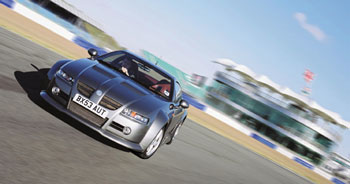
Mark Blundell at the wheel of the SV
To achieve this quality finish, many existing carbon bodied cars have had to have very expensive paint preparation and finishes, some costing up to £35,000 per vehicle. Applied to a £250,000+ vehicle that paint cost is not out of proportion, but on the SV, over half of the vehicle price being spent on a paint job is completely out of the question.
Flat Packed SV
In the development process of MG XPower SV, a wide range of composite materials and processes were examined and test panels passed to MG Rover’s paint supplier, Dupont, for testing of surfaces for painting, adhesion, finish etc. The actual body materials chosen to be used in the SV have been developed by a world leading specialist in carbon composites, SP Systems, based on the Isle of Wight (off the South coast of England for non UK readers). Their SprintT CBS and SF 95 materials were chosen for the overall balance of benefits that they gave, including low weight, high strength and most interestingly, a very high quality surface finish that allowed virtually any paint finish to be applied with little preparation and obvious cost and labour benefits, see the diagram below.
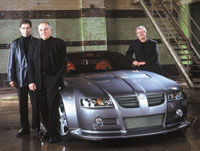 The team behind the SV, Ian Moreton, Peter Stevens and Giordano Casarini |
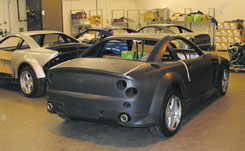 MG XPower SV arrives at MG Sport & Racing for finishing |
Another benefit of achieving this high quality surface is that virtually any colour can be applied in the same way as on steel and the finish is superb. In fact this is almost counter productive as it gives a body finish that is outside many people’s perceptions of what finish can be achieved on a carbon composite material. This could even generate scepticism that the panels are not all carbon composite based. To this end, some of the body inner panels, such as shut faces and the underside of the boot lid are left in the natural carbon fibre finish, just to show off the material.
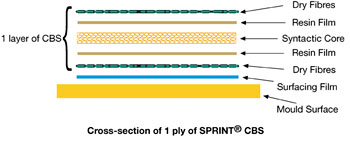
There are many other major benefits justifying the use of carbon composites and there simply isn’t space here to go through them all, however I will look at a couple. One is when looking at a limited run of cars; under circa 3000 examples. It is actually more cost effective to use these composites rather than steel. Not only that, but the accuracy of the manufacturing process allows very repeatable panel production to hundredths of an inch accuracy time after time. This is very important when comparing to craftsman built steel cars, which may have very tight panel fits on the individual car but achieving the same gaps if having to replace a damaged panel may well be somewhat more difficult and costly.
The SV body is made from over 3000 separate pieces of composite material that are individually cut from a roll via a computer controlled laser-cutting machine. This machine provides accuracy, but also labels each piece with individual part number and orientation markings to show how it fits into the mould. The result is not unlike cutting out pieces of material for a suit or a dress. Once cut, these pieces are put in flat ‘pizza’ boxes and transported in refrigerated trucks down to the moulding company in Turin, Italy.
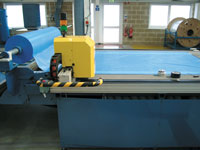 The Auto Cut machine |
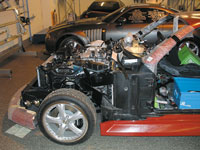 Lightweight steel chassis |
Once there the pieces are laid out in moulds and cured through application of heat and pressure in autoclaves (big pressure cookers) before the finished panels come together to form complete bodies. The accuracy of each individual panel is assured, but to ensure that these individual panels go together properly to form the car’s body needs a precise jig, which looks much like a combined exo and endoskeleton. Once in place a variety of bonding agents and mechanical fixings are used to create a complete body from all these components.
Lightweight steel chassis and V8 power
Whilst the bodies are being created between the Isle of Wight and Turin, the chassis is being created by Vaccari and Bosi in Bologna using lightweight steel to create a very rigid but light unit to take all major loadings. In the metamorphosis from Mangusta to MG XPower SV, the chassis was not left untouched as a number of revisions to suspension design required changes to the chassis, added to by a reduction in the chassis weight. As an aside it is also interesting to note that Vaccari and Bosi also make chassis’ for Lamborghini and Ferrari.
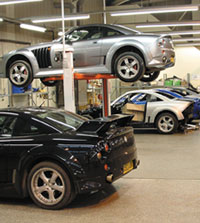 Preparation bays at MG Sport & Racing |
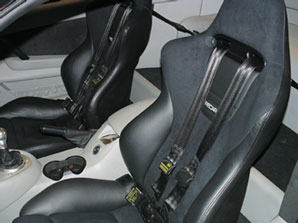 Four point harness seat belts, electronic button on centre console |
All major components come together in Modena, as happened before with the Mangusta. The chassis is built up with suspension, and the engine and gearbox is slid in from the front. When fitted the engine actually sits behind the front axle line to provide excellent weight distribution, almost a perfect 50/50 front to rear split in the finished car. At this stage, the car is mechanically and bodily complete, but is devoid of any paint or trim. Now all fluids are added, and systems programmed before a comprehensive series of tests are carried out. Once through these tests the cars are transported to the UK for final finishing.
UK finishing
The mechanically functional cars arrive at Longbridge where the final processes are completed. Currently painting is completed by two highly specialised outside contractors but this work will be moved in-house once a new a paint facility comes on line at the MG Sport and Racing assembly facility, a stone’s throw from the main Longbridge works. Wherever the painting has been done, the finish is superb.
On the finished car one slightly negative point to mention has to be the external badging. There may have been some reluctance to make the MG and octagon prominent features of the badging and to use ‘XPower’ branding, and there are a number of reasons why this route was taken. However, the front and rear octagonal badges as originally seen are simply too indistinct and similar to silver milk bottle tops once you are more than five paces away from the car. The MG and octagon details on these badges rely on available light highlighting the design cut into the badge, which doesn’t work. Even now with the adoption of black highlighting to the details on the badge, unfortunately the badge still becomes visually anonymous too easily.
Having been painted the cars need to be fully trimmed and this is where some other criticisms has been levelled by those who have had the opportunity to examine SVs that have been on public display prior to the Geneva Motor Show 2004. The main failing has been that cars displayed up to then were not to production specification and quality, and this fact was not made clear enough. In February 2004 as a direct result of raising these issues with MG Rover, the Club was invited to the MG Sport and Racing assembly facility to see the finishing process and examine a couple of cars that were to production specification, except for their steering wheel centres. These cars displayed a marked improvement in quality, since underpinned by the car displayed at the Geneva show.
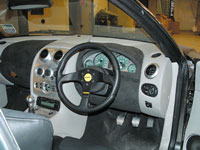 Interior trimmed in leather and Alcantara |
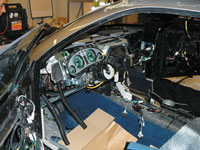 Interior of Geneva Motorshow car during assembly |
The interior is a custom one for the SV and made by Anderson and Ryan, an established Coventry based specialist in high quality vehicle trimming. Interestingly they are located on the old Triumph and British Leyland Canley, Coventry factory site, long since demolished, so keeping a car manufacturing connection alive. The wide range of options allow the SV owner an opportunity to personalise his/her car, but even the ‘default’ spec is far from basic.
A couple of interior aspects are worthy of comment. One is the way in which the acoustics have been tuned so that spurious road noise is filtered, but the more musical sounds like the exhaust and engine notes are allowed through at controlled levels. Mention of the exhaust sound also makes the point that the SV continues the MG tradition of model-distinctive exhaust sound with its very individual ‘Bop, Bop, Bop’ at idle to the intoxicating V8 bellow at higher rpms. Some may find this a good substitute for a sound system.
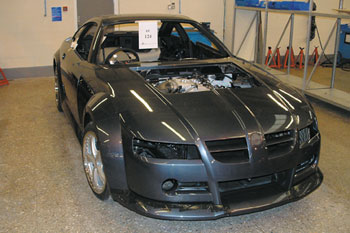
After painting
Looking at the seats and the names Recaro and Sparco are immediately connected with quality and performance makers in this area, and this is the reason why their products are seen in the SV in a range of different trims. Here is a small comment that may be of value. Leather is a very high quality and durable material, but is inherently slippery. While AlcantaraT on the other hand, is very like a suede and has grip properties not dissimilar to VelcroT with the performance potential of the SV, seats trimmed in AlcantaraT will help to hold the driver firmly and allow both better control of the car and greater enjoyment, even with the supportive shapes of the seats. Alcantara is also used on the dashboard, but here it is not for its Velcro properties, but because it is non-reflective so that reflected sunlight can’t dazzle the driver. However, its extensive use over some of the lower areas of the dash may not be to everyones’ taste.
Many people may also look at the Momo supplied steering wheel (shown without the production specification MG XPower centre badge) and note that it is a non-airbag type. The decision not to use airbags has been very well considered and is compensated for by other specific safety features such as the four point seat belts. These special German made electronically controlled inertia/fixed belts almost have a degree of intelligence in the way they ‘anticipate’ events that could be preludes to crash situations. Should certain conditions be detected then these belts automatically lock up and hold you as a race car harness would. In fact how many race cars do you see with airbags and how much more frequently do they crash at speed? The driver also has the option of locking the belts at the touch of a centre console button should there be a desire for better restraint during spirited driving. Another claimed advantage of not having an airbag in the steering wheel is said to be improved steering response through reduced steering wheel weight.
Leading edge electronics
21st Century technology has already been seen in the use of leading edge carbon composites, but comprehensive and integrated electronics is what most people can associate as technological. Here the MG XPower SV is right at the head of the class with a very sophisticated Omitec electronic system called Remote Service Platform (RSP). Omitec is also the supplier of MG Rover dealer diagnostic equipment and software along with similar equipment for other major manufacturers such as BMW, Rolls Royce and Honda. Here are a few of the SV system features.
Some cars have used diagnostic systems that allowed remote communication with the car to identify faults; here the Omitec system takes that a stage further. RSP does standard diagnostic checks each time the car is started, although these are deeper and continuous. Should a fault be detected then this is immediately transmitted to the SV call centre, which responds by calling the owner and informing him/her of the fault and what action needs to be taken. The fault warning lamp on the car’s instrument display will also illuminate to provide immediate warning of a problem to the driver too.
The system also incorporates a live location and voice communication facility allowing the vehicles location to be pinpointed at any time, along with the availability of immediate voice communication between the car and Call centre. For most practical purposes, that allows the occupants to be able to summon emergency services through the operation of a centre console SOS button in the event of coming upon a roadside incident needing the emergency or similar services. This facility can also be used in the unlikely event that the car suffers from a breakdown needing recovery, although under these circumstances the RSP will have usually already diagnosed the problem and initiated communication with the SV call centre.
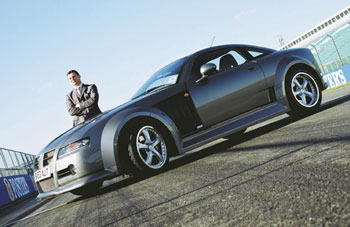
MG Ambassador Mark Blundell with SV
Theft of cars is unfortunately a big issue in the UK and the SV design team have recognised this by incorporating a very advanced and comprehensive anti theft system to the car, which is not a subject to discuss openly, but some elements need to be known. Tracking systems are also now becoming very much a standard UK insurance industry requirement for post theft recovery and in the unlikely event of the SV being stolen, the Omitec RSP system provides a very comprehensive tracking system. Of even more interest is a remotely activated immobilisation facility that can be activated at an appropriate time by the Call centre. Such systems generally operate when the vehicle has come to rest and has remained so for more than a few seconds such as at a controlled junction to maximise effect without compromising other road users safety. Having the car suddenly become immobilised with alarm sounding in a very public place usually ensures that the thieves take to their feet and the car quickly recovered.
The security aspects are further enhanced by the ability for the SV Call centre to remotely lock down the car on request by the owner. Circumstances dictating this could be when left at airport car parks or perhaps at home to ensure that younger and less responsible family members can’t drive the car even though they may have access to the keys when parents are away. The latter a more common problem than is often appreciated.
MG XPower SV is a very high profile product that has been followed with considerable interest by enthusiasts who will never own one, but who are far more likely to buy another MG from the positive cascade effects created by the SV. It has not been that long in the making, but at times does seem to have become shrouded in ‘morning mist’ that has affected perceptions. Now that pricing is actually fixed on two specific models, SV and SV-R, with a third in the wings, I hope to see any remains of the morning mist become dissipated by the ‘sunshine’ of exposure on public roads.
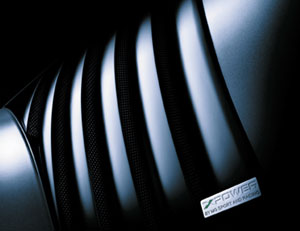
Distinctive side grills of the MG SV XPower
The MG XPower SV has already carved a space for itself in MG history even before it filtered into the hands of owners. It is truly a handcrafted car from all aspects and provides great performance and immense road presence. That there have been delays in deliveries to customers will matter not as long as high standards are met and maintained. With perhaps only 850 in total the SV is sure to remain a rare sight and one which is sure to attract people like wasps to a jam pot when it’s out in public.
Driving will clearly be the ultimate test for the SV as this is to be its core function. Whilst we have had limited opportunities to experience pre-production examples away from the public roads, it has to be in those road conditions where you measure the full effect. The feeling from these limited track experiences is positive and the opportunity to drive a final production specification example on public roads is eagerly anticipated.
MG SV Future models
Geneva 2004 saw the announcement of the first uprated SV model, the SVR with its 400bhp modified 5.0-litre engine family created by Canadian, Sean Hyland Motorsport. In the pipeline is another step up with the MG X Power SV Club Sport version with an even higher spec of engine and other complementary changes. For those less interested in out and out performance and perhaps having to frequently deal with congested roads there will be an automatic transmission version.
In the longer term, there will almost certainly be a development SV fitted with the same spec of 6.0-litre engine that powered the ZT-T speed record car at Bonneville in 2003 to over 225 mph. That engine developed 765bhp and with the smaller aerodynamic profile than the ZT-T, and no doubt some neat Peter Steven’s aerodynamic tricks, who will say how much higher the top speed could go.
Roger Parker