MG ZT 260 and ZT-T 260
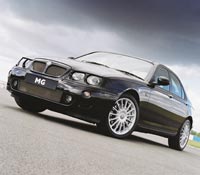
The story starts back in early July 2001 at the launch of the MG ZR, ZS and ZT models in Cardiff. There amongst the display of the new MG models was a rather garishly painted ZT saloon in XPower grey and green livery. Clearly, this was somewhat non-standard from the extended wheelarches and reworked VC10 tail on the boot lid! Interest took a very steep rise on seeing the four exhaust tailpipes, a pair either side of the car and then the rear XPower 500 badge. The exhausts are carried over onto the production 260, although somewhat quieter than the window shaking XPower car!
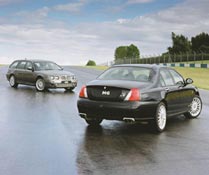
This first experience of MG XPower gave a clear indication that this car probably needed the aircraft tail! Later examination and a view under the bonnet displayed the impressive yet compact installation of the V8 engine, which sounded simply awesome when started. Visitors to that year November Classic Car show at the NEC will remember this car resplendent in the blue – purple flip ‘Typhoon’ paint finish taking centre stage on the Club stand, following its launch at the Frankfurt Motor Show, then badged ZT XPower 385.
Information accompanying the XPower 500 indicated that there would be two road going V8 engined ZT models, a mainstream version delivering 260Ps and an extreme version delivering circa 375Ps with supercharging. The anticipated launch for the 260 was spring 2002 and the extreme version some time later, but for various reasons the launch has been delayed until now.
At the Z Range launch, the competence of the ZT chassis was obvious and subsequent experience with a wide range of ZT and ZT-T models has shown this has been further improved. Overall, as good as the ZT 190 is, it lacks the torque and power to really do the chassis justice. The arrival of the ZT 260 V8 and ZT-T 260 V8 should now completely answer these shortcomings and leave the 190 to provide an excellent supporting role. The 260 also raises the game of the whole model range so creating a halo effect that should further increase interest and sales of all models. Members may also be interesting to read our views next month of ZT and ZT-T 160 1.8T models, both of which we have recently had access too.
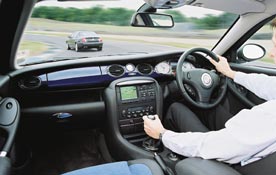
Looking at the 260 models in more detail reveals them as essentially being a ZT or ZT-T with a new powertrain. However, this is a very, very different powertrain! Up until now all ZT models have been front wheel drive using either transverse four or six cylinder K series petrol engines of 1.8 or 2.5 litre capacity, or a 16 valve 2 litre four cylinder diesel. The 260 uses an in line V8 engine of 4.6 litre capacity that drives the rear wheels!
Let us not overlook the point that this is not a simple engine change but a complete reconfiguration of the car and it is quite simply a new car. Whilst its arrival is later than anticipated it has still been a relatively short time from inception to announcement.
There have been substantial changes to achieve this specification yet the only outside design cues to its identity are the exhaust tailpipes and the badging. Inside there is a modified transmission tunnel area to take the new 5 speed manual gearbox and some rear floor changes to accommodate the all new rear suspension and differential, neither of which impinges on occupant comfort or safety. The ease in which this major change has occurred is due in part to the flexible design of the original Rover 75 and partly from the advanced computer aided design systems that MG Rover Group utilise. The ability to accurately model not only the components for physical packaging, but also their dynamic performance in a wide variety of conditions including crash conditions is a major reason for the significantly shorter time it now takes to bring what is in effect a new car to market.
In more detail the engine comes from the Ford stable and is one of their light and compact ‘modular’ units that are made in various formats and capacities. Capacity starts at 4.6 litre with related 5.4 litre V8 and huge 6.8 litre V10 big brothers. The current Ford Mustang GT uses the same specification engine, which is a significantly modified version compared to pre 2002 cars.
The unit is a 90-degree V8 with a cast iron block using 5 cross bolted main bearings for significant engine rigidity. The cylinder heads are all alloy and carry a single overhead cam per bank that operates just two valves per cylinder. Don’t be fooled though by this apparent lack of sophistication in this age of twin cams and four valves per cylinder as this is one efficient, powerful and very clean engine!
With large valves, high lift cams and equal length inlet manifold tracts the engine has no difficulty in delivering a responsive 264Ps (260bhp). This may only be 56bhp per litre, but is 7 bhp per litre more than both the MG RV8 engine and the similar 4.6 litre capacity Rover V8 that delivers such stunning performance in many MGB V8 conversions. It also means the engine is very under stressed at this level of tune that will significantly aid longevity.
Whilst the power may seem to be low for the engine capacity, the more important aspect of torque is most certainly not! 410Nm of torque, or 302lbs ft in old money, is what will make this car a highly regarded MG. The principle worked 30 years ago for the MGBGT V8 and it will work here too. In the BGT V8 torque was raised by 75% over the normal model, whilst in the ZT the difference between the 190 and the 260 is a similar 67%! When you look at performance figures for this ZT against competitors you will have to remember that it is less of what it achieves, but more in the way it achieves it. Expect the car to be able to deliver much the same level of performance whether you use all 5 gears or perhaps only 3. This should be very clear in the car’s ability to accelerate rapidly in traffic without the need for any downward gearchanges. Easy performance will be the name of the game.
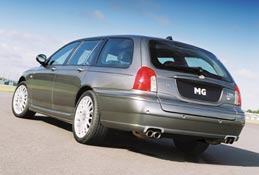
Greater performance always comes at a cost and the official figures reflect this with the combined cycle showing a return of 21.5mpg against between 25.5mpg for the ZT 180 auto and 28.7mpg for the ZT 190. I do have a suspicion though from my experience over many hundreds of thousands of miles behind V8 engined Rovers in the past that leads me to believe that owners will be able to beat that average.
The engine power is delivered to the rear wheels via a 5 speed Tremec gearbox, which again is another well known unit in the US. It has a more than adequate torque capacity and five well spaced ratios. The clutch is hydraulically operated and the weight is said to be slightly higher than found in any previous ZT, in fact all controls are said to have a slightly higher weighting. At the rear is a limited slip differential with a 3.46 to 1 ratio to reduce rear wheel slip under acceleration. Electronic traction control will be available shortly after the launch. It is hoped that an on/off switch will be available for those attending track days!
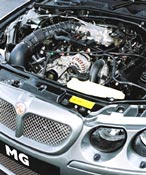
The 4.6 litre V8 engine fits neatly inside the ZT engine bay
Suspension follows a very similar route to the front wheel drive versions with McPherson struts with changes to take into account the different configuration and considerable performance increase. At the rear the original ‘Z’ axle has been replaced by a completely new subframe that attaches to the body via six mounting points, other models use four. The suspension configuration is of a multi link design using lightweight aluminium components. Both front and rear suspensions feature anti roll bars and revised spring and damper rates. Of note is the use of Bilstein dampers front and rear. To accommodate the bulkier engine the steering rack has been mover forward of the axle line which is said to actually provide benefits in feel and feedback.
Wheel and tyre sizes remain as before although for the SE models a new 10 spoke design is fitted, which is available as an extra cost option on the base 260 V8 models. All versions use the IMS system in place of a spare wheel, as the new rear suspension takes up the spare wheel well. Brakes on the 190 are already very capable, and have been uprated for the 260 V8 models.
Inside is much the same as current models apart from the front transmission tunnel mods mentioned earlier. The reduction of space has forced a change to the air conditioning and a new compact HEVAC (Heating, Ventilation and Air Conditioning) system has been fitted. This is neatly interfaced via a small ECU to the existing facia control panel to maintain continuity with the existing model range. In the boot/load space area of the cars, the changes to the floor for the new rear suspension and drive train has dictated a move of spare wheel, plus the battery now lives in this area but all these changes have little impact on occupants.
There is of course another model of ZT yet to arrive and this is of course the supercharged version with more a more radical appearance. This will be simply badged XPower as its power output, wherever it is set, will be more than ‘adequate’ to provide stunning performance. It will be marketed through MG Sport and Racing and here member feedback relating to the SV indicates a less than desirable level of communication. An area that MG Rover Group needs to examine in respect of these halo products.
Overall the ZT and ZT-T 260 V8 models appear very accomplished performance MGs which I look forward to experiencing. If this expectation is realised then the queue starts behind me!
Roger Parker