MGB V8 Roadster Supersports (part 2)
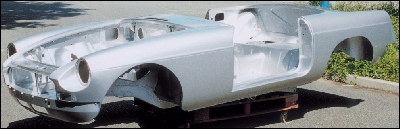
MGB V8 ROADSTER SUPERSPORTS
Part 2 – Bespoke V8 Power
This month we take the prepared V8 Roadster bodyshell and consider the many options of V8 engine, gearbox and back axle to install a complete powertrain. Choosing the right combination to suit your driving style and budget is one of the most exciting stages of the project, and by going through what can be expected from each, you will be sure of making the right decision.
 The Engine
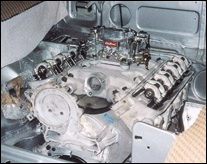
The very fact that the engine is a minimum 3.5 litre V8 guarantees that the finished car will have an excellent power to weight ratio. By increasing the cubic capacity and heightening the state of tune, this can be developed to such an extent that power output measured in both BHP and Torque can match and exceed many modern sportscars. In order to decide on the engine specification, you need to consider the fuel and the ignition system to be sure that they will be compatible. There are three engine sizes popularly available, and each engine size is available in standard and Stage 2 tune, and all should have hardened valve seats to be suitable for use with unleaded fuel. A fair assessment of the engine performance and characteristics is as follows;
| 4.6 litre Stage 2 engine | develops 265bhp & 300lb/ft torque |
| 4.6 litre Standard | develops 220bhp & 280lb/ft torque |
| 3.9 litre Stage 2 | develops 230bhp & 250lb/ft torque |
| 3.9 litre Standard | develops 200bhp & 220lb/ft torque |
| 3.5 litre Stage 2 | develops 220bhp & 200lb/ft torque |
| 3.5 litre Standard | performance as original engine (ie. SD1 or MGB V8) |
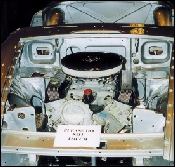 All Stage 2 Engines and some specifications of Standard engine can include full balancing and High Torque camshafts to enhance smoothness and performance, and full engine specification sheets are available on all engines on request.
(Torque and BHP figures assume optimum carburation, ignition and exhaust manifolding, and are given as an indication of achievable performance only. Engines are normally supplied without rocker covers)
Fuel System
Fuel systems are either fuel injection type, or normally aspirated (carburetor).
There are engines available complete with fuel injection systems included as indeed the RV8 has fitted, and unless you have particular expertise in this area, it would be best to leave the supply and installation to a specialist. For this project a carburetor system is best for ease of installation and maintenance with no discernable difference in output. A Weber four barrel carburetor with Offenhauser 390 Dual Plane inlet manifold and Low Rider air filter is used to give ease of set up, good fuel economy, and adequate bonnet clearance without the need for power bulges. There are two other types of carburetor used for this application. Firstly the Holley, again used with an Offenhauser 390 Dual Plane inlet manifold and Low Rider air filter, which gives good performance but is harder to set up accurately and can give very poor fuel economy if not set correctly. It is also a tight squeeze to get sufficient clearance with the bonnet. The other option is the original SU carbs with plenum chamber and inlet manifold used with K&N filters, but although this is fine for a 3.5 litre and possibly a 3.5 litre stage 2, there is insufficient potential to optimize the power from larger capacity engines.
 The Ignition System
The ignition system can use the original V8 distributor weighted and sprung to suit the engine tune selected, or a Malory twin spark distributor which features two sets of contact breakers. For this project a Lumenition ignition management system is being used in conjunction with a standard distributor with the advance weights welded closed, and a throttle body sensor fitted to the Weber carb. This means that the ignition advance at every combination of engine revs and throttle opening position is programmed into the ignition management computer, and these settings are created with the car running under power on a rolling road to maximise BHP and Engine Torque accurately and permanently.
The Exhaust Manifolds and System
Exhaust manifolds will be eight branch RV8 style Stainless Steel to make full use of the flitch panel openings to exit the downpipes. This smoother curvature of the manifold pipe configuration gives improved gas flow and power. For the project car, a stainless steel twin pipe single silencer system is being used to give the classic V8 burble exhaust note. However, it has to be accepted that there will be a loss of up to ten BHP by not joining the two banks of manifolding into one collector box as per the original equipment specification. The system will feature two large bore interpipes each with single Large bore silencers, and Stainless Steel Zoom Tube tailpipe finishers.
The Clutch
For the standard engines up to and including the 3.9 litre standard, the original equipment clutch should be satisfactory, but for power and torque outputs higher than this an AP Racing Green Clutch is recommended.
 The Gearbox
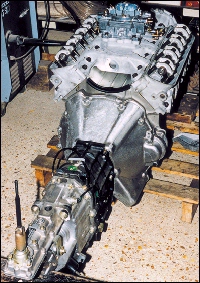
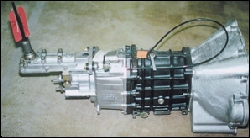
There are three choices for gearbox which are suitable for this conversion and the cheapest of these options is to use a second hand recondition Rover SD1 Gearbox which should be fine for the lower power option engines. The next option is to use a new Rover R380 gearbox which is still widely used in Range Rover, Jaguar and other vehicle applications. It is ideally suited as this was used at the latter end of the RV8 production, having replaced the LT77 gearbox . The ratios are ideally suited to high torque engines and in fifth gear the car will travel at approximately 30mph. per 1,000 revs making cruising at the national maximum speed limit a leisurely 2,300 revs. There is sufficient strength in the gearbox to support the power of the 4.6 litre Stage 2 engine and this unit is the preferred choice for the project car. Remember to use an SD1 spigot bush in the end of the crankshaft to match the input shaft of the new gearbox.
There is one further gearbox worthy of mention, namely the Borg Warner T5 gearbox which is an American built unit used widely in high powered V8s. It is stronger than the R380 and is suitable for use in excess of 300bhp,but has the disadvantage of requiring a special bell housing which is currently not readily available. Similarly the gearbox itself is more expensive new and not easy to obtain as a quality reconditioned part. So for these reasons, unless you specifically plan to fit a monster engine, or are being offered such a gearbox and bell housing at similar cost to the R380, it is not a practical alternative.
The Rear Axle
Taking all that power to the road wheels needs an axle which is both strong and able to cope with the occasional loss of grip on one wheel under fast cornering conditions. As virtually no one will have an original MGB V8 axle to use as a donor exchange part, the solution is to use either a Salisbury (or tube type axle as it is sometimes known). Have this reconditioned to include a new V8 crown wheel and pinion plus a Quaife Limited Slip Differential. This effectively gives you an all new unit, as the LSD replaces the carrier and sun & planet gears, and the new 3.07 to 1 ratio crown wheel and pinion provides the correct drive ratio in new form. A less expensive alternative is to use a reconditioned Salisbury axle including a new crown wheel and pinion, and with a modified carrier to house the sun and planet gears. Given the amount of power available at the wheels, the use of a limited slip diff. is highly recommended.
Consider also that by using a wire wheel axle if possible, you will be gaining approximately an extra 25mm of wheel offset by then using either adaptor type wire wheel hubs (which are narrower than standard if using wire wheels), or standard steel wheel hubs if steel wheels are to be used. By then choosing wheels measured to fill the wheel arches to their sensible maximum, our wheel size specification using a wire wheel axle and steel wheel hubs allows for the fitment of 7 1/2 in X 17 in. wheel rims all round and 215/ 45 X 17 in. Z Rated low profile tyres. The rear wheel rims will feature an additional 13mm outset to give the appearance of greater rim width at the rear.
The Prop. Shaft
Once the engine, gearbox and axle are installed, a made to measure propshaft can be ordered at not much more than the cost of a standard replacement part, and this will not only fit straight in, but be built to take account of whatever power output your specification requires.
For details of any of the products used in this project please contact MG Ownersí Spares Department on 01223 230928
Next month we will take a look at the suspension all round, and the braking system.