Changing Times – CVT MGF

 |
We have all sat in front of our televisions on Sunday afternoons watching the Grand Prix drivers shifting up and down with their steering wheel paddles. Instantaneous changes – or drive by wire, as it has been dubbed – is something that is a fascinating concept and now that MG has followed the growing move towards CVT transmissions, it is something which we can all experience. |
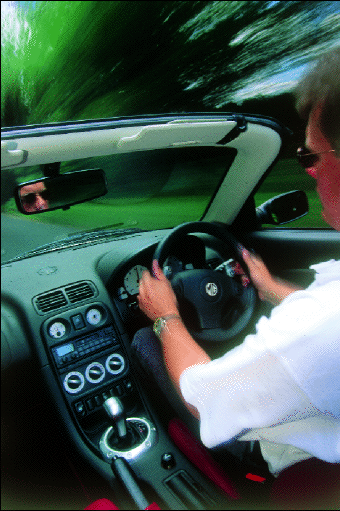
There will always be diehards who will argue that any form of automatic transmission for a sports car is a contradiction in terms and that the legendary four-on-the-floor is the only way to go. But they would be forgetting such advances as the preselector gearbox, which helped make the MG K3 so competitive, the overdrive fitted to countless MGBs and Cs and the automatic gearboxes that made the MGC an even more relaxed long distance cruiser. And no-one will devalue the Mercedes-Benz SL and SLK for being automatics, while Porsche with its Tiptronic transmission has added enormously to the sports car driving experience.
Continuously Variable Transmission technologies are very much the significant motoring advances of the last years of the century, the primary reason being increasingly sophisticated electronic control systems, which have transformed the functionality and performance of the traditional automatic gearbox. Combining this with CVT, has produced a transmission that is both technically innovative and a pleasure to drive.
MG transmission engineers have worked with transmission supplier ZFST of Belgium to produce what is surely the most innovative gearbox seen on a production car and it provides the driver with a variety of options that may be readily selected to meet road conditions or driving mood.
What do you get with the Steptronic MGF? For a start, it is based around the MGF 1.8i – it is unavailable on the VVC. MG claim that the MGF Steptronic is the first sports car to give the option of either automatic transmission, ideal for congested urban use, or a six-speed manual sequential gear change for optimised sporting performance. There are two modes to the automatic, Drive and Sport, while in the Steptronic mode gear changing is either by the conventionally positioned gear lever or shift stick, or by the steering wheel mounted controls. In Steptronic mode there are six pre-set ratios on the CVT (continuously variable transmission).
How the three Steptronic modes operate
The first thing to say about the Steptronic system is that it is totally driver-friendly. Anyone approaching it for the first time need have no worries whatsoever. So, having settled into the cockpit, what are the changes and mode of operation?
 This is a two-pedal car, the brake being large in terms of the normal manual transmission car. The foot rest on the transmission tunnel remains and this is the position for the now redundant clutch foot. The Steptronic gear lever provides a normal CVT automatic selector pattern of PRND (Park, Reverse, Neutral and Drive). If D is selected, the transmission operates in the normal automatic mode, with the ratios adjusted to keep engine revs below 4,500rpm at road speeds under 70mph. Above this figure, the transmission will employ engine speeds in the 4,500-5,000 rpm band. This combination provides relaxed and economical driving in even the most congested traffic.
For greater performance, the lever is moved left from its Drive position into Sport CVT mode. Once this has been carried out, the peak engine power speed of 5,500rpm becomes available and this transforms the character of the car by providing maximum acceleration, because the engine can be held at peak power, while the gearing is progressively increased.
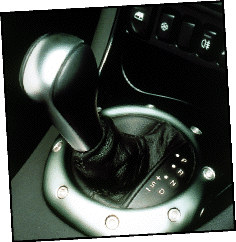 |
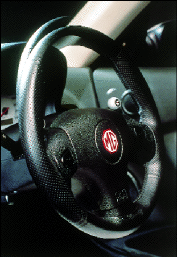
To drive the car in ‘Manual’ mode, this is achieved by moving the gearlever, or one of the two steering wheel buttons. For both the gearlever and steering wheel controls, the method is the same, namely: forward for an upshift and rearward for a downshift. The driver is then able to select from the six gears available, in exactly the same way as a six-speed gearbox. The system permits the use of engine speeds of 5,500-6,000 rpm. Although there was considerable debate at MG over whether the two buttons should each have a single function, it was decided that it would be preferable for both to have that ability to change up or down, leaving the driver to decide whether he or she was more comfortable with the left or right. To change from the manual or CVT Sport mode back to the normal CVT, the driver simply moves the lever back to the right, to assume the PRND plane. For safety reasons, the car will only start in the Park or Neutral settings, so the initial star-up is always in CVT mode. In front of the driver there is an LCD display in the instrument panel. This shows which mode has been selected. D or D Sport is shown for the CVT modes, while the numbers 1-6 are shown in the manual mode. LED indicators light up on the base of the floor gearshift to confirm selection of either the P, R, N or D positions, or the M/S Manual or Sport settings. |
On the road
Inevitably, moving from a manual transmission car to the Steptronic MGF is something of a radical departure. So it is best to think of it initially, as a conventional automatic. Because the power is delivered constantly and the gear changes occur in stepless fashion, this is the most effortless way to enjoy this new MGF derivative.
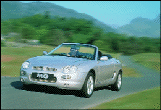 Move the lever across what would be the gate in a conventional gearbox, select Sport mode and there is a dramatic change of character. The entire car becomes more alive, urging the driver to exploit the performance to the full, certain in the knowledge that all worries about being in the right gear at the right time have been taken care of. On a road that a driver does not know, the MGF in this mode allows full concentration on position, braking points and observation and it is a highly rewarding – and quick -method of progress.
Having tried the car in both the CVT modes it is time to really utilise the Manual mode of the transmission. With fingertip control, it is a matter of simplicity to go up and down the six speeds at will, enjoying the transmission to the full or honing driving technique to perfection. But quite apart from playing at being an F1 or BTCC driver, there are very definite benefits from the manual mode. Being able to change gear while keeping both hands on the wheel can be an additional safety feature on an unknown road, particularly if a corner suddenly tightens or a gradient changes on a mountain pass, for example. Or, in the case of driving the car on a snowy slope, being able to go down through the gears utilising the engine braking while maintaining full steering control and without touching the brakes, can literally be a lifesaver.
How quick is the MGF Steptronic? The table will show that in terms of figures, it is slower than the standard MGF in both top speed and 0-60mph acceleration times. But in the real world of driving, the MGF Steptronic feels exactly the opposite. Because the power is constantly on tap, progress on any drive, particularly across country, is remarkably rapid and it was the opinion of several drivers who were at the wheel for considerable distances, that it was probably quicker over the ground than its manual counterpart. In terms of economy, the MGF Steptronic suffers slightly in relation to its standard brother. But choosing the mode for the conditions, standard automatic for the motorway haul, for example, will see this minimised.
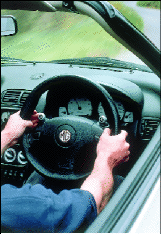
Could you live with the MGF Steptronic? There is one infallible answer and that is to drive it. You will discover that it is not only enormous fun but that it adds an entire new perspective to the MGF. When the car was launched back in 1995, everyone who drove it regarded it as redefining the sports car experience and with the new MGF Steptronic, the game has moved forward in a giant leap. That is not to say that everyone will want to choose this version of the MGF – for ultimate performance, the VVC will remain the choice. And there will be some who will want to stay with the manual MGF 1.8i. For both of these groups, MG will continue to cater.
What the MGF Steptronic undoubtedly does is to further widen the appeal of the MG marque, notably to those who might never have considered a manual sports car for their driving pattern, a slow urban commute being a case in point. It will also gain even greater appeal as a second or third car in a family environment, being equally suitable for both established and those less experienced drivers. Those who take a test drive when the MGF reaches the showrooms in October this year will find it difficult not to be impressed.
| MGF STEPTRONIC– Performance and Economy | ||
| MGF 1.8i | Manual | Steptronic |
| Performance | ||
| Maximum Speed | 193kph/120mph | 190kph/118mph |
| 0-100kph/0-60mph | 9.0/8.5 seconds | 10.0/9.5 seconds |
| Fuel Consumption | ||
| Urban | 10.2 litres/100km/27.8mpg | 11.6 litres/100km/24.4mpg |
| Extra Urban | 5.7 litres/100km/49.3mpg | 6.4 litres/100km/43.9mpg |
| Combined | 7.4 litres/100km/38.3mpg | 8.3 litres/100km/34.0mpg |
Changes for 2000 Model Year MGF Include 3 Year Warranty
As the MGF completes its fourth year of production at Longbridge, MG Cars have announced a number of significant changes to the MGF, not the least of which is the introduction of the three-year warranty. This has no limitations on mileage or items covered in the first year, while the second and third years of ownership are protected by a dealer-backed warranty up to 60,000 miles.
While the basic outline of the car remains unchanged, testimony to the rightness of the original design, the introduction of the Steptronic transmission is seen as a major step. All models benefit from a number of standard changes, many of which clearly differentiate the 2000 year models from their predecessors:
Exterior
The windscreen surround is now in body-colours, rather than black. Smoked indicator lenses are now fitted to front and side. Three new alloy wheel designs, each fitted as standard equipment, have been introduced for each of the MGF models. For the 1.8i, there is a 15″, 8-spoke alloy wheel, reminiscent of the ‘Minilite’ style, for the Steptronic there is a 15″ square six-spoke and a similar 16″ version for the VVC.
Two new paint colours, Alumina Green and Sienna Gold, will be introduced during Autumn 1999. They join a range of seven existing paint colours, the most popular of which is a new version of British Racing Green, followed by Tahiti Blue, Platinum Silver, Solar Red, Nightfire Red, Anthracite, and Old English White.
Interior
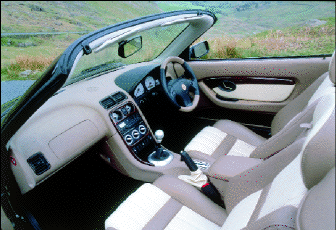
There are major changes to the interior, one of the most welcome and frequently requested features being an adjustable height steering column and leather steering wheel. New sculptured seats are fitted, with a new full range of trim choice, which includes an optional, no-cost Walnut facia as an alternative to Ash. The other most noticeable change is the new Silver instrumentation which replaces Ivory. Following this theme are new heater controls and centre console design. A new alloy gearknob and a detailed surround, inspired by the unique fuel cap design, is fitted and this is complemented by brushed aluminium finishers, incorporated into redesigned door case panels.
Careful consideration has been given to customer and media feedback on the cockpit of the standard car and the 2000 model year vehicles will have one-shot down electric window operation on the driver’s window, and electric adjustable heated door mirrors. A high specification audio system featuring ICT and six speakers, is now standard on all models. There is a wide range of interior trim options.
Passive immobilisation with intelligent passive re-mobilisation replaces the existing system, which re-armed frustratingly quickly. Also from a security standpoint, a tamper-proof electronic odometer/trip with LCD display, is fitted. The speedometer similarly becomes electronic, replacing the previous cable-driven unit.
Mechanical
All cars are now fitted with a revised form of EPAS (Electronic Power Assisted Steering) which provides improved steering feel and responsiveness, better straight line stability and more positive steering wheel self-return to straight ahead during low speed manoeuvring. For cars fitted with ABS – standard on the 1.8i Steptronic and 1.8iVVC and optional on the standard 1.8i, the system used is the latest 5.3 from Bosch.
Accessories
A range of over 60 approved accessories is now available for the MGF, reflecting the growing demand of owners to personalise their cars. Notable among the introductions for the 2000 model year is a power hood, allowing the driver the option of raising or lowering the hood, when the car is stationary, without moving from the cockpit. As an alternative, there is a classically designed tonneau cover for a more traditional style of sports car motoring. A bright grille set is now available, together with large bore bright chrome exhaust finishers, while a sporty rear spoiler also joins the range.
On the interior, there is a wide range of accessories to complement the many leather options. They include bespoke gear knobs, handbrake grips and centre console sets, in Silver, Carbon Fibre and wood. ICE includes a 6-disk CD autochanger. Other accessories listed include Cruise Control and Heated Washer Jets.
PRICING
The current on-the-road prices for the MGF range are as follows:
| Car | Price |
| MGF 1.8i | £18,270 |
| MGF 1.8i Steptronic | £20,170 |
| MGF 1.8i VVC | £20,999 |