A Lost Art
A Lost Art
Now that BMW has decreed that MG will not make any more saloons have we lost something?
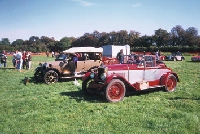
Bull-Nose Morris Oxford and Flat-Nose MG 14/40. Both using the same chassis, the two-tone MG looks lower and longer
The Two -Tone MG
MGs were always a little flamboyant, one up on the rest, looking like they are going very fast whilst in fact standing still: simply a good looking motor car. The style of MG with Kimber’s hand, was nearly always eye catching and often on the edge of art itself. The word ‘sports-car’ could almost have meant MG, had it not been for a few other car makers copying and sometimes trying to improve on, the flowing lines of the smart pre-war two seaters.
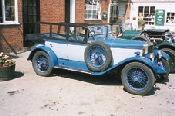 A four seater MG 14/40 two-tone paint used to both lower and lengthen it |
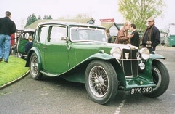 MG Magnette saloon in two-tone green, the wings are a darker shade MG Magnette saloon in two-tone green, the wings are a darker shade |
The company also sold sporting saloons, everyone knows the first models were improved Morris models. It was not long before the saloon bodywork showed that trade mark of MG, the use of two coloured paintwork. Two contrasting or complimentary paint colours would be used to “lengthen and lower” the car. This was felt necessary because of the use of a modified Morris chassis, and rather tall bodies. At first it was the aluminium body of the Bull Nose models, that gained a painted ‘top-half’, above what we now term the waist-line. The use of steel panels in the bodies as time passed, meant paint had to be used to protect it from corrosion. The flat-nose MG on the later Morris chassis, also sported the two colour scheme. MG used the two colours very cleverly here.
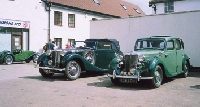
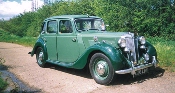
MG VA saloon all dark green, with the following model, a Y, in two greens
Morris had for some time used black wings on its cars, easily done as the wings were sprayed separate to the bodies, prior to being fitted. This way it was easy to build up a car with two colours, you just bolted the chosen wings on. MG followed a similar system. ‘K’ Magnettes in saloon form, could be had sporting bodies and wings of two differing colours. The two-seater MG models were sometimes also sold in two colours, but most often a single one. Again this was to ‘lower’ the car in the beholders eye. There was little bodywork on a sports-car to show off anyway. A saloon lends itself to ‘pretty paintwork’. The elegant pre-war SWV range of saloons that followed the Magnettes, were themselves followed after the was by the ‘Y’ type.
MG continued its two-tone paint system on saloons after WW2. The ‘Y’ types had wings and running boards in one colour, the body another. Again, these were painted prior to fitting, so in theory at least you could have quite a choice of mixtures. The later ‘YB’ was only sold as a single colour normally, and is one quick way of telling a YA from a YB. The ‘Y’ body creasing lends itself to two-tones, and quite a few owners have had their cars painted using the waistline. The maroon and cream car shows this and it both lowers and lengthens the car, but is no standard. Compare this to the two tone green version in standard trim.
 The standard colour-split from MG of a Y type saloon, using wings and running boards |
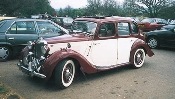 Personalised two-tone colour scheme of a Y type. It looks a much bigger and longer car! Personalised two-tone colour scheme of a Y type. It looks a much bigger and longer car! |
The ‘Y’ led to the ‘Z’ Magnettes in the early 1950s and for a while the “two-tone” paintwork was shelved. But not for long as when the ZB ‘Varitone’ arrived, there was the waistline of the car, with one colour above and another below. With a larger rear window and a stainless steel trim full length, the car looked both lower and longer than the ZA or ZB. It is all in the eye however, a trick of the stylist. The similar Wolseley 15/50 looked very ‘upright and staid’ compared to the ‘long-low’ ZB Varitone. In fact there was only two inches difference in height. The names given to the paintwork varied from a simple ‘two-tone’, to ‘duo-tone’, to a posh ‘varitone’.
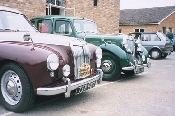 TY type gave way to the Z saloons. At first in single colours, but the ZB Varitone used two. |
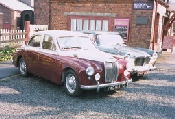 The ZB Varitone looking low and fast, was followed by the Farina The ZB Varitone looking low and fast, was followed by the Farina |
The Z models were followed by the Farinas, virtually all two-tone. BMC tried hard make the Mk3 and MK4 differ from the other Farinas and to some extent the two colours do suit the design. The 1100 and 1300 front wheel drive cars were available in two colours, split at the waist. This made an already low model look even sleeker. Of course single colours could be had and both Farina, 1100 and 1300 were often seen in red, as were many MGBs and Midgets.
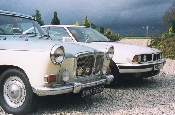
BMW decrees that MG will not make any more saloons
Using two paint colours was a sign of an upmarket car. On a Mk3 Magnette it cost £12.50 extra, 1.2% of the full price. It also permitted more variations of one shell, as on the ‘Z’ Magnettes. after all there was no mechanical difference between a ZB or a ZB Varitone, or a single or duo-tone MG 1300. The saloon models that followed in the 1980s were sold in single colours, as the MG Metro, Maestro and Montego. It had been said that to introduce such colour schemes into mass production was complex and too expensive, so we find stick-on ‘decals’ now take over. This is not the same though as an art form has been lost.
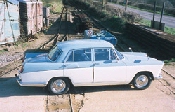 The Italian Pinin Farina styling is sharp and angular, but lends itself to two-tone colour schemes. Long and low with pale colours to reduce its bulk |
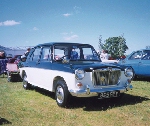 The MG 1100/1300 last use of two colours. It works well using the full length swage line; long, low, fast and sleek |
Now there are no more MG saloons, the two-tone, cheerful, good-looking model has gone. The ‘GRACE’ part of the MG ‘Grace, Space and Pace’ motto has died.
Neil Cairns