MG RV8 Super Sports
When the MG RV8 was launched there was much hype and general approval that Rover had recalled the MG name on a proper two seater sports car. After the euphoria had died down the motoring press were often less kind about the vehicle’s performance and handling although they were delighted to see the marque return.
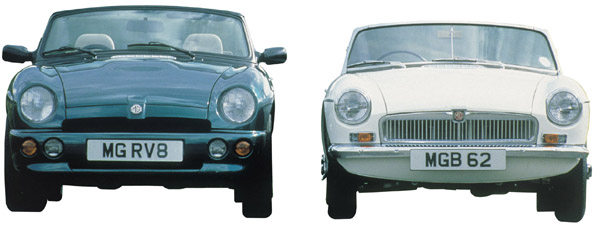
I am sure that many of the motoring journalists failed to read the Rover press package which clearly stated that the MG RV8 was a celebration of the 30th anniversary of the launch of the MGB and was one idea of how the MGB might have developed had production continued. The MG RV8 was not a new MG for the nineties, this honour was to befall the celebrated MGF which is a modern sports car for the millennium and beyond. The RV8 was to gauge the market and to illustrate the transition of the MG name from the saloons, Maestro and Montego, back to sports cars and to this aim it was very successful.
On the launch of the RV8 I was disappointed by its specification considering the resources Rover had at their disposal. However, the one thing I could not criticise was its appearance as I thought they were “spot on” at transforming the MGB into an aggressive and purposeful sports car. However after a factory visit and a road test I could not help feeling that an opportunity to produce a car to rival the TVRs and others had been lost.
Maidstone Sports Cars’ association with V8 conversions and performance parts goes back a long time with many of their vehicles being featured on Top Gear and in various national publications. It was inevitable that MSC should build their own MG RV8, featuring their own in-house designed features. Plans were developed to build the ultimate V8 roadster incorporating every improvement possible.
The first task was to source the appropriate bodyshel. An American rust free bodyshell was purchased. This was fitted in a revolving jig, shot blasted and primed. The RV8 panels were purchased from Rover and the mammoth task of rebuilding the body began.
| The rear wings, rear outer arches, boot corner panels and outer sills were removed, a laborious task of unpicking hundreds of spot welds. New doors were fitted and all panels aligned to ensure good gaps. The new rear wings, wheel arches and sills were then welded on. A standard boot lid was fitted to counteract the complaint of no boot catch on the RV8. In the engine compartment two holes were cut through the inner wings and reinforced for the exhaust manifold exits. An oil filter housing bracket was fabricated and this and other necessary modifications fitted. | |
| To make the RV8 look different it was decided to louvre the bonnet and these louvres were duly pressed in.
With bodyshell on the revolving jig the underside modifications could be easily carried out. Extra strengthening of the floor was required to prevent the damage which can be caused by the power of the V8 engine trying to pull the spring hangers out. A box section was fitted from the centre cross member to the spring hangers. This modification really strengthens the floors and is a great jacking point. As we had decided to fuel inject the car this was the ideal time to fabricate all the injection pump and filter mounts. When the RV8 was launched we could not believe that Rover still used leaf springs and anti-tramp bar rear suspension. This is antiquated and dates back to the horse and cart and to think that Land Rover ditched leaf springs in 1984. |
 |
At MSC we had been developing a rear suspension design for MGBs for some time and here we were building a car that cried out for a modern approach. Obviously from our point of view any system we developed had to be able to be marketed at a later stage, preferably in kit form and utilising many standard parts.
| The design that met these criteria featured four radius arms with the bottom two mounted through the old spring hanger mounts and the upper two mounted through or own fabricated mounts welded to the heel board; a Panhard rod mounted to our own Panhard rod tower carefully welded to the rear chassis; two coil springs fitted between the chassis bump stops and the axle and two Koni shock absorbers mounted to the chassis leg and axle. Obviously the standard MG axle is heavily modified with all its existing brackets cut off and replaced with new fabricated brackets welded on while in our jig. All these parts were subsequently shot blasted and powder coated. | 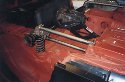 Neat modification to rear spring hangers allow rear axle to be fitted with coil suspension Neat modification to rear spring hangers allow rear axle to be fitted with coil suspension |
The axle was then rebuilt with a 3.071: 1 axle ratio and a Quaife Limited Slip Differential. Work on the axle did not stop there because at this stage the axle was converted to rear disc brakes, This was relatively straightforward using stock discs needing only minor machining and a pair of modern callipers incorporating handbrake. Brackets were fabricated and fitted and a pair of handbrake cables and linkages connected.
By comparison the front suspension and brakes were relatively simple using the Moss coil over system and our own softer front springs of 400lbs/ft. We always feel that most suspensions are set up far too hard and that comfort is as equally important as the ability to fly around corners at 100 mph. To allow the anti-roll bar to clear the engine pulley the bar was modified into RV8 style. The front brakes fitted were our usual mixture of aluminium four pot callipers and large 10.75in ventilated discs. All components were shot blasted and powder coated and all the bushes were polyurethane.
At this stage with all the suspension systems worked out, our attention returned to the body shell. All the welds and seams were sealed with Sikaflex, a wonderful modern sealer which doesn’t shrink, can be painted over and is good enough to make an MG float.
The difficult decision on paint colour was next on the list. We needed something that would enhance the contours of the RV8 but one which was different from the normal colours used. The final choice was BMW Caribbean Blue, a modern pearlescent paint. The whole shell was painted in two pack baked in a low oven and finish was up to MSC’s usual high standard.
The shell was kept on the revolving jig and the slow build up began. The brake lines, fuel lines and wiring looms were installed while the vehicle was upside down. The suspension systems went on next, an easier task with the vehicle in this position. Fuel tank injection pumps and filters were then added before the vehicle was revolved and taken off the frame and placed on the ground for the first time. It looked rather silly sitting on 14 inch Rostyle wheels which were totally lost inside the massive wheel arches.
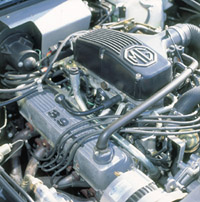
Our attention now centred on the power train. With the RV8 having only 188 bhp we decided that a more powerful and smoother unit was required. starting with a base 3.9 litre V8 engine we stripped it and then carefully rebuilt utilising high compression 9.75:1 pistons and a RC 87 camshaft. The engine was fully balanced and lightened with much weight being removed from the flywheel. Both cylinder heads were reworked with larger valves, the ports were matched and flowed. We were lucky to secure a brand new Lucas Hot Wire fuel injection system which was duly fitted but not before having a super chip installed in the engine management system. The above took the engine power up to 250bhp, all on unleaded fuel. There being a sizeable increase in power without stressing the engine and making it unreliable.
Cooling was taken care of using an RV8 radiator and cooling fan. A very efficient system that does not need the supplement of an oil cooler. The cooling fan covers the entire rear surface of the radiator and when switched on it’s cooling ability is phenomenal and with the added benefit of the louvres to let the heat escape, boiled up V8s are a thing of the past. The use of modern oils should ensure that all runs well for years to come. We prefer Castrol fully synthetic, expensive but even in a V8 should last 12,000 miles and still keep the engine spotlessly clean. Please Note. Never use synthetic oil to run in your engine, it is far too slippery and will not work.
The gearbox was a late model LT 77 incorporating bigger bearings, input shafts and improved oil seals. The gearbox had only covered 700 miles and was from an RV8 development car.
The engine and gearbox were fitted utilising our own engine mounts. The RV8 style manifolds were next. These were copied from the original and incidentally are now available from Maidstone Sports Cars at a fraction of the cost of the originals. These unleash approximately another 10 bhp and really help to lower underbonnet temperatures, a problem most rubber bumper V8s have suffered. Please Note. If you are fitting V8 style manifolds , fit them into the inner wing exit holes before fitting the engine and gearbox ( you won’t get them in afterwards). The manifolds were then mated to our exhaust system to an exhaust note more akin to a TVR. Another improvement over the RV8, which sounds anaemic by comparison.
Plumbing in the fuel injection system is relatively straightforward as the wiring codes all match and in fact only need four wiring connections between the injection loom and the standard ‘B’ loom. Obviously more connections for the sensors ie engine temperature, cooling fan, controls etc, are all needed but perhaps because we have done so many we are becoming ‘blasé’. Wiring in a heavy duty fused wire for the fuel pump is a sensible modification and a very good security device because if you remove the fuse the vehicle is dead.
New standard MGB wiring looms were fitted. It’s just not worth the risk with old wiring. Standard RV8 light units were purchased from Rover and were fairly easy to wire in using brass bullet connections. The front headlights are the same as the same as Porsche 911 units and available from various sources at a fraction of the Rover or Porsche price. The front indicators and fog lights have to be fitted in the bumper before being fitted to the car and again the rear fog lights and number plates must be fitted
Bumper fitting is simple with adjustments available so as to ensure good alignment. Grille and headlight surrounds are also adjustable.
Doors were built using a RV8 door glass and modified MGB window winders and runners. Door mirrors were sourced from a Metro. Door and hood trims were genuine RV8, as was the windscreen surround and glass and associated rubbers. Door locks were again from the Metro.
The interior was to be a challenge as we wanted a sporting modern look. We decided that we could improve the instruments by following the modern trend of white faced dials. This was done by photographing the dial and printing the negative. The result was stunning and set the trend for the interior. The instruments were recalibrated. The dashboard, door cappings and console were to be made in carbon fibre, a modern material found in many sports cars. A pair of Classic leather seats in biscuit colour were purchased and the interior set was made to match. Our trimmer made a high quality wool carpet set including the lower edges of the trim panel set. The centre console was then covered in leather as were a pair of Vauxhall Nova arm rests and connelised to match the interior trim. Behind the seats we fitted a high ridge shelf which was trimmed to match. This allows items to be stored on the rear shelf without falling off and going behind the seats. A finishing touch was an RV8 steering wheel and a large carbon fibre gear stick knob. A standard RV8 hood was fitted, this being a far superior item giving more interior space and a water tight seal. 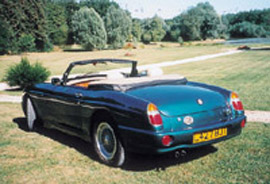 |
 |
To keep the modern theme a ten CD Auto changer was fitted into the lined and carpeted boot compartment. A simple remote central locking system was installed which made the door locks redundant.
The wheels and tyres were given much thought. We wanted a wheel which would show off the all round disc brakes and five link rear suspension yet would also add to the aesthetic look of the vehicle. We chose an upsize wheel of 7×16 inch utilising a Pirelli 6000 225/55 ZR tyres. By using this profile the rolling radius remains the same as the standard RV8 on 15 inch wheels. A space saver was fitted and this doubles the available boot space.
So there we have it, a vehicle that looks substantially standard on the outside, apart from subtle improvements, but is totally unique underneath and far more technically advanced than a standard RV8.
| The RV8 Super sports has a lot of road presence. It feels good, it looks good and boy does it go! Reaction to the car on the road is very pleasing. With 205 bhp on tap performance is exhilarating yet delivered smoothly, fuel injection with and full engine balance does make a difference, but it is the way the power is transferred to the road with superb axle location and improved suspension travel so that axle tramp and axle jumping are a thing of the past. Grip and traction levels are fantastic and the car achieves comfort levels unheard of for an MGB and are fully adjustable. Braking is excellent and beautifully balanced with no brake fade. No more leaking brake cylinders and no more creeping with the handbrake applied. |  |
Our original aim to build an RV8 to a modern specification has succeeded and in fact we have created our own model “RV8 Super Sport.” A vehicle which takes the basics and brings them up to modern standards of performance, handling, braking and road holding but with modern amenities. I’m sure if Rover had developed along these lines they would still be producing the RV8 as an alternative to other marques instead of leaving it as a retro machine.
The advantage of the work we have done is that nearly everything we have developed can be fitted to the standard MGB. Of course our RV8 is the ideal mobile advert, a vehicle demonstrating just about everything that can be done to an MGB and I can think of no better fun way of advertising the abilities of Maidstone Sports Cars.
So if you are interested in V8 conversions, rear disc brakes, five link suspension sets or just MGs in general call us at Maidstone Sports Cars on 01622 890233
A M Marsh
Maidstone Sports Cars