THE FLAT RADIATOR 14/28 and 14/40 MGs
THE FLAT RADIATOR 14/28 and 14/40 MGs
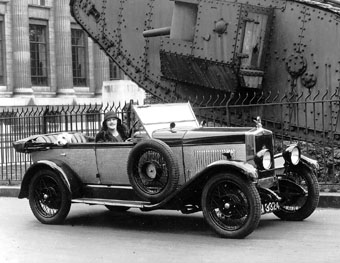
| The easily recognizable rounded Morris radiator had been used by William Morris for his cars since he first started making them in 1913. A car fitted with one of these was referred to as “D-fronted” in the Morris literature of the time, but has since become universally called a “Bullnose Morris”. The first MGs carried this rounded radiator and it complemented the elegant lines of the special coachwork they wore. These early cars, in either open or closed form, had beautifully balanced proportions, with the lowered chassis and rakish coachwork combining to produced a classic vintage touring car. | Whilst not having the elegance of the bullnose cars, the 14/28 with the flat radiator was still a good-looking car. Here a four-seater tourer is posed against a First World War memorial, an early tank. One should remember that the huge losses suffered by troops serving in the trenches in that conflict were still having a profound effect on Britain in the 1920s. |
Towards the end of 1926 the Morris Oxford, on which the early 14/28 MGs had been based, was radically redesigned. It must have come as something of a shock to the thousands of Morris owners around the world to find that the most recognizable feature of their car, the bullnose radiator, was to be consigned to history. Pity those who had bought a brand new Morris Oxford or Cowley just before the launch of the new model made them obsolete overnight; they could not have been overjoyed at the prospect of now having a car that was so recognizably outdated. Apparently, some wrote to the company to complain that they should have been told of the change before they bought their cars – they did not get their money back!
| The revised Morris Oxford and Morris Cowley, in line with then current practice, were called 1927 models from their launch in the autumn of 1926. The Morris Oxford chassis was extensively redesigned and was wider, shorter and much heavier than its predecessor. The distinctive three-quarter elliptical rear springs used on the earlier cars gave way to more conventional semi-elliptics, and the rear of the chassis was upswept to accommodate them. The strengthening work extended to providing a more substantial mounting for the scuttle and the seven-gallon petrol tank mounted there. A pressed-steel facia board which incorporated provision to adjust the rake of the steering column was fitted; the driver was now being provided with a four-spoke steering wheel. Four-stud, pressed steel artillery wheels were used. | The engine, gearbox and back axle came from the earlier model, unmodified. The braking system was slightly redesigned for mounting on the new chassis; there was now a tubular cross-shaft to transfer the braking effort from the pedal to the rods operating the brake shoes which were duplicated for the rear drums, the second set being operated by the handbrake lever. Wing nuts on the ends of the rods provided adjustment. At the front, the new, wider radiator changed the appearance of the car, requiring that the bodywork be adapted to suit. The Morris Oxford was now available with three open body styles – two- and four-seater tourers and a coup – and as a saloon, cabriolet and saloon landaulette. On this model the portion of roof above the rear seats could be opened to give the passengers travelling there a taste of fresh air. |
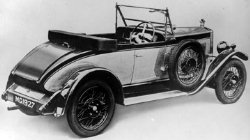 A two-seater 14/28. The rear compartment could seat an extra passenger, or carry a reasonable quantity of luggage when touring. |
At this point we should spare a thought for Cecil Kimber, the General Manager of The Morris Garages at that time, who must have viewed the prospect of the new Morris with some misgivings. The MG Super Sports, based on the old Bullnose Morris Oxford chassis, had, in a few short years, built up a reputation as a sporting car in its own right and established The Morris Garages name in the minds of enthusiasts. Now all this was jeopardized by the arrival of a chassis that offered the advantage of added strength, but the distinct disadvantage for a sporting car of extra weight without any more power. In addition, the wider radiator did nothing to enhance the look of the car, so important when the MG had been sold as much on style as performance. |
| Twenty-one-year-old actress and film star, Madeleine Carroll with her 1927 14/28 Salonette. Note that this car carries two spare wheels – always a wise precaution in an age when punctures were a common occurrence. | 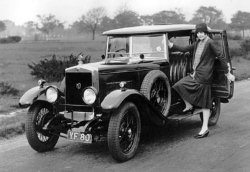 |
Modifying the 1927 chassis to improve its handling, and designing new bodies to fit it, caused Kimber a number of problems and he resorted to asking for assistance from a young engineering graduate, H.N. Charles – who was later to pay a large part in the success of the company throughout the 1930s. He persuaded Charles to join his team at the part of the Bainton Road radiator factory leased to Morris Garages for car production. Working largely in the evenings and at weekends, they tried to sort out what would be required in the way of modifications to the chassis, and to the styling of the bodywork, in order to get the MG range back into production as soon as possible. Long periods were spent working on sketches trying to adapt the body styles to suit the flat radiator, with Kimber’s wife helping with ideas.
In September 1926, an advertisement in “The Morris Owner”, the company house magazine, announced that “1927 models of the now famous M.G. Super Sports will be even more complete and interesting than before. Full details will be available shortly. A postcard with your name and address will ensure your receiving the earliest information.” As only a rather inaccurate sketch of the proposed new cars accompanied this announcement, one can presume that development work was still ongoing!
With the important London Motor Show at Olympia a mere few weeks ahead, the pace of work at Bainton Road must have been hectic. By the time the show took place new cars had been developed, and an advertisement in “The Motor” magazine for 26th October 1926 invited those attending the show to visit the display of 1927 MG Super Sports Models staged at a nearby garage. Shortage of space at Olympia (or the high cost of renting a stand?) meant that MG representation within the exhibition was limited to a single salesman based on the Morris stand, wearing an MG badge. The cars were a ten-minute walk away at Parfitt’s Garage, reached by crossing the railway tracks outside the main hall by means of the station footbridge.
The new 1927 MG models put into production featured a number of chassis and brake modifications in an effort to improve on the Morris chassis. As the cars were to carry lightweight sporting bodywork, the springs were flattened to reduce the ground clearance of the chassis in an endeavour to improve the handling. A vacuum servo mechanism and a modified cross shaft were fitted to the braking system, although the complex system of brake operating rods was retained for the time being. The Morris Oxford 13.9hp engines were stripped, balanced, polished and fitted with stronger valve springs to improve performance, and a modified dash panel and altered steering column rake helped make the driver feel more comfortable. A “straight through” silencer aided performance and added to the sporting appeal of the car but must not have endeared owners to the police who had to enforce the then current regulations that insisted on adequate silencer baffles. The rear axle was fitted with a higher ratio and five-stud hubs were fitted with bolt-on wire wheels carrying balloon tyres.
| In spite of the difficulties faced by Kimber and his team, the 1927 MGs still possessed that element of style that set them apart from the standard Morris products. The range of body styles for the new “Super Sports” was essentially as previously available on the bullnose cars, with some exceptions. There were two- and four-seater open tourers and salonette models – again with either two or four seats – listed in the catalogue issued for the 1926 Motor Show. The previously-available heavy four-door cars being no longer offered. An advertisement running in the show issue of “The Motor” carried the slogan “The car that takes the ills out of hills” and said that the new models were more attractive in both appearance and specification to the previous cars. The virtues of the greater cooling area of the new radiator were emphasized and it was also said that it gave the car “better body lines” – stretching the truth somewhat! | 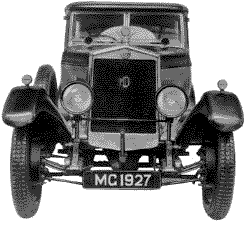 A head-on view of a salonette reveals that at that time the radiator still carried the ordinary Morris Oxford badge, but the MG octagon appeared prominently on the radiator core. |
The other changes, the Rene Thomas four-spoke steering wheel, the right-hand accelerator pedal, the rigidly-attached dashboard and the chassis modifications, were emphasized. The rather odd catalogue issued for the show carried the same “ills out of hills” slogan and illustrated the new cars by means of a set of drawings by artist, Eustace Nash. He elongated the cars somewhat, whilst failing to depict them at all accurately. What was shown, however, was the large, octagonal MG emblem on the front of the radiator core, a further statement of the separate identity of the marque. However, the catalogue did carry the statement that “The M.G. is a W.R. Morris Production”, in deference to the owner of The Morris Garages. In truth, because all the new models were heavier than the previous cars and did not look as good, buyers were likely to find that they had purchased a car that was not quite as fast or sporting as they might have expected. Undoubtedly, many were sold on the strength of the reputation built up by the bullnose cars but, with the open cars costing £340 and £350 for the two- and four-seater models respectively, they did not quite possess the advantages over other, cheaper cars the prices charged would suggest.
However, the road tests of the period convey little of this with the article carried in “Motor Sport” for May 1927 describing the two-seater they tried as “..one of the most delightful little motor cars it has been our lot to try for many moons”. They described also a visit to the showrooms to inspect the rest of the MG range where they were favourably impressed by the colour schemes on offer for these cars. There were two standard colours for the coachwork listed in the catalogue; rich claret and saxe blue but, by the time they visited, brown had been added to the range for some models. For the open cars, the top portion of the body down to a horizontal bead was painted, and the lower aluminium panels engine turned and lacquered. The wings and valences were painted to match the top of the body. Antique grain leather upholstery matched the body colour.
The testers reported favourably on the positioning of the tool box. This was now carried between the rear dumb irons, fitted with a neat lid to keep the tools secure and dry. They liked the two-seater bodywork on the car they drove and said that the rear single dickey seat gave room for an extra passenger, or for a quantity of luggage when undertaking touring holidays. The windscreen, with its triangular side panels to provide extra protection and strength, was praised. Sidescreen design prompted favourable comment, as did the protective baize interleaving in the stowage locker provided for these behind the seats.
 |
 |
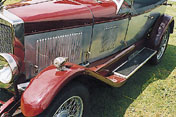 |
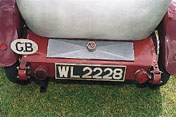
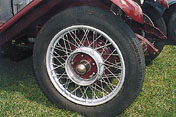
These three modern pictures of a 14/28 four-seater illustrate the additional vents at the sides of the scuttle, the five -stud bolt-on wire wheels and the neat, cast cover for the rear-mounted tool box.
Behind the wheel, the foot operated starter pressed, the ease with which the engine roared into life and the careful placing of the controls impressed the man from “Motor Sport”. Unfortunately, the magazine did not record any performance figures, merely saying that at an engine speed of 4,200rpm nearly 50mph was possible in second gear of the three-speed gearbox. The same car was tested by rival “The Autocar” magazine in June and they gave the speed in that gear as 45mph, recording a top speed of 65mph.
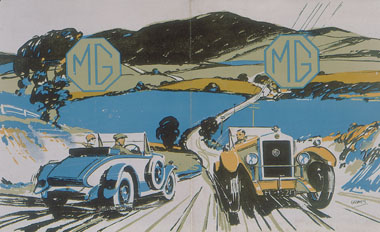
Catalogues produced for the 14/40 Mk IV model.
With the overall weight of the car as tested being over 2,200lbs, and the 1,802cc side-valve engine producing only about 36bhp, it is hardly surprising that it took over 25 seconds to reach 50mph. Modest though this may seem by 1990s standards, it was still a lot quicker than the majority of cars in use then, some of which would have struggled to reach that speed given all day to do it! The headlamps were mounted on a rotating bar, operated by a lever to the right of the driver, alongside the brake lever. This allowed both lamps to be dipped in the face of oncoming traffic, but the twin levers did have the habit of going up flapping trouser legs, to the discomfort of their occupant when they entered the car!
| The Morris Garages carried regular advertisements in the Oxford magazine, “The Isis”, and in early 1927 these featured a series of tales illustrated with drawings of the 14/28 by W.P. Burrows. One, under the title “An Indictment” by Bluebeard, reads “Nero was neither loyal nor lovable, neither chaste nor charming; and his chins were three. Much can be forgiven the sinner, provided he does not possess three chins”. It went on to list his vices and ended by saying that “..he himself always drove an M.G. Super Sports. Which explains even the seemingly impossible”. | Other advertisements were devoted to exploits of Jehu, son of Nimshi, to the slaying of dragons, a tale of rejected passion and the origins of Solomon’s Doctrine. All good fun, and probably to the taste of Oxford classics scholars, but just how many cars they sold is not recorded. Following these advertisements, “Bluebeard” turned his hand to poetry for the next few issues, concentrating on the views of the MG Super Sports held by a curate, an author and a Bolshevik – well it certainly was a bit different! |
In view of some of the shortcomings of the 1927 model, development work continued to try to improve matters, resulting in various modifications being progressively incorporated into the car. The exact order of events is a little confusing but what is certain is that by autumn 1927 the car had received a number of modifications to the engine and braking system and that, at the time of the announcement of the 1928 model year cars in September 1927, it was called the 14/40 Mark lV.
Trying to identify the differences between the 14/28 and 14/40 flat radiator models causes a few headaches, and the writer is here on rather shaky ground! However, what seems to be clear, from the point of visual identification of the two models, is that the earlier flat-radiator cars lack the apron between the front ends of the chassis rails, or dumb irons, fitted to the 14/40 model. The 14/28 has open sides to the dumb irons and a plated extension to the bottom of the radiator. They also have an additional set of louvres on the scuttle between the rear of the bonnet and the front of the door pillar.
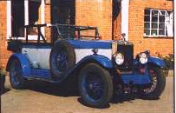 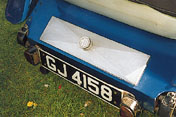 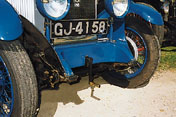 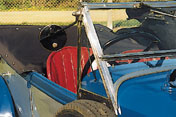 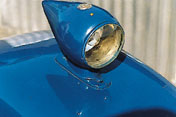 Modern pictures of 14/40s that illustrate the rear tool box, the panel that covers the front ends of the dumb irons, the triangular windscreen sides and the streamlined sidelights. |
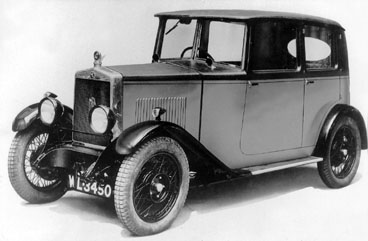 A 14/40 Lightweight Fabric Saloon by Gordon England Limited. 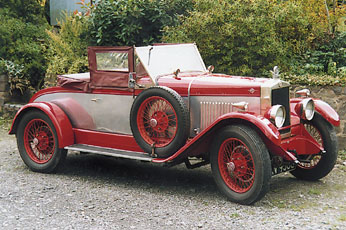 The attractive two-seater 14/40 owned by Cyril Mellor and used by him to undertake many long trips, even a tour of New England in 1991. 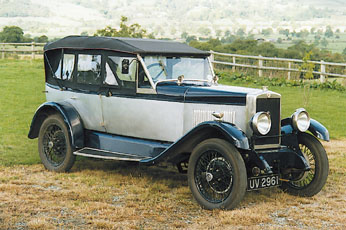 A four-seater 14/40 owned by one of the co-authors of a soon-to-be-published book on the vintage MGs, Robin Barraclough. |
| The advertisement for the 14/40 Mk IV model appearing in the programme for the J.C.C. 200-mile Race at Brooklands in October 1927 is interesting in that not only did it list an additional model, the fabric saloon, but it also featured the “leaping tigress” to portray the car’s fine acceleration – the “Tigress” title was later to be given to the special racing version of the 18/80, the MkIII. The fabric saloon was fitted with a lightweight body built by Gordon England Limited and, priced at £445, cost the same as the standard four-seater salonette. The fabric saloon was not the most elegant of cars, although one example finished with its sides painted mottled brown earned the nickname “Old Speckled Hen” whilst a factory demonstrator; a title now given in its honour by Morlands to one of their beers. | As a full four-door saloon, the fabric bodied car had appeal but the rather slab-sided appearance came from an absence of side valences, items then going out of fashion. The windscreen was “V” shaped with the two panes top-hinged, the rear window was oval and the scuttle was fitted with the nautical-style ventilators that had become one of MGs trademarks, perhaps beause of Cecil Kimber’s love of sailing? The fabric-over-wood constructionof the body was said to give freedom from rattles, and a three-point mounting to insulate it from chassis twisting, but in service these deteriorated fairly rapidly, leading to complaints from dissatisfied owners. |
To celebrate the 14/40 MkIV model, an entirely new brochure was produced. Featuring a number of drawings by Grimes, including a particularly attractive coloured cover, this catalogue listed, and included photographs of, the four versions of the 14/40 on offer. The two- and four-seater tourers had specifications and colour schemes much as the earlier 14/28 models and the four-seater Salonette, now the only version of this model produced, could be finished in an attractive range of colours. The main colours were Brown, Oxford Blue and Crimson, these being applied to the tops of the bodies. valences and wings. The sides of the bodies in each case were painted a shade lighter, to tone with the main colour, and the seats and trim panels were upholstered in leather to match the darker shade of paint.
A two-seater 14/40 was tested by “the Autocar” in harsh winter conditions during January 1928. They recorded acceleration to 50mph in just under 20 seconds, an improvement over the 14/28 tested the previous year and reported that, with a maximum speed of over 65mph, high average speeds were possible. They said that “..it speaks much for the excellence of the standard chassis from which the MG is developed, that it should give the results obtained in the matter of performance without any loss of reliability. At the same time it should be realized that the original chassis is so modified that it becomes an entirely different production in the end.” A fitting tribute, indeed, to the work of the MG staff at Bainton Road.
The 14/28 and 14/40 MGs were very good cars. The basic excellence of Morris engineering at that time endowed them with standards of reliability in service not enjoyed by other sporting cars of the period. Speaking from recent experience of a trip in a 14/40 fitted with one of the special cylinder heads available at that time, performance and road holding was exceptional for a 1920s car fitted with a four-cylinder engine of modest capacity. With the rapid development of small-capacity, high-revving engines in the 1930s, and the production of small sports cars by MG and others to utilize them, these sports touring cars of an earlier age have been largely overlooked. Yes, they are slow in modern terms, but they can prove interesting for those seeking to experience 1920s-style motoring, whilst remaining loyal to the MG marque. It is a pity that so few survive.