Stolen Recovered
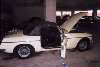
| Imagine that your beloved MG has been stolen, how do you get it back? It may have been found abandoned by the roadside or recovered by Police as a result of their investigations. If your MG still has all its correct identification marks then ownership can be easily traced back to you. However, if the car thief has managed to get your MG into his workshop and removed the number plates, chassis plate and engine number, then the car can be almost impossible to trace. Recently, I visited the West Midlands Police to examine a recovered MGB. This is a car that they have rescued from a car thieves lock-up but cannot trace its original owner, because all the correct identification marks are now missing. |
No identity
| Is this your car? Perhaps you recognise it as yours or maybe it is the car of a friend or relation? It is a pale primrose yellow MGB roadster which has a number of distinctive features. To help the Police trace its owner I have taken a series of photos and put together a detailed description. If your MGB has been stolen then read the following carefully, this may be your missing car. | Wire wheels are fitted with knock-on hubs |
MGB Roadster 1970?
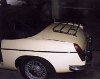
| At first sight this looks very like a 1970 model as it has a recessed grille, although the matt black paint has been removed from the surround, which has then been polished up to a chrome finish. The front wings still bear the British Leyland badges and have the sidelights/indicators positioned close to the grille (post 68). Plastic under shields have been fitted to the front wings. The boot lid has a plastic MG badge and is fitted with a chrome bolt on luggage rack. Rear lights/indicators are of the revised post 1970 design. The hood is of the grey frame detachable pack away type which also featured on cars built before 1971. | 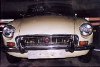 Recessed grille has been polished up to a chrome finish. |
Distinguishing features
| Driver and passenger doors have the original specification door mirrors for a 1970 model but there is an odd distinguishing mark on the near side door which is a hole drilled roughly in the centre of the door just below the window glass. This hole is positioned much too far back to have been a door mirror mounting and has no obvious function. The bumpers are chrome but without the black rubber strips on the overriders. There is evidence of some corrosion with the chrome plate lifting and some signs of damage to the near side corner of the rear bumper. The rear bumper appears to have been fitted very tightly against the back of the vehicle, perhaps the mounting brackets are bent. | 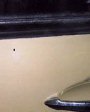 Unexplainable hole in centre of door |
Interior
| Window winders are the all plastic type and the door apertures are fitted with stainless steel threshold plates with an MG in a laurel wreath printed on them, these plates are available from the MGOC accessories department. The dashboard is the standard metal type and finished in crackle black, it has flick type toggle switches while the overdrive switch is dash mounted. The steering wheel has a leather rim, with a red and silver MG logo on the horn push and holed alloy spokes, these steering wheels were only fitted to 1970 cars. Seats have been specially retrimmed in black leather with white piping and are fitted with matching head restraints. The transmission tunnel is covered with carpet and the gear lever has a wooden knob with MG logo and a rubber gaiter which is located by a chrome surround. The twin six volt batteries have a cover that has been modified by the addition of extra black rubber insulation strips, presumably to reduce vibration or form a better seal. | 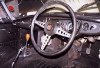 Steering wheel and toggle switch dash indicate a 1970 model 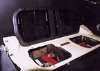 Battery tray has been modified with extra rubber insulation |
Under the bonnet
The bonnet is alloy which was a standard fitting until 1969 therefore it could be an original panel. The engine looks like an 18GG unit and is fitted with an alternator. HS4 Carburettors are covered by spun alloy dashpot covers and fitted with standard saucepan like air filters. The crankcase breather assembly is the later type and connected by rubber pipes from the inlet manifold to an engine side plate. However the oil filter which should be a disposable canister type is in fact fitted with an earlier inverted Teclemit type filter housing. The oil cooler is connected to the engine via non standard stainless steel braided hose. The brake system is as original without a servo, but all the brake pipes have all been replaced a set of copper type piping.
The exhaust system is in stainless steel and this is fitted with a bomb centre box silencer.
There is no doubt that this car has had considerable work done to it and has clearly been looked after and prepared to a high standard. The paintwork is very good and it is possible that the car may well have been completely resprayed in last few years.
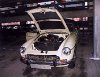 Clean engine bay distinguished by Teclemit canister oil filter. |
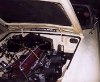 Engine bay very clean and nicely detailed. Note raided oil cooler hoses and new air filter stickers |
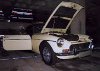 Alloy bonnet has solid bonnet prop |
Can you identify this car?
Overall this car is in excellent condition, it has obviously been well cared for and appears to have been recently restored. If you believe that this MGB might have been stolen from you then contact DC Martin Hall at Bilston CID on 01902 649102 or fax him on 01902 649182.
Chassis plates
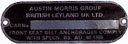
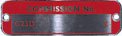
The identity of your MG rests in the chassis number allocated by the factory at the time its manufacture, this number provides the most important evidence of your car’s original specification. On an MGB the first three letters designate the make, engine size and type of the car, G for MG and H for engines of 1400cc – 2000cc. The third letter stands for body style, N for two seater and D for coupe. Next comes a number either 3,4 or 5. The number 3 indicates Mark 1 models of 1962-67, number 4 indicates models from 1967-69, and 5 indicates all cars from 1969 -1979. The next six numbers can tell you when the car was built and the final letter G (introduced after 1969) indicates that the car was built in the MG factory at Abingdon.
Commission number prefixes start with G for MG followed by a number representing the project code number, such as 23 for an MGB, 52 for an MGC and 75 on a BGT V8 while the last letter on the prefix is for body type N on a roadster D on a GT. The suffix letter indicated where the bodyshell had been commissioned, F for the bodies branch of Coventry, P for Pressed Steel, Swindon and Z for Pressed Steel of Cowley.
It is a very simple task to remove the chassis plate, commission number or engine number as these are only held in place by two pop rivets, it would be wise therefore to have your car body more permanently identified. Some export MGBs have had their chassis number stamped into the floor under the passenger seat. You can purchase a set of engineer’s stamps from a tool supplier or ask your local garage to stamp the bodywork of your car. Mark as many of the panels as possible with your chassis number .
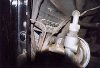 A MGB GT V8 chassis number located beneath the remote oil filter |
 |
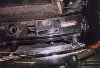 Slam panel usually displays commission and body numbers, only 1980 MGs had VIN number |
 |
Mark your car
Of course all this detailed description and desperate appeal for the owner to claim this MGB would not be necessary if the car had been properly security marked. You can mark it yourself which is better than nothing but the best solution is to have the job done professionally.
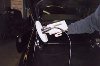
Datatag scanner available to all Police stations enables a quick check to be made on all stolen vehicles
DIY vehicle marking
A simple step that you can take immediately is to hide something uniquely personal to you inside your car, such as a business card or an out of date bank card. Old credit cards can easily be slipped inside the seat trim, behind a door panel or beneath the underlay of the carpet. However, when choosing a hiding place remember that the professional car thief will make a thorough search of your vehicle for any identification marks, so be sure to use several markers and try to choose good hiding places. Get the markers right inside a panel or underneath the sound insulation material somewhere that is unlikely to be disturbed. Do remember to make a note of all these secret hiding places and keep it with your documentation, so that you will be able to point them out to the Police when reclaiming your car. Security marker pens can also be used, these pens leave a mark that is invisible to the naked eye but will show up under ultra violet light, they are popular for marking household valuables such as TVs and videos and could be used on internal metal or plastic car panels. You can mark the car with your postcode, but also be aware that a professional thief will make a thorough search for such markings he may have UV light himself, so be very careful to choose unusual locations for such markings.
Professional security marker systems
Professional marking or tagging systems such as Datatag, Retainacar, Alpha-Dot and UViOLA all have at least three distinct advantages, firstly the Police will routinely search for evidence of them and secondly each system employs a database that will provide a direct means of tracing ownership. Thirdly, each has the particular advantage of being very difficult to detect, which means that the thief will never be entirely certain that he has removed all traces of the car’s legitimate identity. The realisation that a car has been subject to professional marking has been proved to be a major deterrent to car thieves. The cost of effective professional marking is not as high as you might expect and it is well worth the money if it means that your cherished classic will be returned to you or better still passed over by a thief looking for much easier pickings.
Datatag employs hidden transponders which are tiny capsules that can store data about the ownership of your car and these are so small that they can be concealed anywhere, inside interior trim or even in engine parts. Datatag can be contacted by telephone on 01295 272707 or faxed on 01295272853.
Alpha-Dot applies a similar concept but uses tiny micro dots, so small that they can be suspended in a liquid solution and then painted on to your car. Each dot contains a special PIN or personal identification number unique to you. For more information about Alpha-Dot telephone 0345 573329.
Uviola Safemark combines various surface marking techniques and is impossible to remove without severely damaging the surface that it has been applied to, like the others it is backed up by a central database. You can find out more by visiting their web site http://www.uviola.com.
Retainacar is another system that combines several different ways of marking a car to provide added protection, some visible such as window etching and special stickers used in combination with concealed markings. You can find out more about this system by telephoning Retainagroup on 0181 870 2224.
If you sell your car
All these systems can be adapted to accommodate the legitimate sale of a vehicle when the new owner can have their details substituted on to the database.
Not so secret markers
Another approach is to mark your car in a way that can be clearly seen. One of the most obvious is to have all the windows of your car etched with the registration number of the vehicle. The prospect of replacing all the windows would deter the thief who wants to sell the car on quickly and maximise his profit. Retainacar offers a total security marking package which includes window etching in combination with other hidden marking systems.
When buying a car
The ease with which a chassis or engine number can be switched should make you very diligent when looking at a car you want to buy. Always check the chassis number against the documentation but take a careful look at the chassis plate itself. If it is bright and new in comparison with the bodywork and fitted with new rivets, incorrect rivets or even self-tapping screws, be suspicious. Also be very suspicious of a car offered for sale that has no history except the V5. No extra documentation, such as old service or parts bills, tax discs and MoTs, implies that the car has a very new identity and there is nothing else to authenticate its past existence.
Of course if a car has been substantially rebuilt, re-bodied or totally resprayed it is likely to have been fitted with a matching brand new chassis plate, however this should bear the correct original chassis number. There is nothing necessarily wrong with a re-built car that has a brand new chassis plate, but be wary of a totally re-built MG that is offered for sale without any history or even a photographic record. Remember, if you buy a stolen car, even in good faith and the Police manage to trace it to you, then it is likely that you will lose both the car and all the money you paid. If you are interested in buying a car make a note of its details, registration number and chassis number then (provided these are genuine) you can have a search done by Hire Purchase Investigations who will tell you if the car is subject to an outstanding HP agreement or if it has been stolen. You can telephone HPI on 01722 422422. Similarly Retainacar have a telephone line Global Security Gateway which operates a 24 hour international service on all vehicles marked with their system, these cars will have the telephone number marked on them, so that you can call their hot line to check identity.
Recovered
Not all stolen cars are lost forever, many are recovered but the problem for the Police is to reunite these cars with their rightful owners. If you take the trouble to mark your car properly your chances of preventing its theft or tracing it after theft will be greatly improved.
Richard Ladds