Spotlight on Jonathon Wood
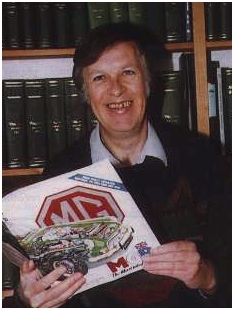
Spotlight on Jonathon Wood
SPOTLIGHT
Keen MGB owning members of the Club will undoubtedly have the well know classic MGB The Illustrated Historyamongst the well-thumbed variety on their book shelves. First issued in 1989 when it was acclaimed one of the top selling motoring books of that year, its popularity has dimmed little as it now celebrates its fourth reprint. Author Jonathan Wood is justifiably proud of this title, one of over 30 to his name, as he tried, and succeeded, to produce not just another MG history book but one that actually talked to the men who were involved – the story behind the story if you like . Obviously Jonathan managed to get the recipe right as year after year new MGB owners’ delve with delight into the pages. Attempting to find the secret of this evergreen book’s success, Zoe Heritage went to meet Jonathan to chat about this title’s origins.
My true MG connections really started way back in 1973 when I became a founder staff member of Classic Cars magazine (coincidentally the birthday of the MGOC). It was the first such publication of its kind, so was quite revolutionary in its time recalled Jonathan Wood. We all ran a classic as our company car and I had the pleasure of a 61 MGA Coupe which invariably went wrong. Happily this gave me considerable adventures to write about and I was never short of lineage for the monthly staff car sagas’ section in the three years I had it. As features editor, Jonathan specialised in seeking out unusual stories and interviewing the industry’s former executives and engineers. His MG interest was fuelled further when he had the privilege of attending the launch of what was and still is the MG bible, MG by McComb. Wilson was a charming man and I found his book fascinating, especially as it came out only months before the Factory closure. Prior to this post, he had been assistant editor on Car Mechanic magazine and had once spent a marvellous week commuting between Woking and Waterloo testdriving and MGB. A friend’s MGB was the first car to ever take me over 100 mph so naturally holds a special affection just for that.
Freelance Career
When IPC moved its offices out of Waterloo to Sutton in 81, this cemented Jonathan’s decision to pursue a freelance career. Although only in his thirties, he already had several books in print, the first being The Restoration and Preservation of Vintage and Classic Cars published by Haynes in 1977. This book was the result of a #15 purchase in the form of a derelict 1928 Austin 16 found abandoned in a farmyard. Subsequent rejuvenation of the car formed the basis of the book which was awarded Veteran and Vintage magazine’s Oscar of the year, claiming it was a book which fills a gap, and is executed in what we humbly submit to be the right way . The car still resides in his garage today. Now Jonathan had all day to devote to book writing and producing books on a variety of makes. Wood had also held a long-term fascination for the foreign motor industry and in 1983, following two years research in Britain and Germany, published his Volkswagen Beetle, considered by Car and Car Conversions as quite simply the most thoroughly researched Beetle book on the market ….. a complicated story expertly unravelled . Both the German and British editions are still in print. He followed this with Great marques of Germany, then America and Italy.
His natural aptitude for history and research saw the emergence in 1988 of the epic 120,000 word Wheels of Misfortune The Rise and Fall of the British Motor Industry, drawing on interviews that Jonathan had held with the industry’s past and present leaders. It was well received and much acclaimed, justly received when he was awarded the Montagu Trophy for the Guild (of Motoring Writers) member who … makes the greatest contribution to recording in the English Language the history of motoring … in a published book. He was also awarded the American equivalent in the form of the Cugnot Trophy, the Society of Automotive Historians’ highest accolade, who considered the book a wonderful example of historical craft, combining as it does, sound research and thoughtful analysis. More recently, Jonathan was involved in two publishing projects that were timed to coincide with the industry’s centenary. He was the principal contributor to Britain’s Motor Industry The First Hundred Years, for which all four editors received that year’s Montagu Trophy. He was then commissioned to write The Motor Industry of Britain Centenary Book which was enthused by the press and industry alike.
Best Seller
One of Jonathan’s best sellers was published in the autumn of 1988 and remains as popular today as it was on its launch over eight years ago. It was, of course, MGB The Illustrated History and he explained how it was conceived: Lionel Burrell, creator of Classic Cars, and I had talked about doing a joint book for sometime and decided upon the ultra-popular MGB as the subject. He had always been impressed by a book on Spitfires that had fold-out cutaway drawings and suggested we do the same. He would do the pictures, I would do the words. My thoughts for this book was not to produce yet another MG book. There were currently several issues in the bookshops selling MGB histories but none actually mentioned any names. I wanted to talk to the people behind the car, the actual creators who had designed and engineered the MGB. Putting his initial thoughts into practice, Jonathan wrote to John Thornley proposing his ideas. I really needed this man’s co-operation if I was to produce the book the way I wanted as he would be able to open doors. His instant response was of course and was more enthusiastic than I had dared hope. Thornley had always been very paternalistic about the B and admitted that he had always thought the car would be out of production by 1968/69 and was amazed at its success. He also believed that the background team never had any true recognition, notably Syd Enever, Don Hayter and Roy Brocklehurst and welcomed the idea of them featuring prominently amongst the pages.
Memories of the initiation of MGB The Illustrated History obviously remains fondly and vividly in Wood’s recollection. John Thornley rang to say he had organised a meeting at his house and I was to bring my tape recorder remembered Jonathan. So one rainy afternoon in Abingdon, a unique reunion of MGB notables assembled. Chief engineer Syd Enever, stylist Don Hayter and Roy Brocklehurst who was responsible for all mechanical interpretation of the B, sat in John’s lounge reminiscing and happily answering all my questions. It was abundantly clear that they absolutely loved the MGB. Apparently John Thornley had given the original brief that the MGA’s successor was to be a high speed road car but to still retain a special flavour, which it undoubtedly does. A car which a managing director could leave in the car park without embarrassment were some of his words.
Lucky Day for MG
Wood could not sing Thornley’s praises too highly. He was obviously a man with a talent for selecting the right person for the job and was an inspirational motivation. Abingdon was a cheerful place to work in its heyday, possibly because John’s philosophy on life was to use laughter as the lubricant when things got tough. It was a lucky day for MG when this former Chartered Accountant ran away to Abingdon , initially as secretary to the newly formed MG Car Club and the rest is history. The three men that sat with John and I that afternoon still bubbled with enthusiasm thirty years on, though sadly poor Syd had lost his memory and contributed but a few words. I was left with the impression that major contributions to the MGB’s over-riding success was this enthusiasm, merged with overall competence of the whole team, all tinged with a touch of humour.
Combined with Burrell’s wonderful cutaway drawings, the MGB The Illustrated History was an instant success. Publisher’s Haynes originally printed 10,000 copies including a softback US version and sold out within months. A reprint the following year in 1989 again saw substantial sales before the recession hit and the book went out of print. A second edition in 1993, updated to include the RV8, was released due to demand with yet another reprint released only recently. The book can be considered as factually correct as is possible on account that the author obtained his information from source and therefore can be considered as an historical document. Regardless, the book is easy and fun, the reader meeting the people who really made the MGB happen and their thoughts and viewpoints behind the decisions. One absorbs the facts without toiling through a belaboured factual manuscript.
So what does make a professional writer like Jonathan tick? How does he manage to discipline himself day in, day out to sit in front of his green computer screen and produce copious words? It is easy he replied, it is called cashflow. It is not a discipline, just fear! When you have a young family to support the freelance journalist market is a very risky business but so far the mortgage has always been paid. My daily routine always starts with a half hour walk down by the river which I find essential. It gives me a chance to think about the project in hand, apart from being good exercise. I then wander into my study at 9am and work through until at least 5pm. That is the ideal. However, the SMMT’s Centenary book had a very short lead time so it needed working on seven days a week for seven months. You do tend to work yourself harder when freelance as you never like to turn work away and of course everyone always wants everything tomorrow. I am very fortunate that in the past 15 years, I have never wondered what I am going to do today, as there has always been some work in hand. Apart from his 30 books to his credit, Jonathan has written several scripts for TV and video, has a frequent column in the Daily Telegraph and regularly contributes to many magazines.
Genuine Enthusiast
Advise to aspiring authors? Jonathan suggested always try and think of something new to say. The first paragraph is always tricky so write anything just to get going and change it later. Research thoroughly and try to be original with pictures (if applicable) and words. Jonathan makes it sound so easy but his reputation for being one of the industry’s leading historians had only come through painstaking time and trouble in getting his facts right. He is never without a new title to work on as publishers know that anything from the Wood stable will be personally investigated, illustrated with new photographs and delivered to deadline. Apart from that he is a genuine enthusiast for the motoring industry, a compulsive bibliophile (as his study bears witness) and is a genuinely charming character. Anything written by Jonathan Wood is a pleasure to read as he had the knack of making history sound interesting, a rare commodity.