Making Advances in 90 Minutes
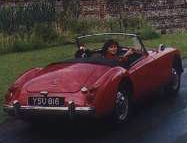
MAKING ADVANCES IN 90 MINUTES
I had be putting it off for over five years. Initially, the “ring you next weeks” were heartfelt and genuine. These dwindled down to “yes, next month looks much clearer – contact you then” but even these faded with time. Now the moment had arrived and evasion tactics were too late to be effective. ‘Flu, last night chicken balti or even that old stand-by excuse “the car wouldn’t start” couldn’t help me now. I.A.M.’s chief examiner Bryan Lunn was sitting beside me, his ‘30 mph‘ emblazoned cufflinks glinting visibly on his shirt cuffs, first gear was engaged and we were off on our 90 minute Advanced Driving Test.

Many years ago when working in London the office conversation at Tea Break revolved around “worst moments”. A excitable, middle aged French lady named Liz (pronounced Leeeze) claimed that hers was taking the (standard) driving test. “It is vorze than having un enfant!” she exclaimed. The following week she failed her fifth attempt despite extra lessons from her only child. Liz may be the only person to compare the agony of examined driving with childbirth but most people dread this test. For many, it is the only exam they ever have to attempt during their lifetime after struggling through various GCSE’s or more. Now I had volunteered to attempt another, apparently more difficult, version. Why?
Since my first meeting with the then Chief Examiner Ted Clements five years ago, I have been ‘getting round’ to taking their Advanced Driving Test. Ted had kindly offered to put me through my paces and allayed all my fears. Being one of life’s true gentlemen, you tend to believe his soothing words that “there is nothing to worry about” and my plans to take up his offer were honourable. Last month the urbane Ted retired. This month I took the Test.
Pass or fail, Ted was right. There really is nothing to worry about. It is recognised that you are there to improve, to help make you a safer and therefore better driver. Help and guidance is what you get, not criticism. Nevertheless, the initial steps are daunting of the unknown and this is at the ‘observed runs’ stage, still a long way from the actual test. Much as I tried to convince myself that it was going to be fun improving skills, that I definitely needed a kick to knock out some bad habits and that the passenger on my left was not sitting in imperious judgement, the butterflies were thundering about like moths crashing in to the headlights.
FOUR KEY SKILLS
All fears were completely unfounded of course! My observer was Mr Nice himself (no surprises there – they all are!) and his pre-drive brief spelt out exactly what he was looking for – namely a safe drive incorporating the Four Key Skills, exactly as described by the current Chief Examiner Bryan Lunn in last month’s ‘Spot-light. To summarise again:
Concentration – vitally important to keep up at all times. We all have lapses but these must be worked at to eliminate altogether.
Observation – effective all round, wide, scanning vision that not just looking but seeing and seeking information.
Anticipation – the link between seeing something and doing something about it. Often the missing link as sometimes we react to situations rather than seeing them develop and planning action accordingly.
“SO LET’S GO OUT AND GIVE IT A TRY!”
After some tentative early steps which included being over polite at a T-junction, giving way to an oncoming vehicle that was but a mere spec on the distant horizon and the over zealous use of the indicators (all for the benefit of my observer!), he then gave me a demonstration drive. Impressive! Although at no time did we exceed speed limits, he made full use of the car’s power and made brisk progress. Namby-pamby driving was possibly slower than I would normally proceed but out in the country slicker and quicker. The whole drive was very smooth and confidently executed with a running commentary on what he was looking out for and the resulting action. Contrary to popular belief, you do not have to commentate as this is purely voluntary.
Back behind the wheel, my weaknesses were identified and explained. Thankfully there were not too many but minor errors included block changes – going down through all the gears when slowing down for a hazard. It is not necessary and the benefits are that you are doing less work, there is less wear and tear on the transmission/gearbox and generally makes for a smoother drive.
We also talked about speed through some of the slower hazards in town situations, through roundabouts or left and right turns. I was too quick which resulted in fighting the steering to avoid an oversteer situation and simultaneously changing gear to accommodate speed. I was reminded that changing into the gear that I wanted to negotiate the hazard beforehand and then completing the manoeuvre at an appropriate speed to the revs meant that everything became much easier. No longer were arms and legs flying about like a manic centipede trying to steer, grab the gear stick and de-clutch but I was happy to make right turns at, what seemed to me initially, very slow speeds indeed. He also advised applying the handbrake at junctions with busy roads in front “just to prevent you from being pushed into the traffic should a car shunt into you from behind in these situations”. Very wise.
Another problem was my steering technique. My hands may have been placed precisely at the 10 to 2 position but cornering lacked finesse. The teaching for right turns: right hand moves up to 12 o’clock position and pulls down, at the same time the left hand slides down the wheel and pushes up. Exactly opposite for left turns of course. This means you always have instant facility for that extra half turn for emergency situations.
Knowing my faults, I tried hard throughout the rest of the drive to correct them. The block gear changes had been for the benefit of my observer anyway so instant improvement there. Once adapted to taking hazards more slowly, keeping the revs down and therefore not needing to change up until car was pointing in a straight line, soon became natural. The steering needed a little more practice before it improved and is still accompanied by mutterings of “12 o’clock pull down, 6 o’clock push up!”
THOSE CUFFLINKS…. 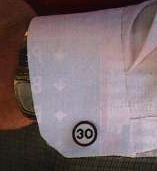
A few days later Bryan Lunn rang to see how I was progressing and suggested that he “pop up to Swavesesy to look around Club HQ” and to give me another observed drive. Three months ago, when interviewing him for the June Spotlight I commented on his appropriately inscripted ’30 mph’ cufflinks to which he replied he was testing in the afternoon and he always wore them on such occasions. The day he walked into our offices, he was wearing those cufflinks….. Before a word was spoken, I knew just what the afternoon had in store. This was not just a social visit. Bryan had achieved in three months what his predecessor had failed to do in six years!
Uncharacteristically, I was completely unworried and almost looking forward to the following 90 minutes. Over the previous weeks my observer had tidied my driving technique and instilled confidence (slightly dented by male passengers over the years!). Bed-time reading had recently been the excellent I.A.M. publication ‘Pass Your Advanced Driving Test’, extremely reader-friendly in approach and definitely recommended. Pass or fail, I was interested to learn just what Bryan though of my prowess behind the wheel and ways in which I could further improve. Straight to the point, his pre-drive brief went as follows: “The Advanced Driving Test is assessed on four ‘S’s –
“It’s got to be SAFE. If it’s not safe, it’s not good driving. If it ain’t good driving, it ain’t advanced driving.
“It’s got to be SYSTEMATIC. In other words, no deviation in mirror, signal, manoeuvre routine.
“It’s got to be SMOOTH. Good pedal balance controlled accurate steering, keeping the car in balance with consideration for vehicle sympathy and passenger comfort.
“Correct use of SPEED. Obviously you must comply with the speed limits but you must impose a speed limit on yourself as and when you need to. Speed limits are not targets.
“Let’s go.”
The actual route took us through narrow country lanes to villages, out onto busier A roads taking in Hitchin and Baldock before a spell on the M11, getting lost around Cambridge (extensive town driving there) with a quick parallel park thrown in and then back to Swavesey. The drive had not been overly slow, lorries overtaken and other manoeuvres performed that one would naturally do when an examiner was not sitting beside you. Regardless of the outcome, I knew that for those 90 minutes at least my driving was far superior to my normal progression throughout my approximate 30K miles a year. Why? The answer is pure concentration. For that hour and a half, 100% of my attention went into my actions behind the steering wheel. I was looking for clues as to what might happen, aware that hedge clippings on the road may mean a tractor around the corner, that it was 3.45 pm and the local village school may be out any moment, peering under lorry wheel to see what was ahead and being very much more aware of my stopping distances.
TEST DE-BRIEF 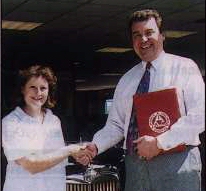
Parking up, Bryan then proceeded to take me through a detailed de-brief. To summarise, he informed that he had been passenger to “a good safe drive and that speed had been used wisely in the right places. You controlled the speed where necessary and imposed limits on yourself where appropriate but made good progress where it was suitable. You demonstrated a good awareness of potential risks and threats in situations and showed a high level of courtesy to other road users. You took opportunities to make progress where it was safe to do so and you never took chances. Congratulations Zoe, I am happy to recommend you for full membership of the Institute of Advanced Motorists.”
PRACTICE THE PREACHING
OK, so I am now a holder of the Advanced Test but two months on, how this influenced my driving in reality? I now try harder to concentrate on the job in hand, rather than worry about the next issue of ‘Enjoying MG’ or whether the dogs have been fed. I now practice the preaching “only a fool breaks the two second rule” and do my utmost to keep out of the nose-to-tail 70 mph traffic jams on the M25. I am not, nor do I feel, a better driver than anyone else just because I have a scroll bearing my name. However, for the moment at least, my awareness and anticipation is greater than it used to be and I am working at maintaining this. It’s not easy though and as I drive down the M3 towards home, I am still wondering if I remembered to get that chicken out of the deepfreeze this morning!
Zoe Heritage
DON’T FORGET……
If you are 25 years old or under, you automatically qualify for a £10 discount off the Advanced Test (normal price £27) valid until the end of 1996.
Also remember that the I.A.M are offering £5 off the combined price of the Advanced Test (normal price £27) and their excellent book ‘Pass Your Advanced Driving Test’ (normal price £7.99). Until 31st December 1996, they are giving all MGOC members a £5 discount by offering us the Test and Book for the combined price of £30.