The MGF from Conception to Production
SPOTLIGHT MGF – FROM CONCEPT TO CONSTRUCTION
The concept of car design has been highlighted, certainly in the MG world, by the advent of the MGF. Its creator, Gerry McGovern, has since been elevated fully into the limelight and has discovered that the design stage was only the beginning of his association with the new MG. Gerry kindly took time out to chat to Zo Heritage about his own career path, ways to get into car design today and the processes involved in the actual creation from doodles on a blotter the actual reality of 0 – 60mph in seven seconds.

“From a designer viewpoint, if you were to choose one car in your whole career that you would like to work on, in terms of the interest it would create, then it would have to be an MG. It would also have to be the first completely new design for 32 years” commented MGF chief designer Gerry McGovern. “I didn’t even think about it at the time but the publicity it has produced has been phenomenal. Even some of Rover’s top people at Board Level have been amazed at the sustained level of interest and enthusiasm there has been for the car which started long before the Geneva launch in March ’95 and still continues well over a year later.”
|
 |
One does not fall into designing one of Britain’s most popular sports car overnight so just what sort of career path should aspiring candidates follow today? “The way a designer would get into the business now is generally through taking a degree in some sort of design or engineering orientated course, followed by an MA in Automotive Design. The latter is a specialised course run by the Royal College of Art, although Coventry University have also started to offer this” said Gerry, who himself followed the RCA route. “Nowadays it is impossible to fall into the business just because you show talent; you also need the training which gives you the methods, processes and understanding of the systems that go into modern car design. However, artistic flair takes a high priority besides good college results if you want to get accepted by a major company. It is probably true to say that you cannot actually train a car designer – they have to have intrinsic talent or they will not make the grade.
 |
 |
“Generally, most car designers are car nuts. For some, this passion comes from the engineering side, with me it is the aesthetic consideration. Personally, a car is a piece of art, sculpture on wheels. From a very early age I was interested in cars, the way they looked rather than the way they moved but later on when I could drive, performance and handling crept into the equation. Saying that, the MGF is a bit of a contradiction to those sentiments as I was prepared to compromise the pure aesthetic by going for a mid-engined layout. If I had been totally preoccupied with the way it looked we would have had a front engined car because it would have been much easier to balance from an overall proportional standpoint. Having said that, because of the route we chose, we have probably ended up with something that is a little different in any case.”
Car Crazy
An artistic slant coupled with a love of cars surely meant that the young Gerry was automatically destined for automotive design but it was pure fortune that he found himself working for Chrysler on leaving school. “Then, it was not as widely publicised that there was either a route into or even a career in car design. Today, people write to us all the time and we tell them the qualifications necessary and the suggested route into the business, all very clear cut. It was only the fact that my art teacher mentioned to a friend working for Chrysler that he had a car crazy student that I even went for a chat to get `pointed in the right direction’. One of the guys I talked to was Roy Axe, a very influential character in terms of car design and later when he moved to Rover, influential there in terms of establishing the foundations for that department – the father figure if you like of Rover’s present design system. He really got the place moving in terms of getting the right sort of people, the right processes and right profiles. Anyway, whilst at Chrysler he thought it may be good if they actually sponsored someone, so I had the fortunate situation where I was being trained through college and the design studio, spending time in both which was ideal.”
McGovern’s formative years in the motor industry was not spent designing cars but rather getting acquainted with “the foundations of the business like learning how to draw, render, presentation and basic design techniques”. What is rendering? “Rendering techniques are the way you actually visualise something and accordingly interpret those thoughts onto paper, not necessarily sketching a realistic picture of the car but rather creating an image.
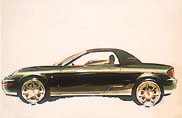
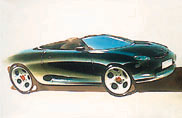
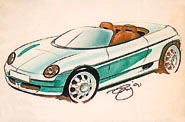
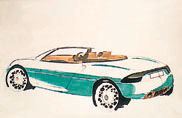
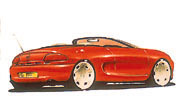
Like all new cars, the outline concept of the MGF was established before a broad brief was issued to the designers, who then generated countless sketches. Gerry comments “at the end of the day the chosen design is all down to personal preference so it is very important that you can get over your ideas in a very professional, dynamic, spontaneous way. This is rendering. Ford say they do all their design work on computer and my answer to that is you only have to look a the front of the Scorpio to see where they have gone wrong.”
Style Approval
Of course, computers play an important role at Rover but they only come into their own in the design department after `style approval’. “Once the board have signed-off (approved) a particular style or design, we then have to turn that drawing into 100,000 cars a year or whatever”. The processes are well defined and the course that the MGF itself followed on the way to its procreation. The designers’ sketches then become full size drawings, given to a talented team of sculptors and model makers who then interpret the drawings into 3D. A full size clay modelresults, the sculptors and designers working closely together at this stage to ensure surfaces start and finish where originally envisaged. The clay model is then subjected to the measuring process where literally thousands of points are taken off the surface of the vehicle and the data fed into the computer. The surface engineers will join up the measurements and actually create a surface on the computer screen. The designers also have to work closely with the surfacing people to make sure what is being created in the computer box is true to the original design. Once that data base has been created, a programme is made and the stage of cutting models is reached. A complete surface is made for every component of the car, not just the exterior but also the interior, from door panels to steering wheels.

“Theoretically, once we’ve approved the design and generated all the information on the screen for surface definition for all parts of the car (even the gear knob is designed), models are then cut. Once these are agreed, we start releasing data base to the various individual component engineers in order for tooling to start. The Project Team, headed by the project director who fronts a team consisting of chief engineer, chief designer, marketing and manufacturing (who will all have sub-teams of their own), have to police the system so that if a change is necessary, in consequence of manufacturing, feasibility, whatever, approval has to be sought from The Team. It is the Project Team’s responsibility to take the project from concept through to production. These people will be meeting at least once a week resolving major issues. For example, if during validation the engineering department says “we want to change the roof because we found that it is not strong enough with not enough torsional rigidity and we would like to introduce some ribbing. Gerry, what do you think of that?” I can turn round and say “it’s not going to work – find another way of doing it” or maybe “go ahead as we can incorporate it without having a detrimental effect of the design”. Those sort of debates are going on all the time as the car progresses through validation.

Time Consuming
“The upfront creative part can be done relatively quickly (about 3 months) but after that – making the design happen – is the really time consuming bit” said Gerry. “You have to be quite strong and forceful to control it, making sure your design is not eroded. You get terribly defensive and think everyone is trying to ruin your design. It is not actually like that but outside the design area people do not share your passion as they look at it from different prospectives. There are always pressures to modify and alter things at this validation stage.”
The validation period is all about is the building of prototypes. “We have a series of build programmes which usually take about three years and what we are actually doing there is developing a robust plan for the programme, sorting out the way the car will be put together, testing the engineering, the powertrain, and all sorts of things to prove the processes we are putting into place in terms of how the car is going to be built in plant at the factory.”
As chief designer, Gerry McGovern is totally responsible for everything you either like or dislike about the MGF. “We had a very small design team for the car, all inextricably linked and all dedicated to getting things right. Sometimes if teams are too large they turn into a bit of a committee. The MGF team was compact which is probably one of its reasons for success.” Chief designers have to be familiar with all departments and understand how it all works within the company, getting the balance between cost, timing, production etc. “in all, a pretty complex business”. Gerry was also responsible for signing-off tooling for MGF production, frequently making decisions on bills of over £1 million. “You have to check it is what you designed and sign it off; if it is not right then on your head be it!”
MGF Brief
Talking specifically about the design brief for the MGF, Gerry pointed out that “you have to step back 10 years to EXE when we actually started to established a design philosophy for MG”. After many years with Chrysler, he had been head-hunted by his old boss Roy Axe, now working for Austin Rover, to work in the new design studio working especially on the concept car EXE. “I looked at various MG proposals after EXE – a lot of them never saw the light of day – but that was at a time when the company was not really serious about producing an MG for various reasons. We were then trying to get our main stream products sorted out and our marketing people were telling us there was no call for a sportscar. Yes, the clubs still retained an interest but apparently sportscars were out of fashion, unless you went to exotica. This was obviously a load of rubbish as it took the Japanese MX5 to demonstrate that there was still one hell of a market for an affordable sportscar and with the greatest respect to the Japanese, they did a brilliant rendition of a Lotus Elan. That proved there was still a market and as Rover were now in better shape, recognised that the time had come to bring MG back.

Most Exciting Car in the World
“Before we actually got to the definitive MGF in terms of September ’91, when we started the programme proper, various work had been done on the prototypes (PR 1, 2 and 3 – front engine rear wheel drive, front engine front wheel drive and mid engine rear wheel drive). We actually built those cars as running prototypes, taking the body shape for all three from the first MGF I designed about 8 years ago. This established that we already had some of the MG pre-requisites (fun, affordability, wind in the hair motoring) but above all, we wanted to make it the most exciting car in the world to drive – which is a very tall order indeed! We knew that the mid-engine lay-out was the one to go for as it had more chance of achieving some of those objectives, as well as the traction and road holding we wanted.
“Therefore, at the very start of the project in September 1991 we had already decided that it was going to be mid-engined roadster and had also agreed upon the definitive design. This meant the sketching stage went relatively quickly and we got into the full size clay fairly early on. We knew we didn’t want pop-up lamps on the car; it had to have exposed lamps as it gives the car a face. In terms of one car that we should take a retrospective look at was the MGB because that is the one most people would remember. The front end of the MGF is where we particularly deliberated to get that link and had to do all sorts of iterations and proposals and came to the conclusion that we were trying to be too clever and that simplicity was the order of the day. `B’ links – deliberate mouth shape with the Octagon placed centrally, general form of the bonnet, shape of the headlamps. I think the car has a level of Britishness and because it is a different configuration (mid-engine) gives you a different shape from what went on before.”
BMW Support
On Rover’s takeover by BMW he comments: “We are fortunate to be owned by BMW as they are giving us the opportunity to design and manufacture thoroughly modern products but still recognising their British heritage – an incredible opportunity for us. The great thing about BMW is that they are really into products, supporting design 100% and investing in us, for without that, you cannot produce new products.
“Rivalry with Z3? You could say that MG was too far gone when BMW took over but they could still have stopped it. I think they recognised the fact that what we produced was totally different to what they had and certainly not in direct competition. Their car is aimed predominantly at the American market which we particularly avoided as it would have meant stretching our already tight budget and delaying the project at least another 15 months. Now we have reintroduced the MG we need to develop it as it is a very strong marque and there is a definite love affair with it all over the world.
Futuristic View
“Personally, I think we have done the right thing with the car and can only build on that and make it better. We work on a 7/8 year cycle and pencilled in there is a replacement for the MGF. Hopefully though, a principal of longevity is built into the MGF which is why we haven’t gone for an extremely radical design, rather more contemporary without being outrageous. Things that are very radical date quickly. Time will tell but I think it will still look good in a few years time. As far as face lifts go, forget it! That design is quite pure. If you start messing about with it you will lose it. That’s not to say in terms of accessories we cannot do things to enhance, for example sports suspension to lower it. We had this debate when developing the MGF but argued that without the hydrogas, the feel would not be so good. A classic example of the aesthetics being sacrificed for ride and drive.”
MG in Safe Hands
Chatting to Gerry, it is quite clear that he lives and breathes car design, especially warming to his topic when MG comes into the conversation. He is (rightly and justifiably) proud of the MGF, which has become very much more to him than just another design signed-off the drawing board. Lectures, talks, speeches and receiving awards are now part of his normal routine, Gerry in part becoming the front man for his baby. To escape, he likes to keep fit being a regular visitor to the gym and pedals happily into the distance on his mountain bike. His obvious fascination for cars is evident when visiting his house; coffee tables strewn with appropriate books and his dining table literally edge-to-edge with his collection of car models. His fiance obviously has plans for entertaining as shelves were currently under construction to house the collection. Clearly the future of MG is in safe hands, boldly taking strides into the future but, as synopsised by the MGF’s Chief Designer “recognising its Heritage but not harnessed to it.” We look forward to the advent of the next MG which, despite Gerry’s protestations, I feel may be a lot closer than the 7/8 year cycle that he diplomatically predicted.

Pictures
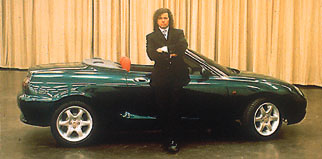
- MGF Chief Designer Gerry McGovern
- Gerry is a self-confessed `car nut’
- MG EXE
- Early MGF concept
- MGF exterior concept sketch
- MGF exterior theme sketch
- MGF exterior clay model development
- MGF interior theme sketch
- MGF interior clay model development
- MGF surface development programme
- Interior model showing investigation into brightwork


