Classic Body Repairs
Last month I completed my series on classic electrical related articles and I continue to receive emails and telephone calls requesting advice on MG electrical problems which I am always prepared to give.
My interest in cars, things electrical and mechanical, started I was very young. I’m told I could name most cars before I was out of nappies and that every mechanical toy given to me ended up in bits as I, predictably, pulled it apart to find out what ‘made it tick’. Having Castrol GTX in my veins wasn’t an accident.
How did I gain my electrical knowledge? I served an Electrical Apprenticeship and progressed to a professional qualification. My working life was spent designing aircraft electrical systems and later sorting out control systems on chemical plants. This work invariably included electronic parts, hence I gained the knowledge which I’ve applied to many of my MG aftermarket accessories.
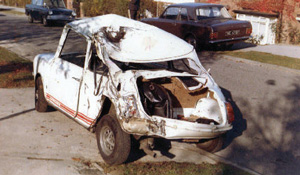
Mini Clubman candidate for a re-shell
My first experience of car bodywork was limited to the repair of minor accident damage or to conceal the effects of rust on the old bangers of my youth. Materials available at the time were limited to ‘Brushing Belco’ (primer and top coat) applied with a camel hair brush and duly rubbed down with 600 wet and dry. I did many such repairs and at the time was delighted with the results but, with hindsight, I imagine my efforts would not have passed close inspection.
When I was about 25 my Austin A35 had suffered accident damage. Repairing this to a professional standard was beyond my skills. Subsequently I was introduced by my insurance company to the local body shop owned by a man called Bernard and he was THE BEST. We subsequently struck up a strong friendship. Being a one-man-band he often ‘burned the midnight oil’ to meet promised completion dates. On these occasions I would spend the odd evening, or week-end, helping him to re-fit panels, wings, bumpers, etc, or polish newly-applied paint my body repair ‘apprenticeship’ had begun. These were the days of cellulose requiring a degree of ‘elbow grease’ to remove the ‘orange peel’. I still prefer the appearance of cellulose to that of modern two pack paint.
Over the following years, Bernard taught me many body repair skills, for example, how to oxy/acetylene weld, how and when to braze and how to lead-load. He also taught me how to stretch and shrink panels and the art of applying paint to exacting standards. I was a very willing and receptive ‘apprentice’ and with time progressed to repairing bodywork, fitting new panels, painting and finishing damaged cars to a professional standard. Possibly the most important thing he taught me was never to say “That will do”, he would not accept sub standard work.
Travelling on the M6, my Mini Clubman was reduced to two thirds of its length by a juggernaut driven by a dozing driver. Fortunately I was not injured. I did a deal with the insurance company, purchased the damaged wreck and subsequently fitted a new body shell. Bernard allocated me space in the corner of his workshop to undertake this project, which took about four weeks of evenings and weekends. The satisfaction of employing my newly acquired skills was immense. In negotiating the purchase of the wreck I made a valuable new contact in the form of the insurance assessor. Now I had a place to work, the necessary equipment and advice when required. So when my insurance contact offered me a damaged very low mileage MG 1300 needing a new body shell, I knew I could repair the car and put it back on the road. At the time, BMC were selling off obsolete body shells, a call to them ascertained that a Morris 1300 body shell was available for £180. I knew I would be able to replace the 1300 front panel with an MG 1300 panel, they were otherwise identical bodies.
Again, working in the corner of Bernard’s work shop I completed the body swap and ended up with one of the nicest cars I have owned, a flame red MG 1300. Now a MG ‘nut’ I purchased the requisite anorak, I already had the greasy hands and dirty finger nails and ‘a love affair’ had begun.
Via my insurance contact, I was introduced to a motor salvage dealer, a great character and a kindred spirit, we became very good friends. He had many contacts in the motor trade and whenever an MG came to his attention he would ‘phone me with ‘an offer I could not refuse’. At one time I had three MGs stored in his yard with my ‘name’ on them. The first was a 1963 ‘B’ Roadster which had lain in the Mexican Desert for six years, was totally ‘clapped’ with one inch play in the king pins and tyres down to the canvass. It had been driven ‘until it died’ and simply abandoned. Strangely, the original purchase documents were in the glove box.
The second was a rubber bumper roadster, rehabilitated from California, many bits were missing but having never been driven through a puddle the body was perfect. Both these cars needed extensive work and converting to right-hand drive. The chrome car conversion was a relatively simple job but the ‘rubber’ car was far more difficult to convert, as American ‘rubber’ cars have no ‘dash shelf’, have three wiper blades, indicator repeaters on the rear wings and no hole on the r/h side of the bulkhead for the steering column. The third car of this lot was a very low mileage, rubber bumper BGT which had had its nearside windscreen pillar removed in collision with the rear of a lorry. Over a period of approximately one year, the three MGs were repaired/renovated and became the proud possessions of our three daughters. I subsequently went on to renovate at least four more MGs, two of which I still own. You will know from my previous articles that in my opinion these are the best of the marque, two MGCs. One is a Snowberry White roadster and the other a 1968 Tartan Red MGC GT. Both underwent a ‘no expense spared’ renovation and are in regular use. The roadster in particular covers over 2000 miles annually on French roads.
My enthusiasm for all things MG and a compulsion to undertake repairs and renovation of these cars has provided me with a lot of broadly-based experience and a degree of expertise working with the marque. I am more than willing to pass this knowledge on to the inexperienced about to consider undertaking a renovation or pondering repairs to a rusty wheel arch. There are many pitfalls, most of which can be avoided. I know, I’ve made more than a few wrong and expensive decisions, more about that in future articles.
Next month I will introduce a series on body renovation with the premise that not all owners can afford a concours car or, indeed, want one. Many will have a restricted budget, some will not have the necessary skills or facilities to consider a major renovation. I will, therefore firstly cover cosmetic repairs to rusty wheel arches, door panels, tops of wings etc. If funds are tight and all you want is a car that looks presentable then a trip to Halfords to purchase fibre glass, body filler and matching aerosol paint is the answer. I predict the response from the more affluent and discerning owners – BODGE.
You will have noticed I said “cosmetic repairs”. Never, never bodge repairs to sills, castle rails, chassis members or any structural body components. I have seen many such cars bodged in this way to fool a prospective buyer. If you are a prospective buyer always ask for a new MoT. Let the MoT man do the checks – he will with the aid of his trusty crowbar and hammer. We’ve all had palpitations as we’ve watched the MoT man give our pride and joy the ‘once over’.