1931 MG C Type Midget
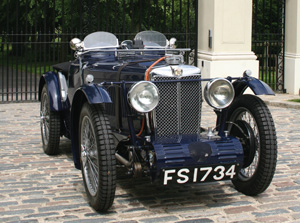
When you look through the MG history books and study all the myriad variations of the pre war models the sleek C-type really stands out, its race car body has a stripped down purity, it seems to present a prime example of the ideal ‘form follows function’. The C-type’s sleek design was dictated by the quest for better performance on the Brooklands race track, designated EX120 (the first 750cc car to exceed 100mph) production cars were called the Midget MKII Monthérly model or C-type.
Perfectly proportioned C-type body
The little MG was directly based on the record breaking EX120 with the chassis almost unchanged from the record car except that the bodywork was re-designed to accommodate two occupants. The lithe, narrow pointed tail body is skinned in alloy and features distinctive twin cowls over the scuttle, the body tub is without doors to ensure rigidity, as a consequence the cockpit sides are cut away to allow access to the snug and supportive bucket seats. Once inside the tall scuttle with its sensual twin cowls and flat dashboard packed with instruments ahead dominates one’s view. Every detail of the C-type is race derived from its quick release alloy radiator cap at the front to the quick release alloy fuel cap at the rear. On the original cars even the filler cap for the engine oil was quick release and mounted externally on top of the scuttle feeding a special reservoir tank for the engine’s oil to enable the pit crew to top up the sump without removing the bonnet. The racing specification external exhaust system is located along the outside of the body, exiting the nearside of the bonnet feeding into a silencer on the side of the scuttle and then sweeping over the back wheel and finishing off with a fish-tail on the rear pipe. The exposed system can become very hot and is located dangerously near the passenger’s arm and therefore it’s bound with glass fibre string sealed with heat proof paint to reduce the possibility of burns.
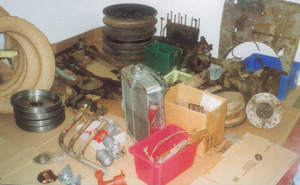
The chassis and components
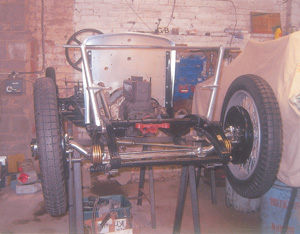
Chassis build up
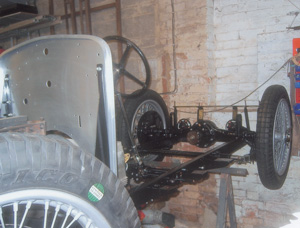
Extensive preparation of chassis
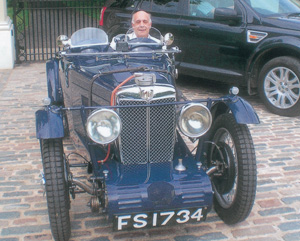
The editor in the passenger seat
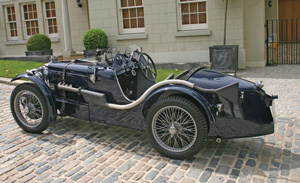
Fish-tail exhaust and boat-tail body
In 1931 the first batch of thirteen C-types were prepared for the Double Twelve Race at Brooklands where the cars secured the coveted team trophy, a C-type driven by Lord March won the race whilst C-types also finished in second and fifth place. For the double twelve a 15-gallon fuel tank was installed beneath the C-type’s boat tail. Race regulations called for a full width windscreen to be fitted but Reg Jackson who prepared the race cars noticed that glass was not specified, so for the Brooklands cars a lightweight wire gauze screen was fitted, along with basic head lights, rear lights and minimalist low drag cycle wings.
Tom’s C-type
When Tom Johnson invited me to take a closer look at his C-type replica, I was delighted to be able to experience the Monthérly Midget at first hand. Tom’s C-type is based on a 1931 D-type that he bought as no more than a pile of original components and a logbook from pre war MG specialist Barry Walker. The D-type was fitted with an 850cc overhead cam engine derived from the Morris Minor unit that first appeared in 1928. As only the firewall remained of the original bodywork, a complete body would be required and as this would have to be hand built from scratch by MG restoration specialists it was decided to re-create the C-type with its race bred lightweight bodywork and a total all up weight of 660 kilos. David Cooksey of Appleshaw and Oliver Richardson of Ashford Hill carried out the MG’s rebuild and restoration work they also undertook the task of making the replica body and then assembling the car. The C-type body was modelled exactly from their own C-type Monthérly Midgets. Consequently, all the instruments and major components are correct to the original specification, with the small exception of the engine being the D-type 850cc rather than C-type Midget’s 750cc unit.
On the Road
Climbing into the cockpit is a complex process that demands agility, diligence and practice but once inside the simple vintage style bucket seat provides excellent support, positive location and a surprisingly high level of comfort. Tom went through the start up procedure and as soon as the engine fired it made the most wonderful sound that immediately evoked a different era, instantly you are transported back to Brooklands in its heyday, a period before the Second World War when life was very good for the privileged elite who could afford such a car. The small capacity overhead cam, four-cylinder engine has only two main bearings but it spins over very willingly with a supercharger fed by a 15/8inch SU carburettor to add even more urge. As Tom swept smoothly through the gears in the ENV non-synchro crash gearbox, I was particularly impressed with the instant acceleration and the way the little racer coped with being driven in the thick of modern traffic. However it was when we got out onto the country roads that the C-type really came into its own.
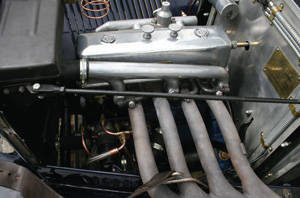
850cc overhead cam engine
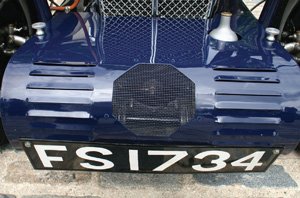
Supercharger driven by the crankshaft
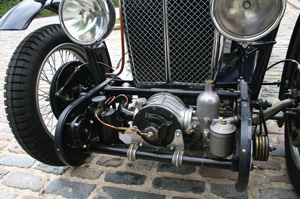
Supercharger fed by 15/8inch SU
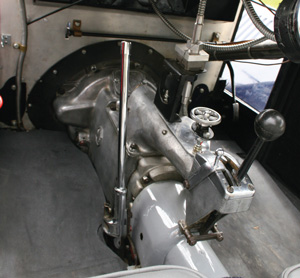
ENV gearbox
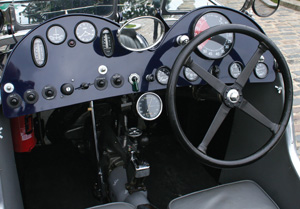
Comprehensive instruments in dashboard
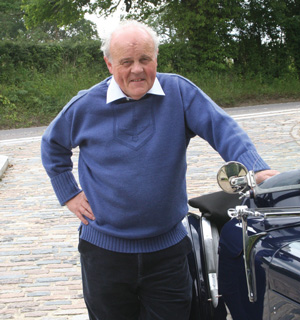
Tom with the C-type
For a devoted MG fan there are few pleasures to compare with being whisked along a twisty country lane at great speed on a sunny afternoon in a prime example of 1930’s race bred technology. Inside the exposed cockpit with the flat screen folded down the outside world makes its presence directly felt with the buffeting of wind turbulence and the wonderful roar from the outside exhaust system under acceleration augmented by the wicked crackle on the over-run. The cutaway cockpit sides bring the hedgerows and trees really close as they swish by just inches away from your elbow, while Tom skilfully conducted this pure-bred MG through the corners, choosing his line so carefully that the little car seemed to ride really smoothly, with minimal feedback from the road. Although, I suspect much of the comfort of the ride reflected the driver’s skill at choosing the best part of the surface, an essential skill to master if you drive a pre-war car with rock hard suspension.
As we made our way to the location of the photo shoot I reflected that the sort of customer that could have afforded one of these in 1931 would have been very well heeled indeed, the contemporary advertisement ran ‘The finest and fastest 750cc car that money can buy’.
On 20th November 1931 The Autocar tested the C-type and opened their assessment with ‘Whatever one’s experience of cars may be, there is a new thrill in handling of the Mark II Monthérly Midget.’ The magazine’s road test gave a very favourable impression of the Midget’s abilities, both as a competition car and also as a road car, a top speed of close to 90mph was recorded which is remarkable for an unsupercharged example with only a 750cc engine. With the performance came ‘steady as a rock’ handling, a comfortable ride and brakes that ‘recorded the shortest stopping distance achieved during the past twelve months’.
Rewarding to Drive
Despite the impressive performance Tom reports that the little MG regularly returns around 23 mpg. This car is quite remarkable; its delicate looks are deceptive, it is extremely sturdy and copes well with modern road conditions. A sports car with this ability on the road and these levels of performance must have been really sensational in the 1930s. However, this is very much a race car and not really a gentleman’s tourer, it was developed for the track and displays the traits of a competition vehicle, it will not idle in traffic but needs to be revved constantly to keep it spinning and the ENV gearbox demands an expert touch, although all this effort is thoroughly compensated because as Tom says, “It’s really very rewarding to drive.”
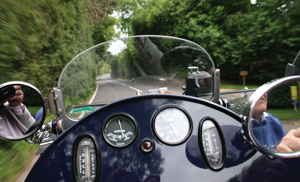
From the passenger seat
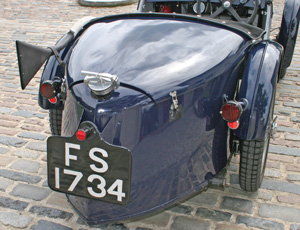
Neat boat tail conceals spare wheel
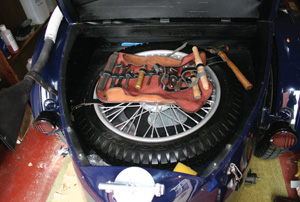
Tool kit
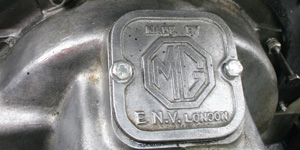
ENV Gearbox
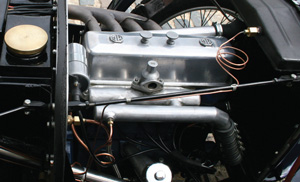
Oil reservoir in scuttle
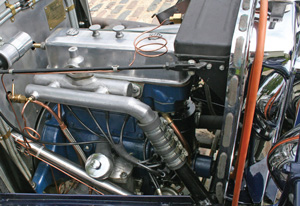
Immaculate underbonnet area
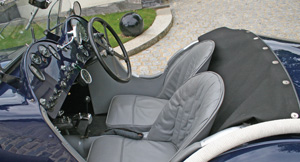
Bucket seats are supportive and comfortable
The restoration of all the mechanical components and the build of the body has been carried out to the highest possible standard and the little MG is incredibly well detailed with all its race car features, and is completely authentic down the smallest item. Tom admits that the project has required a considerable financial investment to bring up to its present condition but he feels that it is such fun to own and to drive that it easily justifies the expense. From my point of view the C-type is certainly a joy to behold and is the sort of car that brings pleasure everywhere it goes.
Our thanks to Neil of Woolmer Park Polo Club near Essendon in Hertfordshire for allowing us to photpgraph the C-type by their imposing entrance gates.
Richard Ladds