Ringers and Clones
Ringers & Clones
The Pitfalls of Buying a Used MG or Why are MG buyers so trusting?
So you’ve found the MG you want and the price is within reach. What’s more, you’ve had it mechanically checked by an expert who says it’s sound. So you’re home and dry, aren’t you? The used car market is a jungle but you’re Tarzan, right? Actually, no.
VIN Numbers are prominently displayed
Perhaps the hidden risks of used car buying seem obvious to regular traders, but it’s amazing how trusting we are when it comes to classic cars. Consider, for starters, the fact that 375,000 vehicles are stolen each year and many of them are never recovered. The Home Office warns that older cars are particularly vulnerable to theft, due both to poor security and a demand for parts. But not all are broken for parts: quite a few are sold intact to wide-eyed new owners.
If I were looking at a three year old hot-hatch I’d be as suspicious as a piglet in a pie factory. But MG owners are part of an honest, happy community. We would never, surely, rip each other off? Like one charming gentleman who sold an MGB, but kept an extra key so he could steal it back, sell it to someone else, steal it back again… This successful strategy led to expansion and by the time he was caught, he had a warehouse full of MGs. The Police had to contact the Owners’ Club to help track down the rightful owners.
One problem is that the U.K. has no such thing as vehicle title deeds. You wouldn’t dream of buying a house without title deeds but, curiously, there is no straightforward way to prove ownership of a car. The V5, or logbook, documents the registered keeper, not the owner. In any case, it’s stupendously easy to obtain a fraudulent V5. Yet if you unknowingly buy a car which has been stolen, the car belongs to the original owner. If an insurance company has paid out for the car, it belongs to them. So you’ve lost the car and your money.
Outstanding Finance
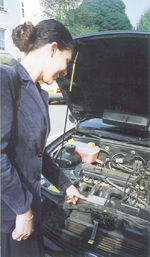
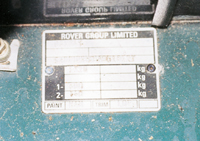
Vin number on an MGF located inside front compartment near brake servo
It’s not just stolen cars which pose a risk to the buyer. Beware the seller who bought on secured finance and found he couldn’t keep up with the repayments. He decides to sell the car – but it isn’t his to sell. Until the loan is fully repaid, the car belongs to the finance house and if you buy it, the car could be repossessed. If the car was on Hire Purchase you could take the case to court and, assuming you were an innocent buyer, you should gain good title. But if the car was leased, tough: once again, you lose the car and your money.
When you’re looking over a car, ask the seller whether he bought it on finance. If so, ask for written proof that the loan was paid off before you hand over your cash. While you’re about it, ask whether the car has ever been in a serious accident, and was it written-off? Every year some 400,000 cars are written-off for accident damage, and a large proportion are repaired and put back on the road. Perhaps unfairly, even the very best-repaired cars never shake the stigma of a write-off and are consequently worth up to 20% less. Okay, so the seller might tell you a bunch of porkies, but faced with a direct question he could come out with the truth.
Checking the Facts
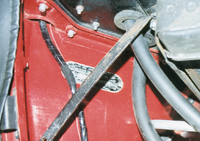
Chassis plate on MGB located inside inner wing just beside radiator
The good news is that there is a way of checking the facts, through the two main vehicle history check companies: AA Car Data Check (0800 234999) and HPI (01722 422422). The bad news is that their information on older vehicles can be somewhat sketchy.
The two services are very similar: each accesses a series of databases to check a car’s hidden history, including theft information from the Police, write-off records from insurers and finance details from the lending industry. There are minor differences: for example, AA Car Data Check offers mileage information to the public and HPI doesn’t. Meanwhile HPI, which has been going since 1938, claims to have a bigger database of historical records; plus for an extra few pounds they will check whether the MOT certificate is stolen.
In addition to theft, write-off and finance records, each check automatically accesses a wide range of data, from import markers and colour changes to full vehicle descriptions. But it’s not infallible. Details of write-offs prior to 1987 are very unreliable, while such things as ringers and clones can be difficult to identify.
Ringers and Clones
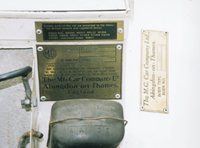
Chassis plate on MG TD located next to battery in engine bay
A ringer is a stolen vehicle with a false identity. The name comes from ‘dead ringer’, as the stolen vehicle has the registration number, and often the VIN (vehicle identification number or chassis number), of another car. VIN numbers were introduced in the very last year of MGB production. So MGs built before June 1979 will be identified by a chassis number and after that time by a VIN number. These numbers should appear on small plate inside the engine bay and will also be recorded on the V5, always check that the numbers on the car match the documents.
Typically, a fraudster buys a write-off from a salvage merchant and then steals a similar model. He transfers the registration plates of the damaged car to the stolen one and possibly the VIN/Chassis plate too. The thief then sells the car, with the registration documents of the write-off.
The next step for the car thief is to think, why bother with buying a write-off? Why not just copy the registration number, and the VIN/Chassis Number if we can get it, from a car in regular use? We’ll have a clone car running around with duplicate documents and we’ll just have to hope the clones don’t park next to each other.
A neighbour of mine was driving merrily along in his recently purchased, 3-year-old Golf GTI, when he came up behind a similar car: same model, same colour and, yes, same registration plate. When he got home he rang the Police. Sadly for him, it was his car that proved to be the clone. The car was taken away and his insurance didn’t cover the loss. Well, what do you expect with a hot-hatch? In fact, a Mk4 Golf GTI is less likely to be stolen than an MGB, Midget or MGF.
Car Thieves with Taste
According to HPI Director Martin Brassell, “MGs are a particularly attractive target for car thieves. The Police recently uncovered a gang which specialised in ringing the more popular MGs and I would caution buyers to look very carefully at the VIN/Chassis Number. Also be suspicious of colour changes.”
Brassell’s warning is confirmed by Home Office figures which give MGBs, Midgets and MGFs an ‘amber’ rating. This means that, in any one year, up to 21 cars in every 1000 are stolen. Of our friends the Mk4 GTIs, fewer than 5 in every 1000 are stolen. Apparently car thieves have better taste than I imagined.
Vehicle Identity
VIN plate on the final year’s production of MGBs located on bonnet locking platform. VIN number itself is stamped into lower clear strip of aluminium
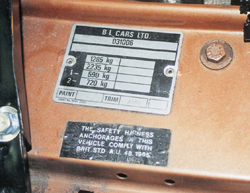
Checking the VIN/Chassis Number is the first step in confirming a car’s hidden history. The VIN/Chassis Number is a much better identifier than the registration plate so long as it is taken directly from the body of the car: it’s usually on a plate in the engine bay or near the driver’s seat. Check each one you find, as it’s not unknown for cut ‘n’ shuts to have different VINs in different parts of the car; even, on one memorable occasion with a remarkably stupid fraudster, different registration plates front and back!
Have a close look at the VIN/chassis plate: are there signs of tampering? Also check any VINs or registration numbers etched on the windows. Do they correspond with each other and with all the available documentation: log book, past MOTs etc?
Keep the full, 17-digit VIN or chassis number to hand when you call HPI or AA Car Data Check. They will confirm whether the VIN/Chassis Number matches the registration number, as well as giving full descriptive details, such as model, engine size and colour, plus the date of manufacture and first registration. Ask the enquiry clerk for the car’s engine number. If the colour, engine or even registration plate has been changed, it doesn’t necessarily mean fraud but it does help clarify what you’re buying. It’s not uncommon, after all, to come across a classic car masquerading as a more valuable model.
Clocking
 Surveys show clocking to be a major concern to used car buyers, but in the classic market a mileage reading can be almost irrelevant. Who’s to say the odometer hasn’t been replaced or run round the clock? Your mechanical inspection is a far better guide to the condition of the car than the mileage.
For newer cars, the usual caveats apply since, as a very rough guide, every 1000 miles knocked off the odometer adds £30 to the car’s value. Check for misaligned digits on the odometer, inappropriate interior wear, fingermarks inside the plastic dashboard fascia… you know the score. There’s always room for a few more tricks of the trade, however. I was looking at a very recent, low-mileage car, when a friend in the trade pointed out a replacement front damper and a rear number plate with no garage name. The damper suggested high mileage, while the replaced number plate, he said, hinted at a rear-end collision. Nothing definite; just indications.
If you have any buyers’ tricks which aren’t widely known, or you’ve been caught out by a ringer, clone, write-off or other used car horror, why not drop me a line c/o the MG Owners’ Club? The more we know about car fraud, the better equipped we are to warn others.
Discounted History Checks

For a limited period, MGOC members can check any car (not just an MG) with HPI for £28 instead of the usual £31. Call 01722 422422 and tell them you belong to the MG Owners’ Club and would like a discount! Remember to have your credit card, and the car’s registration number to hand plus, if possible, the Chassis Number or VIN (full 17-digit chassis number).