MGF Trophy 160-Special Edition
MGF Trophy 160-Special Edition
Kash Uppal of Stour Valley MG Rover has been an MGOC member for many years with a distinguished record of concours successes with his BGT V8. Kash called us up to invite the team to try out the new MGF Trophy 160 on the road and here are our first impressions.
Editor’s View
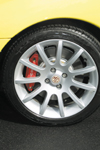
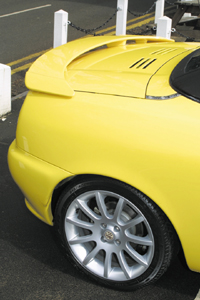
The MGF Trophy 160 is not a subtle sports car it has tremendous presence. Bright yellow paint-work, low ride height, special spoilers and distinctive 16-inch multi-spoke alloys make this variation on the MGF theme a genuine head turner. An effect we actually witnessed as passers-by turned to gaze at the bright yellow Trophy as we were following the car on the way to our photo shoot. The specification is derived from extensive racetrack experience and the result is an uncompromising performance car. 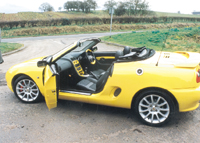 The specification consists of a number of significant performance improvements all of which combine to make the Trophy a very different car to drive from the base models. On paper it has only a modest increase in power but the effect seems quite dramatic in operation. Propulsion comes from a tuned version of the advanced K Series 1.8 litre VVC which now develops 160PS. This 10% increase seems considerably more when you actually drive the car. Braking has also been re-engineered to racecar mode, with the removal of the ABS and fitting of 304mm diameter ventilated front discs with AP Racing, red-finished, MG-branded aluminium calipers.
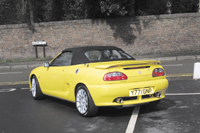
The Hydragas interconnected suspension has competition-based spring and damper rates and 20mm lower ride height. At the front the MGF Trophy features a new bib spoiler and a rear deck spoiler has been added; these combine with the lower stance to reduce aerodynamic drag and lift, enhancing performance and stability. Top speed of the Trophy 160 SE is close to 140mph and it can accelerate from 0-60mph in under 7.0 seconds.
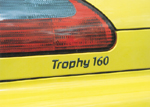 The Trophy 160 comes in four striking paint colours Trophy Yellow, Trophy Blue (both created for the model) Solar Red and the popular Anthracite metallic black. Other distinguishing features include bright mesh grilles for the front and side intakes and the inside of the headlamp bezels are now finished in black.
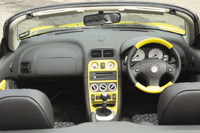
Trophy interiors are distinguished by new body-colour inserts on the door casings and down the centre console. In the case of the bright Trophy Yellow example that we drove, this splash of interior body colour was quite intrusive and may not suit everyone’s taste. I also felt that the leather steering wheel trim (also colour-keyed to the body) seemed to cause reflections in my field of vision. However, it must be said that this would not be as marked with the other body colours and even those intensely ‘bright’ yellow sections on the steering wheel are bound to fade with frequent use. The seats are finished with a special leather/fabric treatment with ‘Trophy 160’ badges, were very supportive and effectively cushioned the occupants against the firmness of the ride. To complete this stylish interior there is also a nifty alloy/leather gear knob.
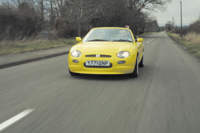 Driving the Trophy is a very different experience from the normal 1.8i machine. The performance and handling modifications change the nature of the F but they do not make it any less effective as a road car. Road holding, acceleration and braking are all improved and make what is already a good car even sharper. The suspension modifications produce a much firmer ride which does emphasise any undulations in the road but on a good surface the improvements seem worth the loss of comfort. The Trophy is a high performance version of the F that pushes the capabilities of an already good sports car even further.
The marketing role of the MGF Trophy 160 SE is to provide another logical step up the MGF range for those seeking extra performance and specification, you can now buy an MGF to suit every driving style and requirement. The Trophy is aimed at the serious performance enthusiast who wants an exciting car to commute in and one that will not be out of place on a track day. The Trophy 160 strongly reflects the increased emphasis on MG’s motorsport involvement within the new MG brand strategy, and this 160 Ps model adds serious, hard-edged driving enjoyment to the established MGF values of fun and practicality.
 UK market versions of the MGF Trophy 160 SE go on sale in early spring 2001 at a price of £20,995 OTR. (The standard MGF 1.8I VVC is £19,495.) It will be made available in selected export markets later in the year.
Views on the Trophy 160 from our Tecnical Support Department
Roger Parker
The custard car, as it has been called, is hardly the most endearing term to describe the new Trophy 160. Nevertheless having seen the frequently published press photos of the new Trophy 160 in just this vivid yellow leaves such a thought in the back of your mind.
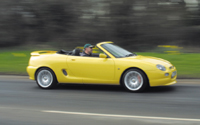 Arriving at Stour Valley Rover showroom a significant part of the frontage was occupied by MGFs both new and old. Squatting in the middle of the line up was a Yellow Trophy 160. I say squatting, as the lowered ride height was patently evident sitting next to cars that themselves were not displaying the all too frequent Freelander ride height. The immediate impression of the colour was that it was not as OTT as the pictures would have you believe, but make no mistake this colour is bright!
The visual statement the car makes is very effective and helped considerably by the addition of the front and rear spoilers. The bib spoiler is fitted neatly to the front panel and from head-on it appears to be quite insignificant. However looking from the side reveals a front lip projection that is quite significant and the claims of its effect on reducing front lift seem quite probable. The rear spoiler is also visually effective and different to previous ones in several ways. The down turned ends in particular, then you notice that there are four evenly spaced mounting points to the boot lid rather than the two on previous spoilers. Fixing is more secure with a new strengthening plate inside the boot lid where the four main bolts come through. Clearly these items are working for their living otherwise there would be no need for this extra fixing arrangements.
 The wheels suit the car well and show off the 304mm discs and big MG Branded but AP Racing calipers off to a tee. However being practical I did take a look at the end-on view and saw that the alloy spokes did protrude somewhat beyond the line of the tyre. This was more obvious at the front where the new 195/45 section tyres are used. Kerb avoidance is most definitely going to be an issue for owners and I see wheel refurbish companies rubbing their hands in anticipation!
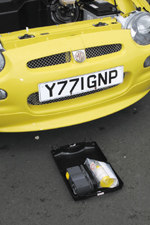
Opening the bonnet revealed a sight that will be a shock to many. The spare wheel well was an expanse of yellow with just a square block of expanded foam in the bottom where the spare wheel would normally fit. In a neat cut out in this foam sits a plastic box which contains a 12 volt compressor and special sealant that is used in the event of puncture. I also noted the stick-on 80kmh label to be affixed to the tyre when it is re-inflated and I wonder how many will bother with that? A full size spare wheel is an option and in view of the potential for scuffing them on kerbs it may be a wise choice, so that you then have the opportunity to send a scuffed wheel in for repair whilst keeping the car on the road!
 Inside the use of body colour on interior fittings was not as harsh to the eyes as I expected, and whilst the yellow would not be my choice, I believe that I could live with it. All other interior aspects will be quite familiar to MGF owners, especially those with 2000MY cars.
Starting the engine immediately reveals the effect of the new exhaust, the note being clearly louder than standard, which isn’t difficult. The engine idle retains the expected quality and smoothness of any other standard F and gives no hint that there is anything extra to be had. Drive off and although this car had only covered 169 miles I immediately felt that the engine was stronger than previous standard VVC cars I have driven. The exhaust note certainly left you in no doubt that this is a sports car and matched the car perfectly. In fact it gave the ideal sound without the noise that is often found with many aftermarket exhaust systems.
The ride is a subject already commented upon by journalists who have previously driven other examples of this car, and this one was no different. The ride is very firm indeed, enabling you to be able to accurately survey the profile of the road surface you were driving over. As a passenger I found this less comfortable than when driving. In return the handling was excellent with very sharp progressive turn in. Unfortunately the test drive did not allow the benefits of the different tyre size up front to be assessed.
Brakes are awesome, and I guarantee that any F driver’s first experience will result in a bent nose! The bite of these calipers on the big discs is sharp for the first couple of applications. Then you adjust to them and find that in all aspects they are quite simply brilliant. Balance is not an issue and neither is progression. My test included periods of heavy rain, flooded road sections and sunshine, so test conditions were ‘varied’! The lack of ABS will be a worrying point for many as for so long now marketing hype has drummed in the fact that we must have ABS. This does make you feel somewhat exposed when the system is not in place, but I have little doubt that this will wear off in a very short time.
Performance was not fully exploited in deference to the 169 miles from new, and the fact that someone will be buying this car in due course. I mentioned that the engine felt stronger than previous VVC cars and even with the restricted operation this feeling was confirmed as the engine revs increased. Experience of several K engined cars with around 170 bhp leads me to conclude that the Trophy 160 is similar.
 For many years I have said that VVC stands for things other than Variable Valve Control, and that the power and torque advantages over the 1.8i are not justified by the added complexity. Now though I feel the VVC spec is coming of age and it is indeed able to justify itself.
The Trophy 160 is half way between the VVC and an Elise. It will not provide the raw excitement, and in some ways suffering, that only the Elise can. It raises the MGFs game by a significant margin, but through the quite hard ride and body colour scheme it also narrows the appeal. The alternative colours help to offset this and my choice would be the Trophy Blue, which is less, ‘in your face’, but still a very bold and striking colour. Quite what visual impact the other standard colours will have I am not sure, but it may then be difficult to distinguish a Trophy from other MGFs. 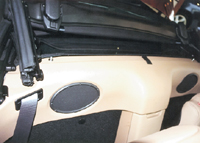 I would love to revisit this car once it has covered around 15000 miles for a number of reasons, but specifically to see how the engine has loosened up and if the suspension has softened any. If that mileage does have this effect, then I would probably join the queue to buy, at the moment though let’s just say the jury is out.
Views on the Trophy 160 from our Technical Support Department
Jonathan Kimber
Having been lucky enough to drive a number of modified Fs from the original Rover race test car to Stephen Palmer converted cars it was interesting to buckle up in to the Trophy 160. The yellow of the car was certainly eye catching, not my choice, but easier on the eye than I had thought. The colour-coded steering wheel was subtle but I felt that the centre console could be toned down slightly suspecting that the Trophy blue, Solar red and Anthracite options would not be as bad perhaps and aluminium options would go down well? The whole look of the lowered car with headlights that now have black bezels, 16″ multi-spoked alloys with the red racing calipers in view, rear spoiler and new front lip spoiler gives the car presence and lots of it.
Enough of the looking – how about the important bit? Driving the Trophy. Turning the key prompted a lovely exhaust note, deeper and more purposeful than the standard car. With only 200 miles on the clock the gearbox was very tight and selection was perhaps not as slick as a car with a few miles on it but nothing to spoil the pleasure. Out on the road the car is quite a firm ride. You can feel all of the defects in the road but not in a harsh manner. Ride comfort is a very personal I found it comfortable but very firm just how I would expect and like a performance car to be.
The first application of the brakes is a surprise. No pedal travel just a lovely firm pedal that inspires confidence. Brush the pedal and you start to slow, press with conviction and you feel as if the car will pull the road up. Opening up the throttle gives an instant response both with the change in exhaust note and rapid increase in speed. When a car’s performance is increased it is not unusual for the driveability to suffer, not in this case, and if anything the low down pull of the engine is better than the standard car.
This car begs to be driven. You do not have to drive it hard but once the engine has freed up over the next 5 – 10,000 miles it has the potential to move from A to B very quickly, putting a smile on your face every time. Would I have one? If my requirements of towing and three dogs allowed of course – but perhaps not yellow. Having sampled a car from, what is heralded as a new era for MG, I can’t wait for the rest.