Magnificent MGA
Magnificent MGA
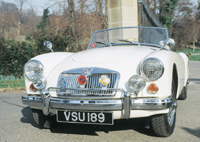
After several conversations with Brian Miles about his MGA I decided to call on him in order to photograph the car. I expected to see a well-restored example because Brian had already told me a great deal about the rebuild and I when I saw the A I was not disappointed. Brian is a man who likes to make a thorough job of every task he undertakes whether it is an extension on his 15th Century timber framed house or the rebuild of an MGA. Spending 35 years flying as aircrew for British Airways gave Brian the opportunity to carry out extensive renovation work on his house and involvement in such projects has developed his eye for getting things to look right. When he organised the rebuild of this classic MGA he decided that he wanted everything done to the highest possible standard. 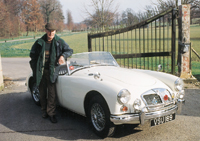 The most appealing thing about the car is that it does not have that unreal glossy sheen of so many restored classics. In fact the MGA looks completely original but brand new, just as if the year was 1960 and it was newly arrived from Abingdon. This impression continues when one is taken for a drive in the A, it stops and starts just like a new car and pulls uphill really well, its 1600 engine revving nicely and providing bags of torque. The body is tight and progress is made over uneven surfaces without any accompanying squeaks or rattles.
Brian bought the car in apparent good order from a dealer for £8,500 expecting to spend perhaps a couple of thousand or so to bring it up to tip top condition. However, being a perfectionist is not a cheap option and when he took the MGA to a professional restorer it became apparent that although the car was sound it did need some work.
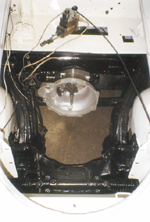 The body is the most challenging part of an MGA rebuild and getting everything to fit correctly is notoriously difficult. Much of the A’s bodywork is original but all the door pillars and the sills needed replacement. In addition the entire wooden floor was replaced with top quality marine ply. Once all these body repairs were completed Brian was not happy with the paintwork, so a respray was also decided upon. The only way to paint a car properly is to strip it down to bare metal and thus it came about that now a complete rebuild programme was underway. The engine and gearbox were taken out and the body removed from the chassis. With the body out of the way the chassis was revealed to be remarkably sound and only a couple of crossbars under the passenger footwell required replacement. The chassis was repaired and then re-coated in black enamel and also filled with warm Waxoyl.
 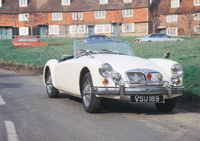 Stripping the body back to bare metal revealed some more small areas of corrosion in the tops of the rear wings that had been concealed beneath the paint. It was now possible to repair this by welding in new metal and then the shell was ready for painting, complete with all its original panels and without any filler. It was re-sprayed in Old English White and reassembled with all new seals and rubbers. Just like the chassis, the sills and all other box sections were also filled with warm Waxoyl.
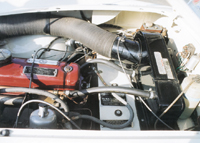
Next the suspension, which was treated to new springs front and rear and all necessary bushes. Brakes were also stripped with new discs and pads fitted and all the brake pipes replaced with copper and the system then re-filled with silicone brake fluid. The engine was completely dismantled and rebuilt as new, as were the carburettors and the gearbox. On re-assembly a new clutch and thrust bearing was fitted; the MGA also has a stainless steel exhaust system with twin tail pipes.
 Brain fancied wire wheels although the car was on steel wheels. In order to make successful conversion he acquired a sound 1600 MGA banjo wire wheel rear axle and the necessary front hubs. This enabled fitting of wire wheels although he chose 60 spoke chrome wires in place of the MGA original specification 48 spoke wire wheels.
The wiring loom was replaced and the car was fitted with new lights, horns, Lucas batteries and just to be sure a new starter, dynamo, relay unit, coil, plugs, and petrol pump. Brian found an expert local instrument company to rebuild all his instruments. He is very proud of his rock steady fuel gauge which works so well because it is driven by a brand new but original spec sender unit, paradoxically the fuel tank is the only component that was not replaced. Although the A had covered 98,000 miles Brian thought it appropriate to clock it forward to 00,000 as the car was having such an extensive refurbishment.
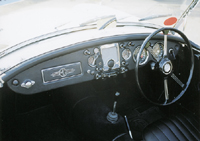
 The windscreen was replaced with a new laminated one. The seats were re-upholstered, fitted with rebuilt runners and covered in black leather, Brian continued the leather theme throughout the cockpit and covered all the trim panels in matching leather along with the dash. The MK 1 roadster dash was originally finished in metal body colour but Brian preferred the vinyl fabric-covered dash of the coupe model, however his car features a dash covered with leather not vinyl. The cockpit rail was also replaced by a new one in yew and this too was leather covered. New black carpets were made up for the A in good quality wool, superior to original specification in fact.
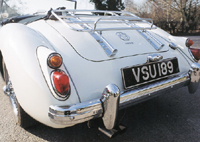
The chrome on the MGA was either replaced or re-chromed, Brian bought a new luggage rack which he did not regard as a properly chromed so he had that re-chromed as well. For complete weather protection the A had a mohair hood and new side-screens and a full length tonneau cover. These details only list the major items and do not chronicle in detail all the work that has gone into Brian’s car, the closest tally he has come up with is that he has spent in the region of £18,500, and this is not including the original purchase price.
The MGA was fitted with a Lucas battery cut-off switch, which Brian used as an extra anti-theft precaution whenever he left the car unattended. For several years he suffered from an occasional but very frustrating starting problem which remained inexplicable. After replacing all the ignition components an auto electrician spotted that the problem was in fact a fault with the cut-off switch itself and its removal has cured the problem.
 Brian bought the MGA in 1990 and the restoration work, which involved three different companies, took around 18 months to complete. He has a photographic record of all the work done on the car. Since the restoration the MGA has covered 3,700 miles, Brian was particularly careful to run-in the rebuilt engine covering the first 500 miles at a steady 40mph and the next 500 miles at a steady 50mph. Brian has enjoyed the MGA and he can claim to have got the car exactly the way he likes it but now he finds that he has less and less opportunities to drive the car. Brian’s wife has developed a problem with her eyes and cannot bear to be in a draught which makes the MGA quite unsuitable and he doesn’t care to drive the magnificent sports car on his own. Neither does Brian subscribe to the idea of laying up classics and believes that they should be driven regularly. He feels that his MGA will only deteriorate if it doesn’t get regular exercise, although he chooses his moments and since its rebuild the MGA has never been out in the rain. Therefore he is reluctantly considering the sale of the MGA; after all this work Brian wants a substantial offer for the car and he is putting it on the market at £22,000, which is rather less than he has spent on it. You can contact Brian on 01892 863597. The MGA comes complete with a full photographic rebuild history, a file of bills and tax discs and MoTs to support the mileage. Brian will also pass on a full collection of reference books and the original workshop manual with the car.