MG Dragonfly
History and Heritage
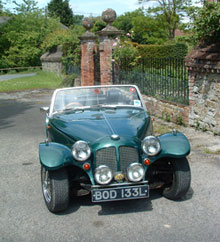
Conceived over many years in the architect’s mind of MG devotee Daniel Pratt from Odiham in Hampshire, the first Dragonfly hit the road in 1981, an MG Midget with a longer chassis, extensively revamped engineering, and a beautiful new body.
Special Dragonfly badge – photo by Stuart Bebb
Dan’s partner was Coach Builder Steve Watson of Hook in Hampshire. Side-by-Side they designed and built the prototypes with Steve’s expertise helping to realise Dan’s dream.
Entrepreneur Mervyn Rees, who later bought Dragonfly Cars Ltd from Steve and Dan was entranced by the beauty of the concept and how the Dragonfly used the latest technology to recapture the glamour of yesteryear.
Original Dragonfly sales brochure
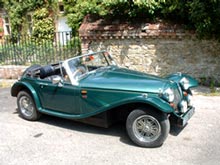
The Dragonfly concept took the base Spridget and extended its wheelbase by very nearly a foot, this improved the weight distribution and gave the vehicle a larger footprint and sleeker design.
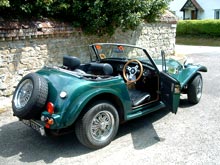
The result was a classic 1930s style soft-top two seater, living right up to the highest British Standards, which dominated this field an archetypal sports car with that long bonnet out in front, beautiful wire wheels and a superb mesh grille.
The original design work tried very hard to recreate the thrill of looking out from the driver’s seat of a classic pre-war sports car.
The Dragonfly Returns Home
It’s believed that only circa twelve cars were produced altogether in a combination of final and kit form. How many kits from this 12 actually made it into the finished article is unknown.
Complete set of components from the sales brochure
Steve Watson’s son Ben, had always had an interest in the car from a young age with a picture of the Dragonfly on his bedroom wall, it was 25 years later he felt they should have one in the family and set about tracking one down. Looking high and low he managed to find one that was for sale. Working in the US at the time and unable to view the car straight away he managed to secure first refusal from the previous owner Mr Sawkins. Having explained the history, Mr Sawkins was overjoyed to think that the car would be back with one of the original Designers.
After purchasing the Dragonfly Ben surprised his father by delivering the car to his house on a trailer. The first thing Steve could say was “It’s got the wrong lights fitted” and I guess the rest is History. The Dragonfly Roadster now fully restored is enjoying its life on the south coast of England with Ben, his wife and their baby son.
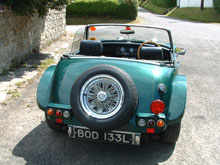
Ben’s Dragonfly on wedding duty – photo by Stuart Bebb
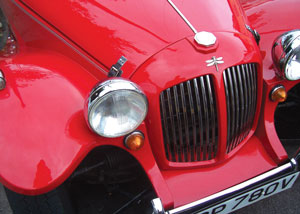
Complex radiator grille was originally going to be made from chromed brass but that idea proved too expensive
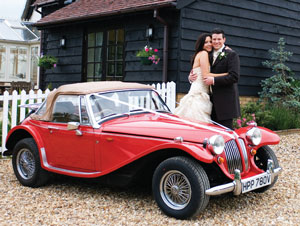
The happy couple – photo by Stuart Bebb
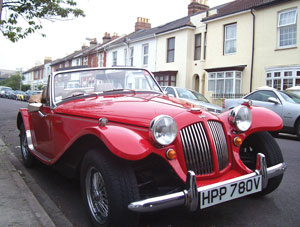
Quality chrome fittings
When Ben and Steve took receipt of the Roadster the doors and the grille needed to be fitted. Unfortunately the engine wasn’t running so Steve took the Dragonfly along to his old colleagues at A.S. Bone and Sons in Hook Hampshire who stripped the engine down and replaced the manifolds, carburettors and fitted a new clutch. Steve also replaced the battery, washer, wipers and repaired/repainted the doors and grille. All of the locks and window mechanisms had to be refitted in addition to the quarter lights.
It flew through the MOT.
Steve Watson Talking About the Dragonfly
Dan Pratt had an Arkley that he built on his Midget and came to me to do all the finishing work and to paint it. He then said, “I’d love to make a design I have in my head but I wouldn’t know how to go about doing it or making the body.” I said to him, I could, and explained that I’d helped create the sand cars used by the Army Generals for Peter O’Toole’s film, Lawrence of Arabia, other projects included painting the James Bond DB5 and also working to convert Ford Zodiac cars into estate cars because Ford didn’t do it at their factory. I was also involved in making the prototype of the Ford Corsair Estate. Whilst at the factory I had the opportunity to learn how a shape was created for the first time on vehicle prototypes.
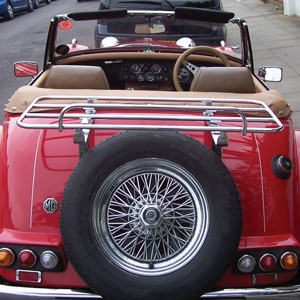
No boot lid and little storage hence the chrome luggage rack
Dan and I bought an old Midget took the engine out, cut the body off chopped the chassis and extended the wheel base an extra 103/8” this may seem a strange measurement but this was the maximum adjustment for the track rod ends to maintain the ‘Ackerman Angles’ of the turning circle.
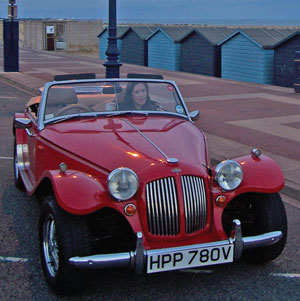
Dragonfly on the seafront
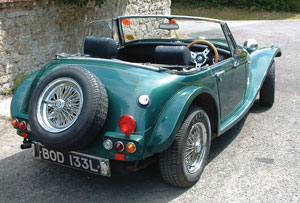
BOD 133L featured in road tests and safety tests
We then built the body, which was added to and altered many many times during the process.
This was done in my spare time from a crash repair and coach building business. To get to a position where the design could be sent off to get a plug made for the production of Dragonfly body panels took four years.
When Dan and I created the Dragonfly we made an aluminium strip frame, we pop rivetted the aluminium strips together and then covered it with a fibreglass mesh over the aluminium frame. I used body filler for hundreds of hours and had to make it perfect, rubbing it down by hand and integrating a brass grille for later chroming.
Ultimately the brass grille idea proved too expensive and was going to cost more than the car itself, so it was discarded and replaced by a fibreglass grille. The brass one was destroyed along with the car body after the plug had been made for the fibreglass pattern.
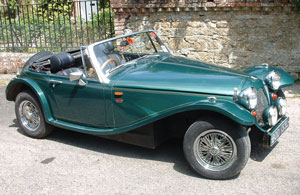
BOD 133L the first Dragonfly
When the first Dragonfly (BOD 133L) “BOD” was completed and ready for the road Dan got in touch with Donald Bastow who was the leading Mechanical Engineer in the country on vehicle safety and construction at that time. Dan asked him to do an independent report on the safety and design of the Dragonfly; he came down and spent a day doing this.
With his report and charges we received a letter saying how much he’d enjoyed inspecting the vehicle and if we wished a good test run would be to his door where we where invited for lunch. Mr Bastow’s report sent to Prudential Insurance in 1981 enabled the vehicle to be insured and classed in the same group as the original MG Midget.
In total seven vehicles (four fully made and three kits) were made by myself and then the company was bought by our friend and entrepreneur Mervyn Rees. Mervyn took the manufacturing of them to his garage on North Camp Aldershot where it is believed that a further five to seven where produced.
Donor cars were hard to come by at an economical price because manufacturing had ceased a few years before. Mervyn had a good idea we used to make trips to the Channel Islands to buy donor cars and import them back into the main land.
Dan and I used to be called over to do the coach lining on the production vehicles and my son in law Jamie Pitter was called over to do the welding of the extended chassis. Jamie is an excellent engineer and was a coded welder.
With the Dragonfly the whole concept was a visual one. Not made for performance but from a visual idea in Dan’s head from a Riley Imp he had seen in the 1930s. Galvanised wire was used for the grille. Some have changed this for visual preferences however the desired aesthetic was for the galvanised wire grille.
The term Dan used for the overall design aesthetic behind the creation of the Dragonfly was ‘Suspended Acceleration’ with the rear tyres designed to be larger than the front this was done on BOD and the second black Dragonfly that was used as a demonstrator.
I can remember taking the black Dragonfly to Reading Football Club delivering my eldest son Mark for training, the coaches didn’t do any training that day, they all drove around the block in the Dragonfly. This black one went to Mervyn as part of the company purchase.
Hoods where made by the London Trim Company slightly different at the back to accommodate the different shape at the rear where everything else remained the same to fit the original frame.
When it was made all the lights including the freestanding headlights all had current Lucas production part numbers. The headlights came with a black body to them which needed to be sent away for chroming, the original side lights which some people have changed because they can’t be purchased any longer where from the Austin A35s, the reversing lights flasher and side lights at the rear where all current lights from the original Mini.
It should be noted and is important to remember that the Dragonfly is not a kit car it is a car conversion a robust sports classic to be loved by all.
I invited the owner of Kit Car Magazine to write a report on the Dragonfly because he owned several other magazines that dealt with kit cars and that type of sports car. He was thought to be the world leading authority on kit cars at that time. After he came down and did the report he said it was the best conversion he’d ever seen… Because the concept had retained the hood fitting, windscreen, multi manufacturer interior and the door locks, winders, quarter lights etc that could only be produced by a multi manufacturer such as MG.
Some people view this car as the rarest member of the MG family with what I estimate would range from between ten to fifteen vehicles ever being made.
Ben Watson