Heat and Dust – The Classic Safari Challenge September 2008
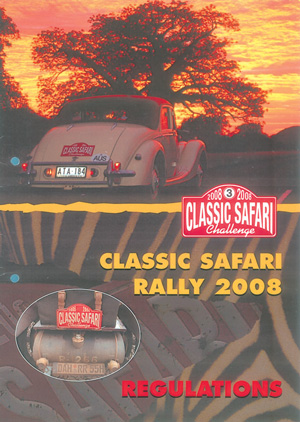
Having barely completed the London to Sydney Rally in 2004, and just about rebuilt the car with the help of Ian and the MGOC workshop team in order to complete the 2006 Rally des Alps, it was about time for myself and SME 289S to have a rest. 2007 was an uneventful MSA euro drive and with a house move planned to be completed in May/June 08, therefore I decided to add one more challenge and up popped the Classic Safari adventure for Sept 2008.
Late in 2007 the car was ready for serious modification after blowing the exhaust manifold in France on the way back from the MSA Euro Classic in Portugal. The clutch and front race had given up and the carburettors were difficult to hold steady. Ian advised radical action so out came the engine, to fit a new clutch and a carbon thrust bearing. New oil seal gaskets on the exhaust side inspection plates. All new fuel lines with and upright 11/2 SUs (no more grovelling with O rings from the bottom or vapourisation problems as in the London to Sydney). We ditched the aluminium radiator (too difficult to weld in the middle of Africa) and replaced it with the competition steel version complete with Kenlowe fans mounted front and back. We welded the top plates onto the wishbone mounting to give more strength to the front suspension. We took off the steel bonnet and number plate to be replaced with fibreglass version with self-adhesive numbers, another 100lbs off the front suspension. We fitted four new Avon 185/70R14 CR22 van tyres and two Dunlop SPs in the boot with four inner tubes.
Soon everything was ready and I took the car to Tim Beal and Pete Dalton up in Lincolnshire for their expert opinion plus a complete rally pre-preparation. Then we delivered the fully prepared MGB GT to the docks and it was dispatched to Cape Town. This time my navigator would be my wife ‘Trish’ so it would be either “never say die” or divorce. The event was to be 23 days of long distance tarmac and smooth gravel staying at 5 star lodges with the opportunity to see wildlife along the way with time off for a swim or even a round of golf, so said the ‘marketing package’. We would run from Cape Town and back to Cape Town via South Africa, Namibia, Botswana, Zanzibar, Swaziland ending at the Cape of Good Hope back in South Africa. In summary the route (off main roads) turned out to be very difficult due to early rains washing out the dirt that forms the smooth surface leaving very difficult rough corrugation (not ideal for an MGB).
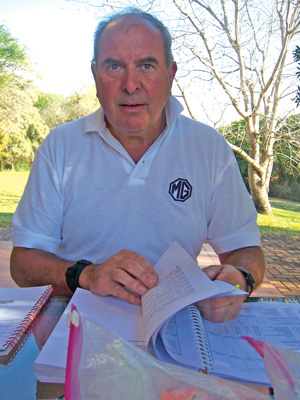
David consults the route book
Up through the Cedarburg Mountains and across the vast Namibian desert, almost nothing passes by this route other than game and tribes people. The roads sweep and turn through mountain passes and giant sandy dunes. The desert flora changes colour by the hour as we head off across the Caprivi Strip with elephants crossing the road at will. We stop in Kasare to enter Zimbabwe (Victoria Falls) followed by an eastern route through the Kalahari Desert.
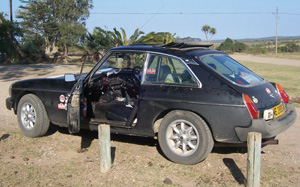
One MGB GT in rally trim
Back in South Africa to explore Kruger Park and the gravel roads to Isandwana and Rorke’s Drift, both soaked in blood and history of Zulu Wars.
Up in to the Drakensberg Mountains to Cathedral Peak and some scarily difficult gravel on the way to the Indian Ocean and Karenga Game Reserve. Into Le Karoo for more stark and semi desert before hitting the wine mountains at Franschhoek. The final day to the Cape will let us finish at the end of the world and see the Atlantic meet the Indian Ocean, it sounded idyllic but the reality was somewhat different.
Twenty-six entrants and the event’s six support vehicles arrived in Cape Town on the 19th August and each one had to be at Scrutineering by 4pm, followed by route book briefings. Each day would be timed with varying numbers of Time Controls and special stages. One penalty point for every mile late on stages and a 30 minutes penalty for any TC or PC missed. We were warned to avoid dead bushes because they have thorns stronger than nails, punctures are guaranteed if you run over them, and of course we must give way to rhino, elephant, lion and cheetah, et al.
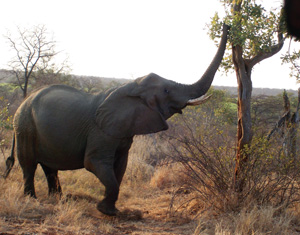
Typical hazard
Our drama began in the docks, the car started beautifully after its eight-week trip but a large pool of fuel appeared under the tank. Change fuel pumps (good old Ian had fitted twin SU electric pumps in parallel) so it was only necessary to change over the spade connectors. Same problem, so we crawled under the car to discover that the braided T valve feeding both pumps was loose, so we simply tightened up the jubilee clips and cured the leak. The front sump guard was vibrating so we found a Porsche race preparation shop close by the docks and changed over the polyurethane gaskets for hard rubber, problem solved, no charge. Off to Scrutineering, everything OK except our fire extinguisher was judged too small but it was agreed we would buy an extra 600/900cc unit en route.
Day 1.
Cape Town to Clanwilliam 332kms. This leg consisted of two gravel stages, through to Cedarburg Mountains, we stopped to see the rock paintings before crossing part of the 170,000 acres made into a wilderness area in 1973. The car felt good, especially the engine mods, they have given super engine response, nice to have that purr back with a bit more poke.
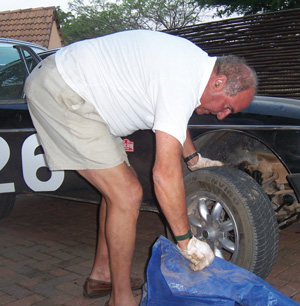
David fettles the BGT
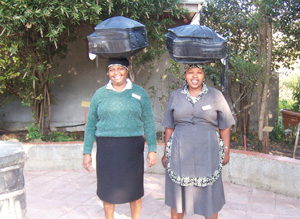
Cheerful porters
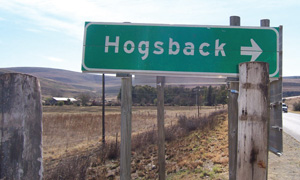
Hogsback sited on the slopes of the Amatole Mountains, overlooking the rivers and fertile plains of the Tyume Valley in a region dominated by three ridges said to resemble the bristles on a hog’s back.
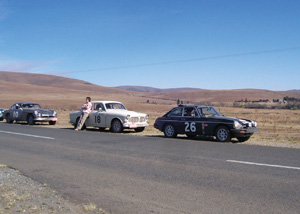
Pause for reflection
Day 2.
Clanwilliam to Fish River Canyon 618kms. Onto gravel and tarmac to the Namibian border via the Elephant’s river. Things were getting rough especially the special stages, all on gravel; we crossed the Namibian border and the dry Orange River. Namibia was dirt roads throughout but we had back up from the truck and tyre services just in case of problems. We stayed overnight at a lodge where the colour of its building materials blended with the desert background.
Day 3.
Fish River Canyon to Sossusvlei 500kms. Namibia is four times the size of the UK or 27 times the size of Belgium. We spent a day on gravel to the sand dunes over the Tsairsberge Mountains. Here our overnight lodging was built of clay and thatch looked directly out over the Sossusvlei dunes, with mountains of sand as far as the eye could see.
Day 4.
Sossusvlei to Swakopmund 350kms. Before we started the day proper we tried to check out the MG Magnette that went off on a special stage yesterday. It’s having fuel pump problems and both rear wheels were bent. We visited the dunes that rise to 300m high and form part of a 300km long by 150kms wide ‘sand sea’ along the coast. We were doing well and had only lost six minutes when we stopped to try and help the Magnette. On through the Namibia desert for more gravel with the rattles getting worse but onwards to Swakopmund. When we arrived I was worried about rattles in the front right suspension. I went to El’s tyre depot to find that the offside front shock absorber was hanging in mid air after the top bracket now welded to the top and suspension block had shattered. Soon however, as on the London to Sydney I found a welding shop with a wizard TIG welder speaking Afrikaans English which is almost impossible to understand. He said new plates will take two hours while I waited in the bar. On my return I found the Merryweather Jaguar S type having new exhaust brackets, the Volvo 142S of my friend Jose De Sousa a new axle casing for its rear axle, and the Mark II Jaguar new engine mountings, so I felt a bit more at home. The MG was ready with welding to new brackets and how it stayed like that through terrain ahead is beyond belief.
Day 5.
Swakopmund to Twfelfontien 324 kms. Up through the skeleton coast amid daunting sand and sea mists. Elephant are very common; the special stages are through villages so it was difficult to judge speed and safety. East of the Brandenburg Mountains to the high part of Namibia through deserted plains with only the odd tribes people in circular reed huts. We stayed at a “Hollywood film setting” no not really, but until you arrive you cannot differentiate the lodge from the massive outcrop of orange rust coloured rocks. It was a fantastic place to have visited and the staff all formed a choir to sing us local folk songs after supper.
Day 6.
Twfelfontien to Ongava 400kms. Onto Damoraland through the natural habitat of desert with elephant, black rhino, giraffe, cheetah and hosts of antelopes and springbok. Everyone had a hard day and the roads were getting worse. Our MGB was still running well and we had only picked up 14 minutes of penalty (8th overall and pushing). We heard today that the Mark II Jaguar has had serious suspension problems but like everything they got it fixed by the wondrous back up teams of Andy/Chris and Richard/Simon. That night we stayed at Ongava Lodge, each room a small house with a bath in the middle of the bathroom floor. Trish went off to look at the wildlife by Range Rover while I stayed behind to tighten up bolts and have a well earned bath. The phone rang to say we had lions in the camp, I looked out and there was a mother and cub outside my window. We learned later that the hotel had once lost a guest in 2007 who’d returned to her room without an escort to find a hungry lion in her path.
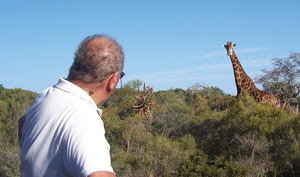
Giraffe on route
Day 7.
We are driving across the Etosha game reserve to our rest day lodge at Mokuti. Unfortunately the MG Magnette had lost a rear wheel with the half shaft still connected. Andy and the guys hammered it back into the diff but their race was over. The Jaguar Mark II was also falling off its chassis, so both cars were retired back to Cape Town. The Corsair was driving on no suspension and a loose steering rack.
Day 8.
Mokuti to Popa Falls 562 kms. We dropped two more minutes today but it was gravel roads and dust, pretty good by Namibia standards. Fifteen kilometres from our Time Control we heard serious “clunking” noises from the rear end.
Trish has been doing calculations for fuel consumption because during parts of the day there was no fuel available for over 280 kms. We calculated approximately 9 – 10 kms/litre, we had a 50 litre tank and carried 5 litres in reserve. We made Time Control at end of the day but I was nervous about the differential. Before committing Andy and Richard I went into investigation mode. The diff bolts were all loose and there was almost no oil. The main problem was both rear wheels had become loose; the wheel nuts took at least half a turn each. Andy and Chris tightened up the diff, refilled it with oil and we were back in the running. Everybody was having problems and I think the organisation was starting to have concerns about the rate of attrition (three cars had now retired).
Day 9.
Popa Falls to Kasane 445 kms. We drove the Caprivi Strip along the border with Angola and onto the Botswana border, we travelled all day without a gear change in overdrive top at 100km/hr, it was hot and exhausting. The roads were gravel and more entrants were having problems including the big Bentley which had seized its diff. We stayed at Mavsana Lodge for two nights which gave time for repairs.
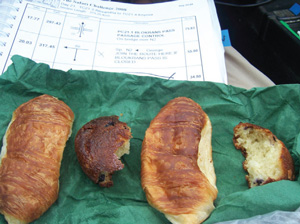
Working brunch
Day 10.
Visit to Victoria Falls that was in itself a fantastic spectacle. It was frightening to see the devastation at first hand for the people of Zimbabwe. We managed to persuade our guide to obtain two 100billion Zimbabwean dollar notes, for which we paid one US dollar, these are unbelievable. I have given one to each of our sons and made them multi-billionaires.
Day 11.
Kasane to Salebi Phikwe 630 kms. We remember this day for the incorrigible ‘potholes’, some of them very deep and axle breaking if taken too fast. We drove in first gear and climbed our way through 60km sections towards fuel time, it was very hot and suddenly the temperature gauge started to move towards red. We needed to get some air moving through the radiator and clearly the fans must have stopped. Fortunately we managed to limp into the Caltex fuel station which was our TC after 331.53kms. I needed a probe to find out what had happened to the Kenlowe system and out of the garage came ‘Christmas’, a friendly soul who hard wired the fans to a main line in the fuse box to keep the fans on permanently with the ignition. Andy and Chris sorted the problem at the overnight stop, it was a 35amp fuse that overheated. The system then went back to thermal cut out for the rest of the event. We had crossed the Kalahari Desert which is bigger than Switzerland.
Day 12.
Selebi Phikwe to Agatha 423 kms. The Ford Corsair finally gave up the ghost and the big 4.5 litre Bentley was on a transporter to Cape Town. We set off for Zanzibar which I had thought was an island but it exists as a border crossing and is a country within South Africa. Up the Limpopo river valley and into South Africa, we were running very well. We found that we had little or no oil in the gearbox, so we used a squeezy bottle with a long nose fill it up with sump oil.
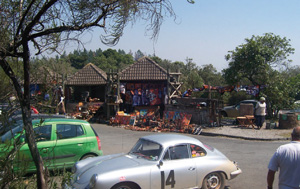
Village life
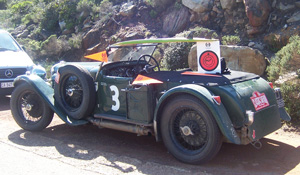
The Friedrichs’ 1933 – Alvis Speed 20
Day 13.
Agatha to Pestana Kruger 400kms. We heard that the medal sections were cancelled because the pot holes were too difficult to navigate, so we went to the Casper neck Pass and on to God’s Window, 700 metre cliffs into lush forests, a fantastic view. We kept going despite mechanical noises that were too difficult to diagnose, so we just ignored them.
Day 14.
Pestana Kruger Lodge. Day off thank goodness.
Day 15.
Pestana Kruger to Phinda 421kms. We noticed our reserve fuel tank was getting very inflated so we decided to release pressure every stop. Pressure builds up through the intense heat generated by the rear window of the GT’s hatchback. Through Swaziland back into South Africa with lunch on the way at the Royal Swaziland Golf Resort.
Day 16.
Phinda Game Reserve for the day, leaving time free for a thorough bolt checking and fluid top up.
Day 17.
Phinda to Cathedral Peak 476kms. We arrived at the Zulu battlefields to hear that one of the 4×4 crew had rolled in the special stage, so everybody was concerned about how they were. It turned out that Hilary had broken a finger but both were OK. The Jaguar XK120 of Christine and Graham Daly had finally stopped, so yet another car was on its way back to Cape Town. Richard in the Saab 96 also packed up so we were really becoming the walking wounded.
Our visits to Isandlwana and Rorke’s Drift were memorable; at Isandlwana the British Army suffered a great defeat when over 1400 soldiers were slaughtered by Zulus. At Rorke’s Drift 150 troops held out with only 17 casualties, 14 Victoria Crosses were awarded in the engagement, more than any other battle in history.
By skilful management of fuel we were still only 20 minutes of penalties behind the leaders and with a full tank.
Day 18.
Day off and more golf against the Aussie’s which they won, so we are all square in the match.
Day 19.
Cathedral Peak to Elliot 544kms. We travelled on gravel roads like corrugated iron and by the time we stopped at “The Lemon Tree” in Inderberg I was all for calling it a day, I felt that the car couldn’t take much more. We finished with time to spare but then Trish told me that we still had to go a further 20kms up a mountain of 7000 feet to find a hotel called “Mountain Shadow”, I was not amused nor were other crews.
Day 20.
Elliot to Kanega 411kms. After rising at 5am we had to go back down the mountain 30kms to the start, then wait 30 minutes for first TC to open for the gravel section. We did well but nearly wiped the Porsche 356 out at the end of the special stage. We only had a minute to spare so pushed very hard then locked the brakes in the dust, what I didn’t realise was that the preceding Porsche had not moved away from the end of the timing area. We went left down a bank but stopped over the timing line so no damage and no penalty.
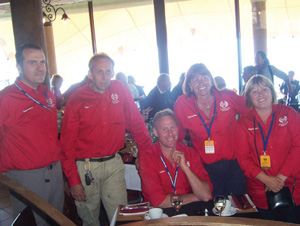
The team of Organisers
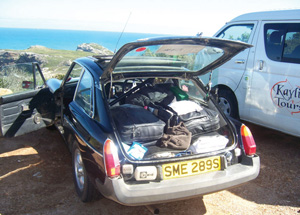
The BGT fully loaded
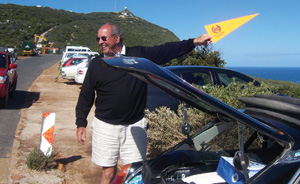
Grand Tourer
Day 21.
Kariega to Kwysna 432kms. We were off to see the sea for the first time since we left skeleton coast in Namibia. The little Alfa 750 Spider has broken its rear axle so was a day behind trying to get it welded. The Fredricks’ super Alvis had broken its front stub axle, so it was put on a truck to a museum in Port Elizabeth. We left the TC start on time but when we turned left out of the gates I couldn’t steer properly. We turned back to find the support crew and found that the front engine mountings had collapsed on the offside, jamming our steering on the offside track rod end. We had to get to the next special stage only 14 minutes away so Richard and Simon used a crow bar to move the engine upwards and jammed a piece of 3”x2” wood between the chassis and the alternator. Off we went and did the stage in regulation and drove the 400km to Petula. Andy and crew took the mountings and welded them, put them back on and we finished feeling better than at the start. Thanks to Andy, Chris, Richard and Simon for a fantastic job that saved the car and left us without penalties. Unfortunately I was late for the deciding UK verus Aussie golf match so after five holes we called it a draw.
Day 22.
Krysana to Franschhoek 500kms. This was going to be a long day and I was worried about the suspension, axles, and now the engine mountings but the engine still sounded and felt great. Brakes were fading but Richard helped me adjust rears and handbrake and this gave me a bit more confidence (we had won a special section the previous day so we were feeling good). We were in wine country and drove through spectacular passes. That night we celebrated because we had won that day’s special stage as well.
Day 23.
Franschhoek to Cape Town 200kms. What a day, we found it endless but once we reached the Cape of Good Hope everybody finally relaxed and realised a very difficult but memorable adventure was over. The MGB went superbly well, Trish was a great companion and navigator and we are still married. We came 7th overall and fourth in class behind some serious competition which was an achievement made possible by Ian and team at the MG workshop, Tim and Pete and en route Andy, Chris, Richard and Simon. The car was back in the UK on the 8th October ready to go to Silverstone for the Norwich Union Classic.
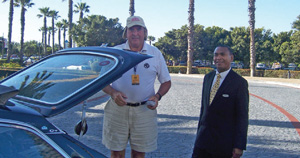
David takes the time to chat
Footnote:
Can you believe it? Having covered the 8,000kms of rally stages without scratching the car; we find it had been shunted in Cape Town before being dumped in the container. Watch this space for the further adventures of possibly the most rallied MGB GT ever?
David W. Miller