Gas Guzzler – MGB GT
I can almost hear the groans as the traditionalists amongst you are about to turn over the page in disgust. Anyway, in the spirit of open mindedness please bear with me and you might be surprised.
Back in August, when I visited the Staffordshire Moorlands MGOC to celebrate their first anniversary, I was asked by Paul Williams, one of their members, to take a look at his MGB GT.
From the outside it looked just like any other rubber bumper GT, except for a small plastic flap in the rear bumper. Anyway, Paul popped the bonnet and there were some strange extra bits in there, which he explained enabled it to run on LPG.
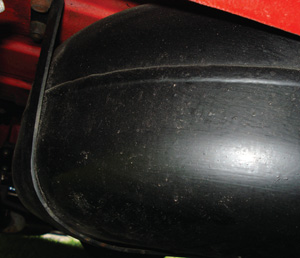
1. Gas tank in place of the standard fuel tank
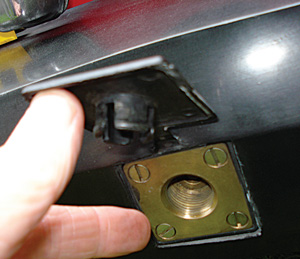
2. Gas inlet in rear bumper
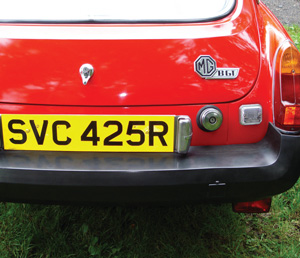
3. Rear of car showing gas inlet flap
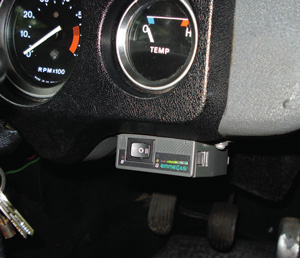
4. Dashboard gas control unit
Now you may shoot me down in flames, but is this possibly the only one? You may be thinking, who cares? Well in today’s financial climate maybe quite a lot of people. Petrol prices are unlikely to go back down significantly now that they have breached the £1 per litre threshold. Which unless you have a lot of shares in an oil company is very bad news and it’s getting increasingly more expensive to run any kind of vehicle, let alone a 30-year-old classic. Most of us have to think about fuel costs before taking part in road runs or attending events a long way from home. As for running an MGB as your every day transport for anything more than just popping down to the shops, it will be increasingly expensive.
I was even more intrigued when Paul explained that he’d actually done the conversion around seven years ago when he renovated the car, with the intention of using it, at least initially, as his everyday transport, being a self employed electrician. So we weren’t looking at something that had been initiated by the current credit crunch or fuel crisis and its reliability had been tested to the full.
For those of you who are not familiar with the technology, the way it works is that you store liquid gas in a special tank in the car, normally in the boot, which is then piped to the engine compartment where a vapouriser atomises the liquid into a gas and this is introduced directly into the carburettor intakes, instead of petrol. This gas burns in a similar way to petrol and at a similar rate. However, LPG is cheaper and this saving equates in the case of Paul’s car to cutting his fuel costs by half.
The downside is that there can be a reduction in performance, however, on the road the car performed really well, was very lively and the engine ran smoothly. Bear in mind that I am no “Stig” and this was in no shape or form a proper road test, but the BGT just felt normal.
With regard to the performance reduction, I am told this is due to the carburettor intakes being reduced by the gas intake venturi plates, which sit between the front of the SUs and the air filters (11/2“ down to 11/4”). However, the experts tell me that correct tuning will compensate for this and in practice it’s hard to tell the difference.
Paul bought the car as a wreck back in 1990 and it took him until 2001 to get it on the road, learning to weld along the way. He set out to build a car that could be used every day as well as for pleasure, it was this idea that led him to investigate doing a gas conversion. He approached a local conversion specialist garage (Cargas in Stoke) and bought a kit for around £600 which included everything he needed to convert his MGB. Apparently kits are available for most cars. One of his biggest problems was finding a place to fit the tank, which is shaped like a doughnut about the size of the spare wheel, in fact designed to fit in the spare wheel well in the boot. However, he wanted to keep the spare as well as having another tank for petrol on board for emergencies and starting the car in cold weather. One point here is that it is recommended that you start the car on petrol and once it’s running switch over to gas, especially important in the winter. This doesn’t involve running round to the front of the car and turning on a tap, all you do is press a button on the dash and valves and relays do the job for you.
Paul’s solution was to ditch the standard petrol tank and mount the gas tank in place of it. He then fabricated a small petrol tank which wrapped around the driver’s side of the gas tank and utilised the original sender. This tank holds around 21/2 gallons. He admits that sealing this tank was challenging and took quite a few attempts.
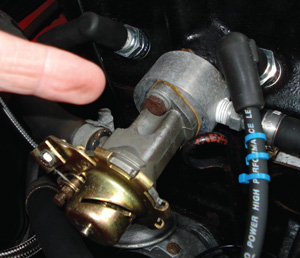
5. Heater valve adapter
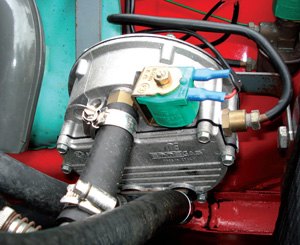
6. Gas vapourizer
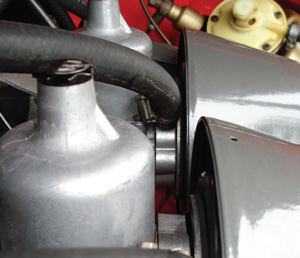
7. Carb venturi adapters
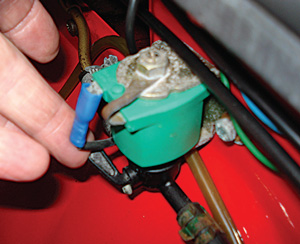
8. One of the fuel control valves, with manual override tap
With this arrangement he could be sure of keeping the car running even with the sparse coverage of LPG stations that were to be found back in 2001. No problem these days because many forecourts now sport an LPG pump.
Of course huge developments are taking place in the LPG conversion market and a smaller profile gas tank will become available which could be used with the standard petrol tank.
Another thing to consider is the cylinder head valve seats, which will be ok if you have already had the lead free conversion, but Paul considers that it’s better to spend a little bit more and get the correct gas type fitted if you can. However, Cargas tell me that an ordinary lead free head is just fine and they have even run non-converted cars over long periods with no problems.
Also as the gas when pressurised is below freezing, it will freeze the vapouriser solid if you don’t heat it up. To get round this an adaptor is supplied which is plumbed into the heater pipework which uses hot water from the system to keep the unit warm. There was an in-built design fault with this, as you had to have the heater on to get it to work. This was resolved by fabricating an adaptor to sit behind the heater valve against the block, which meant that hot water was always available to the unit. In the early days he didn’t bother with this heating arrangement and the vapouriser froze up solid stopping gas flow for an entire journey to Llandudno and back from Stoke.
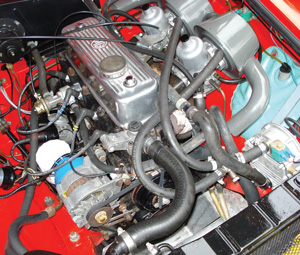
9. Engine bay showing LPG components installed
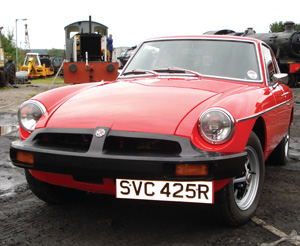
10. Nice looking GT
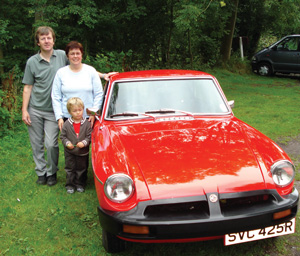
11. Paul and family with his converted BGT
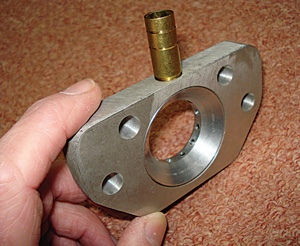
12. Close up of carb gas venturi plate
DIY kits basically consisted of the following; gas tank, pipes, vapouriser, control valves and relays, carburettor venturi adaptors, hoses, dashboard control unit with gas gauge built in.
On the safety side, you still need to get the converted car inspected by an approved LPG installer who will issue a certificate for the installation. Almost certainly required by your insurance company.
The car has covered around 18,000 miles since the conversion and apart from the Llandudno incident has been totally reliable.
Paul tells me that there’s hardly any tuning required and the oil stays crystal clear.
I visited Cargas and met John Walters who is the Roger Parker of the LPG world. Basically what he doesn’t know about automotive LPG systems isn’t worth knowing. Another surprising thing was that the emphasis was not just on economy or reducing pollution, but they are also involved with high performance projects, keen to explore the potential of LPG power to the full. How about a 3.9 V8 Rover engine which runs on LPG, is supercharged and develops around 340BHP on their rolling road with only a mild tune? They were keen to show me this and took the revs up until it hit the limiter, I can tell you it was most impressive and as smooth as silk, no ear defenders required.
Most of their work now is on modern multi-point fuel injected engines, with all of their associated engine management systems. All of which make our simple twin SU set-up look like something out of the ark. Not surprisingly Range Rover and Rolls Royce owners are amongst their customers.
One point that John makes is that if the engine and ignition system on your car is tired, then don’t expect to get good results with LPG, basically if it’s shot before conversion then it will still be shot after. Particular attention must be paid to the ignition system.
They tell me that sourcing an adaptor for the heater valve and supplying a small petrol tank would not be a problem at all. You would need to spend in excess of a £1000 to £1500 to have your car professionally converted which would take a fair time to recoup. However with the current cost of kits still at around £500 to £600, then the exercise becomes much more viable as a DIY project. Not forgetting that you could help to save the planet along the way.
Now I am not suggesting that you all run out and get yourselves a kit, but it’s certainly worth considering and Paul’s skill and ingenuity in carrying out this conversion deserves full praise.
Visit the Cargas web site www.cargas.co.uk where you will find a link to the LPGA who will be able to point you in the direction of a local supplier. Although, Cargas can ship kits to anywhere in the UK if required and are always willing to give advice.
Finally some facts and figures gleaned from a recent article in the Daily Telegraph; ‘Using LPG in place of petrol can cut you fuel bills by half, with a litre of LPG costing 50p compared with 97.8p per litre of unleaded (Nov 2008). The number of motorists using LPG has increased from 3500 in 1998 to 150000 this year, with 1400 service stations in Britain now selling the fuel. Gas engines emit 20 percent less carbon dioxide than petrol driven ones’.
Roy Clarke