MG Maestro Turbo
Faster than a Ferrari
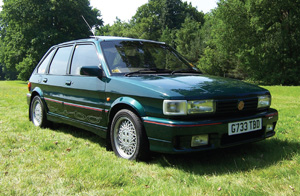
That’s what the Austin Rover’s advertising campaign stated in 1989, in actual fact the MG Maestro Turbo was faster than a Ferrari Mondial. Well from 0 – 60 mph at least! There were only 505 (215 in Red, 149 in Green, 92 in White and 49 in Black) of these very special and exclusive Maestros made. You can understand my excitement then when I came across father and son Frank and Christopher Lovelock’s British Racing Green Maestro Turbo (number 345/505) at the Southern Classics gathering at Chichester, West Sussex in April of this year. However, before I describe Frank and Christopher’s story in more detail, let’s remind ourselves of how the Maestro Turbo came about.
Unlike the MG Montego, turbo charging the Maestro came much later, if a little too late, in its production life. In 1984/85 an initial testing programme was embarked upon to see if the Maestro chassis was capable of handling a turbocharger. At first Austin Rover was coy about a potential turbocharged Maestro and by 1988 the idea appeared to have slipped their minds.
MG Maestro Turbo body kit featured fibreglass bumpers, incorporating front driving lamps
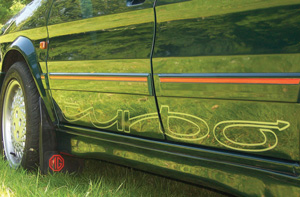
Maestro Turbo body graphics
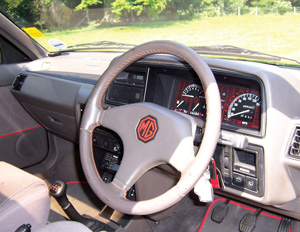
MG Maestro Turbo interior with Red beading on the mats and door trims
However, at the October 1988 Birmingham Motor Show, Austin Rover took the wraps off a new Maestro Turbo model; and immediately received an enthusiastic response. Various improvements were incorporated, including an impressive body kit, designed by Austin Rover but produced by the well-respected Tickford specialist car company. The body kit featured fibreglass front and rear bumpers, the front incorporating driving lamps, full-length side skirts and a roof-level tailgate spoiler. The body kits were colour coded along with the side mirrors, grille and side mouldings, and except for the Flame Red models, each car featured a contrasting Red insert strip (Flame Red had a Black insert strip). As with all other Maestros, main production occurred at Austin Rover’s Cowley plant, near Oxford. Maestros destined to become turbocharged came off the production line minus the bumpers, tailgate spoiler and exterior body graphics, then shipped to Tickford’s for finishing. Before being dispatched to car dealers the cars returned to Austin Rover where they were assigned a build number.
Returning to Frank and Christpher’s car, it only had one previous owner from new, with just 57,000 miles on the clock. Due to a change in his circumstances the previous owner let the car go in April 2007; Frank informs me that the owner was very sad to see it go, which is hardly surprising. It is brilliant to see that it has gone to a very loving home, the genuine enthusiasm for the car both Frank and Christopher show is very obvious. The moment I saw the car I was very impressed, it is in an original and thankfully un-modified condition, with even the factory fitted Phillips radio/cassette still in place. When Frank had retired from his job in the car trade he could never have imagined that he would own a car of such rarity and interest. It was actually his son Christopher who suggested that he and Frank should think about buying a modern classic to take to car shows, as Frank had some much deserved free time in his retirement. Naturally, Frank was unsure as to whether he wanted the commitment of a classic car and all the problems it could bring, but he soon came round to the idea. However, Frank laid down some clear conditions as to what he wanted in his potential car. The car had to be different, not too complicated, not an open-top car and most importantly it had to come with a sound history. A MG Maestro Turbo appeared to tick all of the above boxes. Frank and Christopher actually found the car on the MG Maestro Turbo Forum website not long after their search for a Turbo had begun. Having been in the car trade for a number of years previously, Frank had never come across a Turbo before, he admitted that “It was a very lucky find for us”. Since owning the car Frank and Christopher have won an impressive array of prizes. For example, it won best Turbo at the MG ‘M’ Group (the Club for MG Metro, Maestro and Montego Enthusiasts) Saloon Day last year, plus a string of other prizes, due to its original condition and exclusivity.
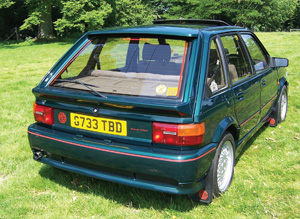
MG Maestro Turbo with special rear bumper, full-length side skirts and tailgate spoiler
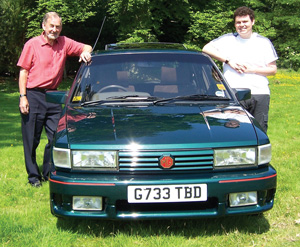
Frank and Jamie by the immaculate and original MG Maestro Turbo
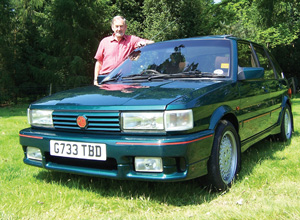
Frank Lovelock by his MG Maestro Turbo, capable of covering 0 – 60 mph in 6.7 seconds
After seeing the car at the unfortunately quite wet Southern Classics event I thought that the readers of ‘Enjoying MG’ would enjoy reading an article on this car especially as it appears that so little is known about them in many MG circles. Therefore, having obtained Frank’s permission to write the feature, he subsequently very kindly invited me to his home just south of Horsham, in West Sussex for a real good look at the car and most importantly a test drive. I hadn’t actually been in a Maestro for some years but as soon as I stepped into Frank’s, I remembered it quite fondly, although this was probably going to be a bit quicker than the 1.3 Maestro my uncle used to own. The local roads around Frank’s home (a mixture of fast trunk road, and mainly twisty country roads) were just right for a pleasant drive to see how the car handled and performed. There is no doubt about it that this is a very quick car; especially through the gears when the turbo kicks in at about 3000 rpm. It is certainly one of the fastest accelerating hatches I have been in which includes the Honda Civic Type R and the Ford Focus RS. There was absolutely no sign of any torque steer when accelerating hard, which is unusual especially when you consider that the front wheels have to steer and put down the 150 bhp that the OSeries engine produces. The handling of the car was pretty impressive too, with no obvious excess understeer or oversteer present. Frank insists that both he and his son drive the car well within its limits to ensure nothing catastrophic happens to any of the engine or suspension components. One area Frank is particularly cautious with are the brakes on the car which he feels are “not the best”; I suppose it reflects the cars age with vented discs at the front and only drums at the rear; however at least there is no ESP or ABC (or whatever these modern braking systems are called these days) to intrude on the driving experience!
I must say that when I left Frank after the drive I came away quite envious and very pleased to have seen that such a rare and unique car was now in such good hands. It seems to me that the Metro, Maestro and Montego are the forgotten MGs which is a shame, when I was growing up it was not the MGA, MGB, MGC or Midget that got me interested in the marque but actually these three models that I remember. I do hope that in time, what few of these underrated performance saloons left on our roads achieve the respect they deserve in MG circles, of course the original products of Morris Garages were derived largely from saloon cars of the time. Potentially, there are less than a hundred MG Maestro Turbos left on the road which means they will be a rare sight, if you see one for sale – then I suggest buy it.
One final thought, it may only be a Maestro, but there are not many cars these days that can beat or even equal 0-60 in 6.7 seconds and do 135 mph (where allowed), what a shame they did not make a few more of them, that really would have given Ferrari something to think about.