Revival of an Old Friend (Part 1)
Part 1 Background
Hands up all who think that I have fully migrated to only 21st Century MG models? Hmmm, that many. Well surprising as it may seem I still own and cherish my July 1968 built, August registered MGB Roadster. I bought it back in the heady days of August 1973, when petrol came only in heavily leaded form with 101 octane 5 Star rating, and (just) before the Arab oil producers started to wield their substantial economic muscle.
Fast forward twenty years and very many things about the car have changed, not least of which was the engine conversion in 1984/5 from 1800cc B series to fuel injected V8. In this form the car had attracted wide press interest culminating with an invitation from the Rover Group and in July 1989 I took it along to a Rover Board meeting, the consequence of which was the development of the RV8.
However, by the time the RV8 was arriving in the public gaze, my MGB was looking decidedly rough, so I took it off the road to carry out what started as an underbonnet cosmetic tidy up. As in so many cases what started as a genuinely conceived and limited aspect job, developed into a far deeper project based on, ‘whilst I have this off I might just as well do this and that’. Trouble is, the list just grows faster than you can do the jobs, however eventually it saw the light of day again.
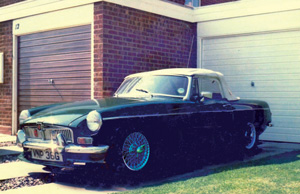
The Parker B in 1978 at its 10th birthday
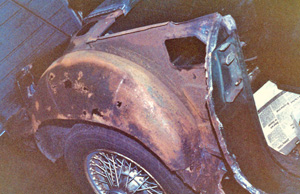
Few MGBs were given such depth of restoration. An image from 1980 showing rusty panels revealed once rear wing removed
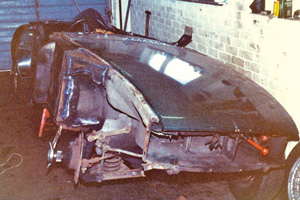
Few MGBs were given such depth of restoration in 1980 image 2 with the clear view of home made repair sections
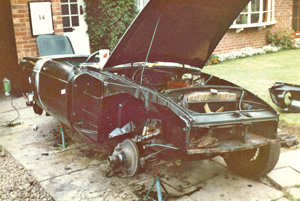
Once rebuilt Waxoyl was very liberally applied to avoid future problems and it has
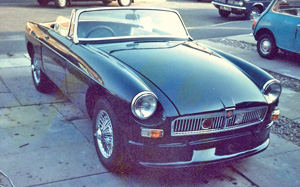
1981 just before the final exterior trim and interior trim fitted
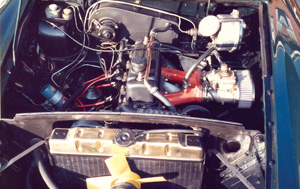
What was brisk for the 1970s, 1948cc, modded head, cam exhaust and 45DCOE, was not for the 1980s and was replaced by fuel injected V8
When I originally bought the MGB, it was a standard car with just two factory fitted extras, wire wheels and a heater. I have to say that if today’s trade description laws applied when the car was built, Abingdon may have had legal difficulty with using the description ‘heater’. Overdrive was not originally fitted but even when I bought the car in 1973, the benefits of overdrive were patently obvious and that’s why this was the first major change I made in 1974. The difference in character was massive and provided some immediate financial return with improved fuel consumption. Today the change to overdrive is even more valid, should anyone be wondering.
The following years saw some less intrusive tinkering in the search for extra power with HS6 SUs, tubular exhausts and non-vac distributors all with little worthwhile benefit. Then one day my desire for real improvement was given seriously added impetus when my MGB was completely ‘blown into the weeds’ by a standard looking Marina 1.8TC, a car with a performance profile on the same level as a rusty wheelbarrow, and a level of stability at speed commensurate with a nine-storey jelly in a crosswind. Some MG self-respect was restored a few weeks later when I found this car with its owner, and the secret was uncovered in the form of a modified engine and a Shorrock supercharger.
The supercharger route was simply not viable for me then, but I did follow the path of fitting a professionally modified cylinder head that allowed those HS6 carbs to start to earn their keep. Then in 1977 when the engine was just approaching 100,000 miles number three cylinder rings decided to give up, leading to the need to rebuild the engine. This opened the possibility of opting for a 1948cc conversion; interestingly this conversion was not new even then, just to illustrate how long it has been around.
The 1948cc conversion worked very well with the modified head and other parts and provided a marked improvement to the performance, although I would add that this was only good for the period. However, the effect of the cylinder head mods possible then was some way behind what can be offered today from experts such as Peter Burgess. Back then though, I enjoyed the car which was more than a match for the then very common 2 litre Cortinas and Cavaliers that otherwise had the performance to embarrass any standard MGB.
Nothing stands still for very long though, and by the turn of the decade general vehicle performance levels had risen enough so that the MG started to trail again. Being conscious that the desired level of increased power would not come from further conventional tuning the experience with the supercharged Marina came to mind, but parts didn’t seem that common.
The Saab 99 Turbo had ushered in the era of turbo cars and a couple of B series turbo options were available. Then the recently introduced O series engine had replaced the B series in all BL cars, except ironically the MGB for which it was originally designed, and so this was a serious option, but tuning potential was still unknown at this time. That then left an old favourite, the Rover V8, as by this time a steady stream of V8 conversions were available and of course Ken Costello’s conversions had already outlived the Factory GT V8s in production. I had always appreciated the lazy torque of the V8 and the major performance boost it gave to the MGB.
The major control over my decision was money, or as most people understand, the lack of it. So when during the first couple of years of the 1980s, an opportunity arose to buy some genuine Lucas test engines and equipment that was being disposed of at silly clearance prices you know that two and two will always make four.
Used and in some cases quite worn V8 engines were on offer, some five speed gearboxes and various ancillaries including some defunct Federal Rover SD1 3500 fuel injection systems. Whilst creating an MGB V8 was under serious consideration, adding the EFi label was not. However, the compact dimensions of the inlet system looked as though it could be made to fit under the standard MGB bonnet and would also save me about £400 on a new MGBGT V8 twin SU set up or a Holley and Offenhauser. That was a huge potential saving of funds that could then be diverted to buying other required parts.
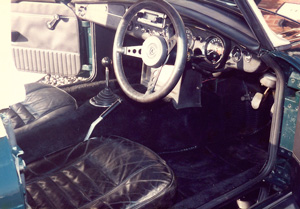
Original interior aside from 1969 GT leather recliner seats and how did I live with that wheel for nearly 20 years?
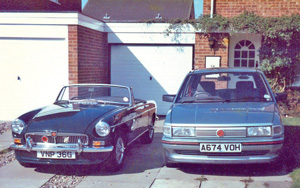
The last image of the car in original 4 cylinder format in 1984 alongside the MG Maestro 1600
In retrospect too little thought was given to the issue of getting it all to work, but with people at Lucas down the road to ask this wasn’t perceived as such a big problem. However, it soon became clear that getting it all to work was not going to be quite as simple as hoped for and indeed those contacts at Lucas would be vital.
Fitting the V8 was straightforward and as anticipated the injection manifold did fit neatly under a standard MGB bonnet with only a small amount of machining necessary to lower the plum around 12mm. Indeed that would have not been needed if I had used the OE V8 engine mounting brackets on the chassis, which sit the engine lower in the body, but then I was retaining the original chrome bumper crossmember and pre SD1 V8 sump so I had to have the engine sitting higher and the V8 conversion mounting brackets were designed to accommodate this.
Getting the injection system to work needed some lateral thinking in the area of fuel supply and a modified (new) MGB fuel tank, and other detail changes, but when the few teething troubles were ironed out it was a tremendous success.
In the mid 1980s an electronically fuel injected V8 MGB with the then the ‘Buzz word’ letters ‘EFi’, attracted that unexpected very wide exposure. That came as a pleasant surprise and with a little embarrassment from a number of ‘rough edges’ that were acceptable to just me, but hardly show condition. Cosmetics aside, even then I had clear ideas on where some further changes would improve things, and once again this is where one thing leads to another and shows why a project car will usually ‘never be finished’.
An example of this was the wire wheels, which I had already changed to uprated chromed 5.5”x14” with 72 spokes. I hoped that since so many higher powered sports cars ran perfectly well with 72 spoke wires, often with 15” diameters (Jaguar E Type for example), the conversion to V8 should not demand any further changes. Generally speaking this proved to be true, but, and isn’t there always a ‘but’, and I was able to feel clear flexing in the wheels, leading to a regular need for re-balancing. Spokes never loosened, but the inconvenience of needing very regular wheel balancing wore my patience very thin.
The solution came in the opportune appearance of some second hand 6”x14” centre lock, knock-on Minilite style wheels with 205/70×14 tyres. Whilst the tyres could be used under the front wings there was no way they would get anywhere near fitting under the rear arches, so I simply transferred my current 195/60×14 tyres to these rims.
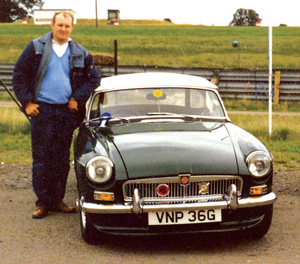
Two years later in 1986 at the first outing following the completion of the conversion to fuel injected V8 with owner
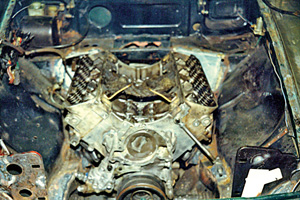
First trial fit of V8 in 1985
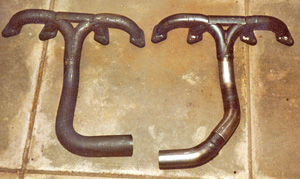
The then normal type of V8 block hugger manifolds, quite restrictive!
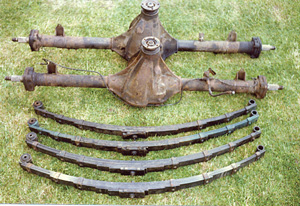
Standard MGB and V8 rear springs and axles
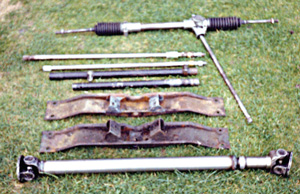
From top to bottom, V8 rack, standard and modified solid MGB steering columns, modified and standard gearbox cross members and specially made longer propshaft
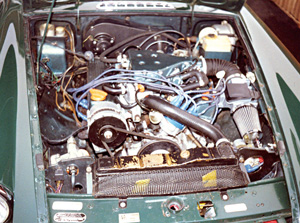
Finished engine bay circa 1986
The wheel change may have been simple but the effects were astonishing. On the positive side the slightly wider rim made better use of the tyre footprint area and grip was better. There was also a significant weight reduction with the alloys and this was clearly felt in a lighter more responsive steering, plus the wheel balance problem was solved. So far so good, but it wasn’t all good news.
The new wheels significantly reduced the airflow around the brakes, resulting in a very noticeable drop in brake performance. This meant I went from superb brakes; with an occasional minor delay in really heavy rain, to a normal initial response followed far too quickly by serious brake fade. The reason can be easily seen when looking at any Minilite style wheel against a wire wheel. In just the same way that your eyes see more brake discs through a wire wheel so air flow to that disc is easier too. Cover the disc up more and airflow is also reduced, and it’s the airflow that carries brake heat away. Less flow means more heat build up and earlier fade. The resolution to this brake problem is covered in a later instalment.
To be continued…
Roger Parker