Battery Maintenance
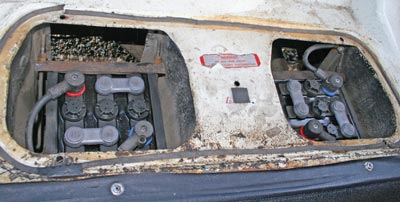
Christmas comes around every year and almost as frequently does the question of battery charging and how do you charge older MG batteries. So here is a reminder for this and some additional quick pointers to perhaps answer some common associated questions before they are asked. This is going to be apparently simple and unnecessary to some readers, but it is clearly something that a significant number of newer members into older MGs for the first time have no previous experience of and for them this is very useful information. Later on is some more comprehensive information.
Twin six-volt MGB batteries in situ, when connecting a battery charger or jump leads try to regard it as one big twelve-volt battery
MGA, MGCs, plus chrome bumper MGB and V8 models have two six volt batteries originally, and this configuration generates perhaps the most frequently asked question, ‘How do I charge the batteries?’ The same as any other car battery is the short answer, but the confusion comes when looking at how to connect the battery charger as two batteries causes confusion. Most people can cope with a single 12 volt battery and are able to remember the positive to positive, and negative to negative method of connection of charger leads to the battery. However, the problem always arises when faced with two six volt batteries although this simple principle remains valid.
To simplify things remember that the MG’s electrics are 12 volt and whilst there may be two batteries the car simply receives a 12 volt supply. Think of the two six volt batteries as a single 12 volt battery cut into two and then the two cut halves joined together with a cable. So when looking at anything to the do with the batteries when they are connected in the car, mentally ignore the separation and that cable connecting them, and think of the battery as being a long and thin single battery, with one terminal behind the driver’s seat and the other behind the passenger seat. For charging purposes you attach your battery charger positive lead to positive battery connection and negative charger lead to negative battery connection.
I have specifically not mentioned the polarity of the terminals as this depends on the polarity of the car, positive earth for MGA and MGB to the end of 1967 and from then on for MGB, MGC and V8 it is negative earth. If you need terminal clarification then all batteries have + and – symbols moulded into the battery body by the terminal they refer to, and that will tell you whether it is positive with a +, or negative with a -.
Many earlier MGs that were originally built as positive earth have now been changed to negative earth, often to be able to add a modern radio. Therefore a means of identifying the correct earth of your car is important, simply examine the lead that goes from the battery and which is bolted directly to the body of the car, this is the earth lead. If the battery terminal that this lead attaches to is the negative one then the car is negative earth and vice versa for positive earth.
So when charging two six volts it’s simply a matter of fitting the positive lead of the charger to the positive battery terminal and the negative to the negative terminal. Most battery chargers now come with safety circuits to protect the charger in the event of reversed connections and this usually results in an obvious complaining by the charger buzzing frantically when this is done. Once again remember to view the connected 6 volt batteries as a single 12 volt battery and charge at 12 volts (rarely is there ever a need to charge a single 6volt battery on its own).
For many years the general advice was to disconnect the car’s main battery supply lead when charging batteries to avoid possible damage to items like the alternator. The reality to this is that unless there is some heavy charge rate applied, say over 6amp, then these trickle chargers are most unlikely to cause a problem.
Another old advice line was to always remove the batteries from the car when charging. This was mainly done to cater for heavier charging rates that generates more hydrogen gas (which is flammable), and possibly causes the electrolyte in the individual cells to boil up and lead to bubbling battery acid in places you don’t want it. Low level and modern electrically stable chargers do not suffer these problems and battery removal is not usually needed. However, good ventilation and connection and disconnection of the charger only when it switched off is strongly advised as hydrogen burns really well with the slightest source of ignition, remember the Hindenburg airship for the most graphic example.
Battery Management
In recent years we have experienced the rise of clever battery management systems to the commonly used list of equipment for classic car owners. Essentially this is a battery charger but with microprocessor control and is a wonderful addition to the garage of anyone who has cars that are used infrequently. Note that these chargers are just as valid for infrequently used modern cars too.
Essentially these systems are designed to allow long term connection of the battery to a live charger. The management aspect, as the description suggests, monitors the state of the battery(s) and then switches the charger on and off keeping the battery voltage (and charge state) in a predetermined window that is known to provide peak efficiency that also promotes longer battery life. Often the cost of one of these systems (£40 to £50) will be covered by keeping the bat tery(s) in a serviceable state for perhaps double the time period that would have been the case with less frequent manually arranged charging.
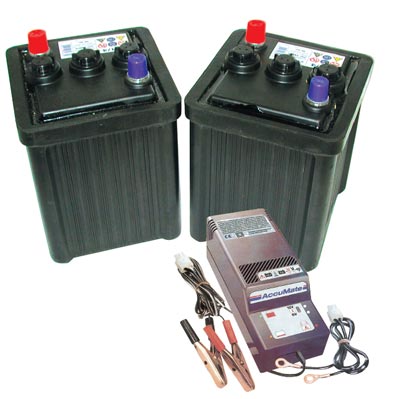
Twin six-volt MGB batteries in situ, when connecting a battery charger or jump leads try to regard it as one big twelve-volt battery
Most of these management systems come with either the normal crocodile clip temporary connections or a permanent fixing connection with the positive lead having a built in fuse protection. These permanent battery connections have a keyed plug for quick and correct connection and disconnection to give very convenient access to use the car. Fixing these connections permanently to the battery, with fuse protection, then allows the wires to be fed through to a conveniently accessible, but usually inconspicuous position, where the one half of the keyed plug is laid, allowing simple connection of the other half of the plug for activation of the system. When the car needs to be used it is a two second job to switch off and unplug, and when returning the same two second job is involved in reconnecting.
A growing number of MGF and MG TF owners today have their cars more for pleasure than daily use. These car’s more complex electronics and constantly draining security systems will on average cause the battery to be drained below the capability of starting the car if it stands idle over a period of four to six weeks. This provides a very valid justification for considering a battery management system and a growing number of owners now use one of these systems.
Single 12 volt battery conversions
Just a few lines on this subject to confirm that there is no official 12volt conversion for twin 6 volt equipped classic MGs. Many conversions have been done by owners and most are effective, but it is far from the simple solution many believe.
The Rubber Bumper MGB had a completely redesigned and strengthened battery box when it went 12 volt and few home conversions have addressed the need for extra strength to carry the heavier 12 volt battery when using one of the original battery boxes. In addition the access to the Rubber Bumper battery box is much bigger to allow the 12 volt battery to be lowered into place in its correct orientation. You would have to ‘post’ a 12 volt battery in endways to an original 6 volt battery cradle (not recommended).
A 6 volt battery has a square base and any 12 volt battery with enough power reserve will have a much bigger oblong base that demands modification of the battery box. 12 volt batteries with small square base dimensions can be found but are too weak and will suffer premature failure, so tend to have to be used in pairs. Usually these will cost more and will often be more difficult to find than living with standard 6 volt batteries, a totally pointless path in my view.
Adequate battery clamping is needed not only to pass MoT standards, but also to prevent battery bouncing up and shorting against the body. Cars have been burnt out from fires started in this way! The original 6 volt clamp is unsuitable and will not fit a 12v battery properly if at all, so a new clamping arrangement is needed, which has to take into account the 12 volt battery is heavier.
Moving the battery to the boot offers a solution to battery security when a proper secured tray is used, but then ventilation can be an issue, especially on a GT. A sealed battery with facility to a venting port where a tube can be added and vented to outside is ideal.
When in the boot of a roadster a battery needs to be protected from damage and accidental shorting out, so a protective case is advisable in the style of a Rover P6 or Jaguar XJ6 that had boot mounted batteries. The GT rear floor platform doesn’t allow enough height between the boot floor and the underside of the deck to accommodate the battery. Holes in the rear deck may not be that practical but will be necessary.
Rear mounted batteries require extended main battery cables but joining these cables is usually unwise, as such joints often create resistance points that generate heat and add to the voltage drop. Under such circumstances it’s best to renew the whole cable run and use a higher rated cable to reduce potential of any greater voltage drop.
Moving the battery into the engine compartment is an effective solution and many modern MGs and most other cars have the batteries so mounted. However, on classic MGs even the most competent and neat of underbonnet battery conversions simply look wrong. Aesthetics aside though, and the move is a better one for several practical considerations and the reason why most cars now have their batteries in the engine compartment.
Overall there are as many draw backs to a 12 volt battery conversion as there are advantages which is the reason why there is no simple approved kit. Many owners wrongly feel that the six volts are inefficient when the real reason is more basic, such as poor connections, infrequent use of the car and battery charge levels that are left to fluctuate too much with infrequent trickle charging. Personally, I feel there is much to commend the original two six volt batteries and maintain them by using a battery management system for all the positive reasons already stated.
Roger Parker