Return to Le Mans
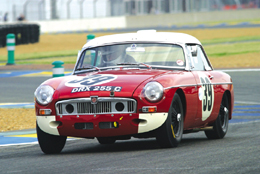
Barry Sidery-Smith at the 2006 Le Mans Classic
Historic motor racing has now become so popular and firmly established that few of us reflect on just how much it has developed in recent years. In this country The Goodwood Revival provides an ideal example of how to celebrate our rich past in motor sport with great classic racing and close attention to period detail, while in France few events have a more illustrious history to celebrate than the legendary Le Mans 24 Hour race.
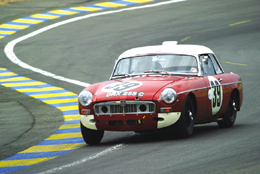
DRX 255C on the circuit at Le Mans
In 2002 the Automobile Club de I’Ouest and Peter Auto a company specialising in historic motor racing came together to create the first Le Mans Classic weekend. The idea was to stage an event that would recapture the historic spirit of Le Mans and it was decided to hold the event every two years. Entry to the Le Mans Classic was open to cars that have either competed there in the past or cars of an identical specification to those eligible from 1929-1979. Thus the weekend would feature non-stop racing but would be designed to get as many historic cars out on the track as possible. This was achieved by splitting the cars into period grids and dividing time on track between them to provide a continuous run of classic racing action.
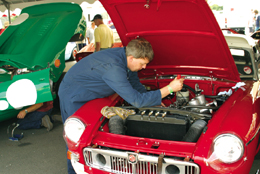
Jeremy Rodgers of Surrey Sports and Classics makes some final adjustments
To further recreate a period atmosphere the Le Mans Classic insists on a dress code in the paddocks where no jeans are allowed, while mechanics will wear their overalls and the drivers either their race suits or smart casual attire.
MGs at Le Mans
As an added special interest in this year’s Le Mans Classic the MGOC will also be sponsoring the entry of the original Le Mans MGB now owned and driven by Barry Sidery-Smith. Barry is extremely well know among the MG fraternity and also has a particularly strong affinity with Le Mans as the keeper of the last surviving works MGB. Back in 1965 when this very car driven by Paddy Hopkirk and Andrew Hedges crossed the line to finish in 11th place and second in its class the young Barry and his wife Pam were among the cheering crowd. Even though he was a keen motorsport enthusiast and already an accomplished race driver he had no idea that one day he would own that famous car.
Barry started racing in 1959 at Goodwood when he entered a club event in his Austin Healey 100/4. After that he raced a TR2 and then a TR3. In 1964 he campaigned an ex-works MGB 94 HJJ which gave him several successes including a third place at an international race at Brands Hatch. He was able to acquire these race cars because he worked in the motor trade with his father operating a large car hire business in Surbiton. However they also bought and sold cars, which meant moving them on if the price was right, and so 94 HJJ was duly sold to Don Bunce. Barry then acquired another race-prepared MGB 656 FXF, in those days before historic racing was established it was not unusual to find ex-works cars up for sale and they didn’t command anything like the high prices that they do today, in fact Barry owned and raced several special race prepared MGBs before the Le Mans works car came into his possession. It was advertised in Autosport in the early 1970s and he was asked to inspect it on behalf of Bob Shellard who then bought it and raced it until 1972 when he commissioned Barry to sell it for him but only two enquiries were received and the car remained unsold. It was Pam who when looking through some old race programmes made the connection between the MGB they were looking after and the 1965 Le Mans race. After that they decided to keep the Le Mans car even though it was a bit of a stretch financially at the time. The sharp and predictable handling of the works MGB even tempted Pam to take up racing and after her first outing in 1975 she enjoyed campaigning it for the next two and a half years and after that Barry used it for club racing.
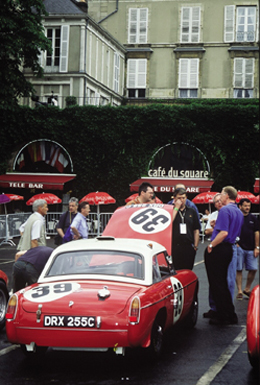
Scrutineering at the town square
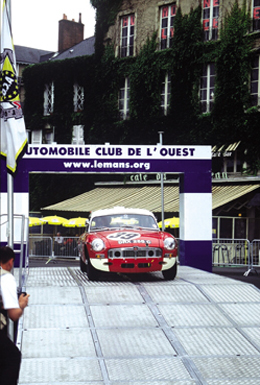
On the ACO start ramp
Back on track
1980 saw the first race on the new Spa-Francorchamps circuit and Barry took the Le Mans MGB along. The weather was appalling and the rain bucketed down, however both the MGB and Barry are good in the wet and urged on by Julius Thurgood from the pits he kept up the pace. Unaware of his placing Barry just kept going and completed the race to discover he was third behind a Lotus 22 and an Aston Martin. For him the highlight of this event came when he ascended the rostrum to be presented with his award by none other than the legendary multiple world motor racing champion Juan-Manuel Fangio.
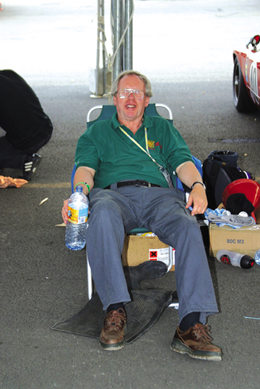
Barry takes a rest
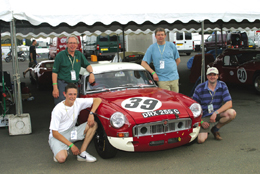
Barry and his pit crew
The works MGB returns to La Sarthe
Barry first drove his Le Mans MGB on the circuit at Le Mans in 2001 and it was an extremely emotional occasion. He was particularly thrilled to be out on the famous circuit and at the wheel of such an historic car, as he drove back into the paddock on completing the race he was very moved as the crowds cheered and many enthusiasts swarmed around to greet him. It struck him then that he too had been a part of an enthusiastic crowd that saw the MGB race back in the mid sixties but this time he was driving.
Over the years the Le Mans MGB had never been restored, until after running it at the first Goodwood Revival it was felt that it needed looking over as it was chipped in various places and there was some slight corrosion where the alloy had reacted. The MGB was handed over to Mark Tipping in Byfleet to restore and when he took off the front wings he discovered only an inch of rust along the bottom edges while the main structure was still in perfect order. So he reassembled the car and repainted it, the first time it had been painted properly since it left the factory in 1964.
After this restoration work the car was subsequently campaigned at Goodwood and the first Le Mans Classic and also in the Le Mans Legends races. It was in 2004 at the second Le Mans Classic race that Barry had his most serious accident in the MGB. He was still on the first lap heading up the Mulsanne straight and just turning right to set off towards Indianapolis on the long straight that forms the narrowest part of the circuit, when a Bizzarini went across the corner of the grass, spun off and the emergency warning lights were switched on. An E-type that was just ahead of Barry slammed on its brakes and suddenly broadsided across his path leaving him nowhere else to go. Barry struck the side of the Jaguar and eventually came to rest. Sitting in the car he quickly switched off the ignition and collected his thoughts. He soon realised that he was stationary on the track without any lights on the MGB. Despite having a broken sternum and being very badly bruised he quickly clambered out of the car and scrambled over the armco to safety. He then had a very long ambulance ride to the hospital on the circuit and then the main hospital at Le Mans where he received excellent care from the French medical service. Barry was touched by the concern of Patrick and Sylviane Peter, the event organisers, who took a direct hand in looking after his welfare in hospital while in France. He was also very grateful to Dr Rod Longton and his team for their care and for arranging to transport him back to England safely in the back of a large Winnebago so that he could be carried laying flat and firmly strapped down. Keeping him strapped up was necessary for his sternum to knit back together and he had to take things very carefully for many months, but he has now made a full recovery.
Barry believes his injuries would have been far worse had he not been driving such a solid car as the MGB plus the obvious benefits of having full harness seat belts and a top quality race seat. Sadly the historic racecar sustained serious damage to the front end and needed two new chassis legs, front panels and front wings. However the screen was unbroken and after this very high-speed accident the cockpit remained undistorted as both doors of the MGB would still open and close. A special appeal was put together by Julius Thurgood of Top Hat Historic Racing to help get the Le Mans MGB back on the road and Barry was particularly touched by the kindness and support of his many friends and also those people who didn’t even know him who sent in donations to get the car back in action. British Motor Heritage provided a complete front end comprising chassis legs and front panels. Barry had to locate a couple of rare alloy front wings; in fact he was lucky to pick them up. Fortunately the MGB was soon back together and because of its solid bodywork still remains a substantially original car. Jeremy of Surrey Sports and Classics oversaw the rebuild and his two old established and highly experienced race mechanics Bill Lewis and Brian Wells undertook the work. Barry and his MGB will be at Le Mans once again in July to compete in the 2006 Le Mans Classic and if you are able to join us then you can be a part of the crowd enjoying the unique atmosphere, watching spectacular historic racing and cheering him on.
This year the MGOC Travel Club has put together a very special long weekend over the 7th to the 10th July to attend the third Le Mans Classic.