MGF/TF 280mm Front Brake Upgrade
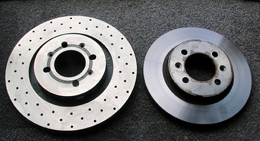
Why upgrade when most owners already find the MGF’s braking perfectly adequate? There are a number of reasons that actually make an upgrade for the MGF and also the TF more appropriate than on many other cars. The MGF was created on a restricted budget and employed a range of parts already in use with other Rover Group cars during that development period, something that most MGF owners and enthusiasts already know. The Rover Metro was one source of donor parts and in the braking area the MGF carried the front brake assembly from the GTi version of the Metro. This meant that it had a 240mm diameter ventilated front disc clamped by a single piston-sliding calliper. Not that the Rover Metro was the first user of this specific disc, as it had been standard fit on all 2 litre petrol Maestro and Montego models since 1984.
Compare the size of the 280mm brake discs with the original 240mm
Whilst these 240mm discs provide perfectly adequate braking performance on standard cars for most driving circumstances, there was quite significant room for improvement, especially if there was any hint of competitive driving or raised performance. Looking back again at specifically the MG Maestro many owners opted to increase the performance of these cars. Ultimately the limited run of Maestro Turbo models provided the pinnacle for performance applications and these were distinguished by the special body kit. Unfortunately this upset airflow and reduced the cooling flow over the brakes. It followed that it became possible to fade the standard brakes without too much effort and this was before the common and very easy to achieve boost increases added an extra 25 to 30bhp that made the demands on the braking issue more acute.
Not that this was the ceiling for these turbo cars as adding 50 to 100 bhp was still relatively easily achieved and in such circumstances the standard brakes were simply inadequate. Being one in this position I decided to look into ways of improving the Maestro brakes. Obviously the normal route of up-rated pads and even grooved and cross-drilled discs was considered, but with standard Rover 214 models running with a 262mm diameter disc, clearly the original 240mm Maestro disc was the restriction and a larger one was desirable.
This prompted a close look at what manufacturers fitted to models of similar performance and weights and it became clear early on that 280 to 290mm diameter were the norm. The search then centred on finding an existing disc whose dimensions were close enough to the original to be reasonable to convert to fit the Maestro hub. VW was an immediate and serious contender due to the Golf having so many near identical dimensions. Indeed VW were not that enamoured with Austin Rover when the Maestro was launched as in their opinion there were too many items too close to the Golf, even though they were selling Austin Rover their gearboxes for the model.
The Golf initially had 239mm diameter discs, which were soon found to be inadequate on anything beyond the 1300cc versions; the VW response was to increase the disc to 260mm for all models. It is also interesting to see that approx 260mm became the norm in general terms for a wide range of other manufacturers. VW did not stop there as the introduction of more powerful sporting models, specifically the supercharged G60 Golf and Corrado also saw the front discs increase further to 280mm diameter. The advantage for the Maestro was that the same basic hub dimensions remained, meaning it was still basically compatible with a small degree of machine work. It was therefore a pretty easy decision to go for this disc.
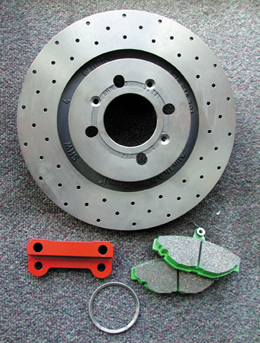
The MGOC kit contains all that is required for the complete conversion
The machining involved re-drilling of the disc to cater for the 95.4mm PCD (Pitch Circle Diameter or stud spacing) of the Maestro, against 100mm of the VW, and different countersunk grub screws. Plus an additional centralising ring for the hub was created, as the centre hole of the disc was slightly larger than the Maestro hub.
One of my goals in this conversion was to allow the continued use of the original calliper, which negates the worry about having to break into the hydraulic system, so no mismatches between calliper and master cylinder and simple sourcing of future spare parts. However, increasing the diameter of the disc means the calliper won’t now bolt in place as it needs to be moved 20mm further from the centre of the hub (that 20mm calculated as follows; 280 – 240 = 40 ( 2 = 20). The design of spacer has also been well proven over many years with quality brake conversions from the likes of AP Racing and others. It bolts to the original calliper mounting lugs of the stub axle and has new calliper mounting points the desired 20mm further out. This allows the calliper to sit in the correct position and being further from the hub centre means that there is increased leverage, effectively amplifying the braking effort of the driver’s input. There is also a significant advantage of a disc with a larger mass and surface area for heat soak and dissipation.
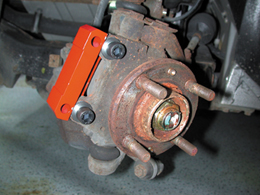
Spacer in place
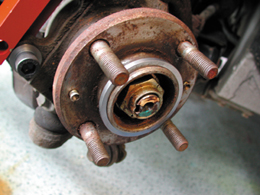
Centering ring fitted
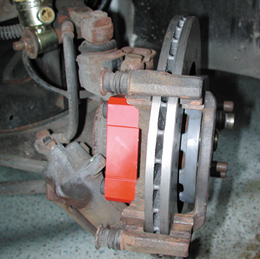
The centering ring has two different sides and is necessary to re-position the disc correctly
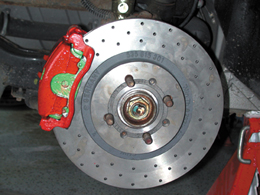
New Green Stuff pads fitted
This conversion attracted a considerable interest because of its relative simplicity, low cost and major effect in providing a drastic braking improvement. The great commonality of parts between Maestro and MGF shouted at the possibility that the same route could be followed with the MGF, and indeed it can. The MGF uses the same 240mm disc as the Maestro and Rover Metro, as previously mentioned, but the calliper is physically smaller and common only with the Metro GTi. The Metro is about 20% lighter then the MGF so brakes on an MGF are having to work much harder. The Maestro is about the same weight as the MGF but has an advantage of a bigger calliper and pad swept area.
The calliper difference can be further seen with the Maestro calliper piston being 54mm diameter against the Metro/MGF 48mm. Master cylinder bore sizes are not the same so the difference in work generated is not as clear as the 6mm difference in calliper piston diameter first indicates. The weight issues are also complicated by fundamental differences in distribution. The FWD Maestro is very nose heavy with all of the heavy bits up front, whilst the MGF (and TF) with the mid engine has a much more even weight distribution. This impacts significantly on the braking performance with the front end heavy Maestro seeing most effort done by the front brakes with little on the rear. The F and TF by comparison sees a much greater sharing of the braking effort between front and rear brakes. These differences explain why the 280mm disc on a Maestro shows a stunning improvement to the brake performance, whilst the same conversion on the MGF (TF) only shows a very good increase.
When I sold my Maestro in 1999 and bought an MGF these different braking characteristics between the two cars was obvious, with the MGF not being as poorly placed as may be imagined. Nevertheless, with power enhancements pending I still decided to change to a 280mm front disc, well worth the effort, which over the next three years needed no work or maintenance, and continued to provide that powerful and progressive brake performance.
One difference I found between the Maestro and the MGF 280mm conversions concerns the choice of brake pad. On the Maestro I had found that with most of the brake effort being achieved on the front the use of a mild performance road pad such as Mintex 1144 or EBC Green Stuff was needed as a minimum. However, on the MGF for pure urban road use I found that the standard spec pad was slightly better in initial response and light pedal pressure braking. Add some quicker driving and certainly mild track day work and the Green Stuff level of pad becomes attractive again. This helps to illustrate how much more work the FWD car does over the mid engine one.
It is important for those MGF and TF owners interested to note that there are some wheel restrictions that apply when fitting the 280mm kit, but not as restrictive as applies to the 304mm AP Racing calliper on the MGF Trophy and TF 160. The first is that all of the alloy wheels ever offered on the MGF and TF have enough diameter clearance, but depending on the individual style of wheel there may be a small conflict between the back of the wheel centre (‘spoked’ area) and the edge of the calliper carrier. In general terms I know only of the original MGF 1.8i 6 spoke alloy wheel that has this problem and is solved by using a 5mm wheel spacer. However, small hub dimension variations have shown a remote possibility of very minor variation to that statement.
The 280mm brake conversion on the MGF and TF is very well proven today and offers clearly improved braking, better aesthetic appeal behind the usual design of open alloy wheels, all in a very economic form. It doesn’t involve any breaking into the hydraulic systems so is as straight-forward to fit as replacement of standard discs and pads. The kit offered by MGOC Spares uses quality sourced parts to capitalise on the already proven good service of these conversions. This conversion is also an ideal preparatory step to make to your MGF or TF if you intend to take up any of the specific power tuning suggestions covered in the previous ‘More Power to Your Elbow’ articles (see Enjoying MG March 2005).
Roger Parker
MGF/TF 280mm Front Brake Conversion Kit is available from MGOC Spares 01954 230928