Parts for MG and Rover Cars
The 8th April 2005, now referred to as Black Friday, was the start of the most turbulent period in the history of the MG marque. All previous crises have involved internal corporate decisions by the parent company or in the sale of that parent company. 2005 however, presented the financial collapse of the parent company creating a vacuum of a magnitude not seen before.
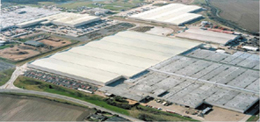
The XPart factory site, light roof only
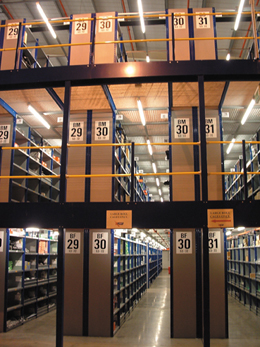
Three floors of small parts
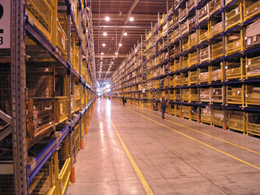
Too far to walk
Residual values, warranty, dealer support and parts supply were all affected to varying degrees and the following days and weeks was a difficult time for many people, especially those employed directly or indirectly, and of course owners and prospective owners. Clarity was soon granted in respect of the warranty – there wasn’t any – but there wasn’t the same clarity for the other aspects. The one area that was least affected though was parts supply.
XPart, formerly part of the Phoenix Group of companies, handles parts for recent MG and Rover cars, but was one of the assets sold to Cat Logistics, part of the massive worldwide Caterpillar Group of companies. The sale was completed in 2004, well before the events of 2005.
At face value it may not be clear how an American company famous for making caterpillar tracked earth movers comes to buy a relatively small car company parts business. However, when your company is the leading global player in your field it follows that even the best machinery needs to be serviced and maintained. To achieve that you need to be able to quickly and efficiently supply parts to customers in all manner of obscure places and to that end a separate supply chain has to be set up.
With such an operation in place, which became Cat Logistics in 1987, it follows that the experience and skill gained can be applied to providing the same service for other companies. If your capacity is not being stretched then this makes even more sense as now you’re able to move more for the same overheads, but now someone else is paying you for the facility. Obviously this diversification can be a great revenue earner and the momentum sees the service being taken up by others with a similar spares supply and distribution need.
Fast forward to 1994 and BMW’s purchase of Rover Group, which was followed by the decision to outsource the Group’s parts operation to Cat Logistics, thus ending a long running relationship with Unipart. This was not operating at the time that BMW sold (gave) the Phoenix consortium elements of the Rover Group that became MG Rover. Phoenix decided to continue with the transfer to Cat Logistics, which became operational in March 2002, and was unfortunate to suffer from some high profile initial shortcomings. Phoenix also created an ‘in house’ parts company to manage the parts business and called this XPart. The final element was the sale of XPart by Phoenix to Cat Logistics in 2004 for a sum in excess of £100m.
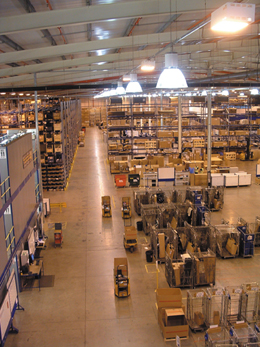
Dispatch area floor to ceiling bumpers in background
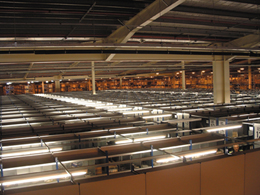
Looking across top of small parts with main storage behind
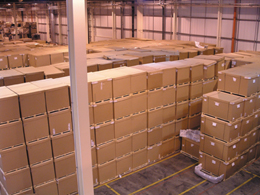
Some of the bumper stock
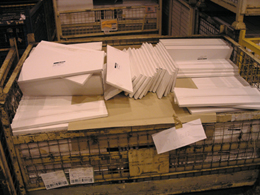
K series head gaskets in abundant supply
There have been many to criticise Phoenix for the sale of assets, but this specific sale does have a silver lining for owners of MG and Rover cars. This is because it has placed the whole of the parts business outside and almost completely isolated from the collapse of MG Rover. Clearly there is some impact at both ends of their operation, at the manufacturing end, as many of the parts manufacturers were also supplying MG Rover production lines, and the collapse has had an impact in seeing some to go under. At the other end of their operation is the failure of some dealers, thus reducing the outlets for the parts to car owners.
These are not insurmountable problems and should at worst create a blip in parts supply. XPart has direct access to all the manufacturers of parts they handle, over 800 in total, and they also have rights to source on an ‘as needed’ basis, plus rights over production tooling. This enables them to simply transfer tooling from one component manufacturer to a new one, in the event of a supplier collapsing or stopping manufacture.
The impact on suppliers of MG Rover parts has been varied. However, many suppliers were more seriously exposed in the spring of 2000 when BMW announced their intention to withdraw, so since then, with the always precarious position MG Rover was in without a partner locked tightly on board, most suppliers have reduced their exposure to the prospect of an MG Rover collapse. So when this actually happened they were mostly in a position to weather the current storm, and so are able to continue supplying the spares demands.
This largely unaffected parts supply, the independence of XPart, the continuance of a great proportion of the MG Rover dealers, and of course MGOC Spares, means that owners of modern MG and Rover cars can still get parts in the normal way, whether that is for work to be done by themselves, their garage or main dealer workshops. This is a message that has clearly not been understood by a large section of the motoring public, judging from the repeated questions received.
The current period is one of continuing turbulence and there will be more changes but the bottom line is that parts supply will continue for the three million or so MG and Rover cars in what is known as the vehicle pool. These are cars still being used and being less than about 15 years old. As a matter of interest the production totals for modern MGs show just over 77,000 MGFs, just over 39,000 TFs, just over 74,000 ZRs, just over 25,000 ZSs and just over 25,000 ZTs. That is around a quarter of a million modern MGs, which may be small in global car manufacturing terms, but I bet it is much higher than many of you realised.
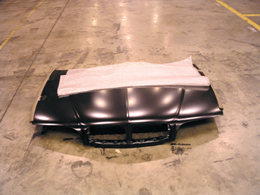
Rover 600 bonnet one of many variations
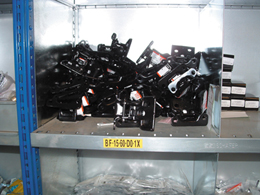
Hinges
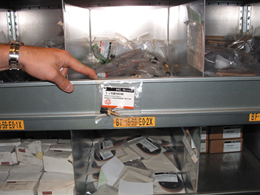
Engine management sensor
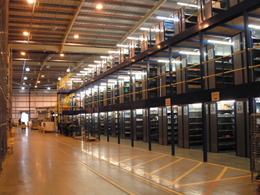
Triple deck of small parts storage
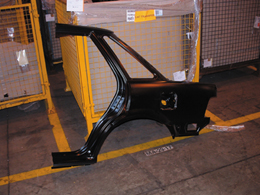
Pre 95 Rover 400 rear quarter panel
XPart has not been blind to these issues and has made a number of announcements emphasising the rude health of their business, although there has been a recent announcement of some job losses within XPart. One of the emphasised points seen in many XPart statements and repeated in the press was the stock level of parts being to a value of over forty million pounds worth or so. £40m doesn’t have any real impact, especially when figures of £1.4 billion is talked about in respect of MG Rover losses. To help provide some perspective to this we contacted XPart and visited their huge Desford centre in June to actually see what such a stock value actually looks like.
Desford is a small village a few miles west of Leicester. Nearby an airfield was built which was taken over by the RAF during the Second World War and became a training base. Becoming surplus after the war it was bought by Caterpillar in 1952, which does give some indication how established Cat is in the UK. On the site is a variety of operations, logistics being one, and it is within that area that XPart operates.
The list of statistics about the XPart facility are quite eye opening, 22 miles of fire sprinkler lines, 12 miles of parts racking and an internal floor area equivalent to 22 football pitches. As usual nothing beats images to give perspective and the aerial shot of just part of the massive Cat site shows the more recent light coloured roof of the XPart section, dealing with parts just for MG and Rover cars.
The vastness of the facility is illustrated by the use of motorised vehicles to run through the majority of the stores facility, walking and hand picking is contained in a separate area where smaller parts are stored. In one corner, a massive space in itself, are boxed plastic bumpers stacked almost to the roof, itself around 80 feet above the floor, and using a special fork lift designed to reach these upper levels provided an ideal platform to take some of the photographs that really do convey the huge scale of the operation.
Not that XPart is operating with just parts supply in mind as they have commenced several initiatives to fill the void left by the MG Rover collapse. These include setting up a network for the dealer chain with alliances to the various companies who used to be tied to MG Rover in supplying support for dealers in areas such as servicing and diagnostics for MGs and Rovers. These initiatives are not going to be seen by most owners, but their effects will be reflected in the level of service they receive when their cars need work.
So today, tomorrow, next week and beyond when you need to replace a part on your MG or Rover, you will be able to get it efficiently. If your car needs to have some electronic diagnostics work done then the hardware and software will be widely available, as it is today, to complete this work and keep you motoring well into the future.
Roger Parker