ZT 260 Fuel Pump Renewal
Talk of fuel pump failures in an MG and immediately the lack of the comforting ticking of the good old SU immediately comes to mind, but it not something that should be associated with a nearly new car such as the ZT 260. The fact is though that we have recorded a few early model cars that have suffered a pump failure and both the circumstances of the failure and the route to rectify is one which could well be of use. The fact that a number of failures have been noted on a range that is small in number, 851 MG and Rover V8s so far identified, indicates that it is quite possibly a problem that other owners will face. The other thing is that a much higher proportion of V8 owners are Club members than any other ZT model, although the fitting of the pump and other fittings is very similar for all ZTs.
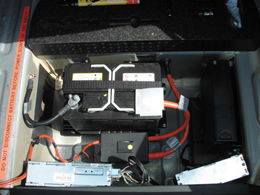
1. First disconnect the battery
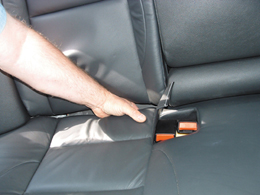
2. The rear seat squab must be removed
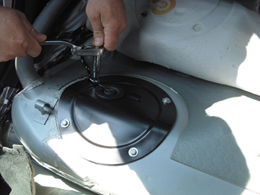
3. Removing the fuel pump access cover on the driver’s side
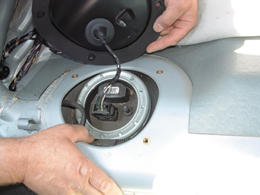
4. One the cover is off the pump is held in place by a twice-on locking seal
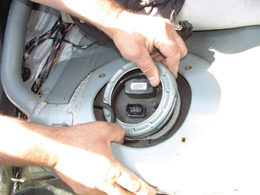
5. Locking ring and seal being removed
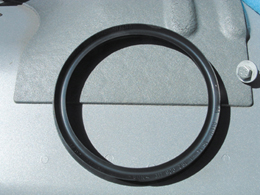
6. Rubber seal
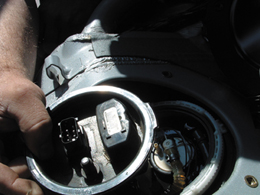
7. Removal requires maneuvering of the pump assembly through the access hole
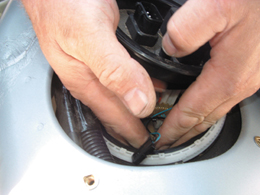
8. It is necessary to disconnect the inter connecting pipes and electrical connection to scavenge pump
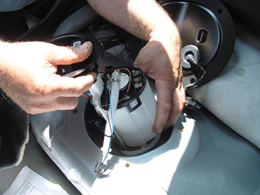
9. New pump positioned ready to install
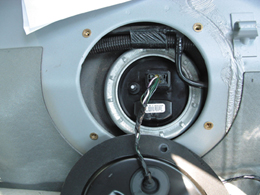
10. Final connection re-fitted
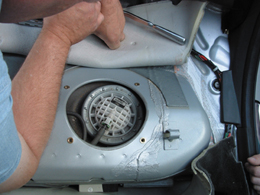
11. Not strictly part of the fuel pump change, but as the pressurised fuel passes through the filter contained in the scavenge assembly on the passenger side before leaving for the engine, it is useful to check that the unit is fully connected together otherwise fuel pressure will be lost
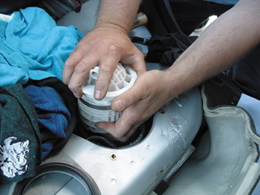
12. The scavenge unit partially lifted from the fuel tank, a twisting motion between top and body allows the two parts to seperate
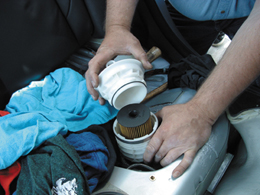
13. Note the strong dovetail interlock design between the top and body of the main unit and position of O rings to ensure when fitted it is very tight and leak free fit. Any leak would be within the tank so you would have no external fuel leak, just low fuel pressure
The layout of the ZT fuel tank is best described as a ‘saddle’ tank, which for non-steam railway or horse riding types, means that the tank has two distinct wells in which fuel is stored. This is done so that the maximum available space for the fuel tank is used, dictated by the tank having to allow services such as exhaust pipes, and in the case of rear drive cars, propshafts, to pass under the middle of the tank. When the tank is over half full then the fuel level is above the highest part of the saddle area, but when levels start to drop then you have two distinct reserves of fuel.
The way in which the whole of the fuel volume is accessed involves an obviously more complex arrangement than you find on an MGB for example. There is then a need to accommodate the specific requirements of a fuel-injected engine and the continuous pressured fuel supply. The process by which this is achieved involves filling the fuel pump on one side of the tank, which draws fuel from that side of the tank. Clearly when the fuel is used the level is much lower than the other side. Obviously vehicle movement will create a ‘sloshing’ effect that will see fuel move from one side of the saddle to the other side, but of course this can actually work both ways, which some of the time is undesirable. To overcome this, there is a second fuel pump that sits in the opposite well to the main pump and which scavenges fuel and transfers it into the pick up bowl of the main fuel pump. This way the maximum capacity of the saddle design tank can be made.
Both fuel pumps have been known to fail and the circumstances of the failure can be used to diagnose the probable failure. In all cases the characteristics will be that the engine either splutters to a halt, refuses to start when all was normal the last time you ran the engine, or will run at idle but as soon as you even breathe on the throttle the engine dies. All are fairly standard types of fuel starvation characteristics.
With a ZT (all models) if you suffer any of the above circumstances the first check is to note the fuel level the gauge is showing. If below half a tank the first suggestion would be to rock the car from side to side to see if some fuel transfer is able to allow the engine to start and run apparently normally, failing that add a couple of gallons from cans. This will point to whether the problem is with the scavenge or main pump. If it is the scavenge pump then the added or moved fuel will feed the main pump and normal operation will return for a short while. If the problem is the main pump then there will be no change.
The car featured, a 2003 model 260, was driven normally, parked and a few minutes later would not run at all above idle. A couple of gallons of added fuel didn’t improve things and a recovery was needed. In the workshop the engine would start on the key and as long as the throttle was not touched it would continue to idle, albeit roughly. Having T4 diagnostics on hand foreshortened the fault finding process, which confirmed that fuel pressure at idle was a measly 9psi and as soon as the throttle was touched the engine stopped, but 2psi was seen as it did so.
Now on the ZT 260 has a slightly different fuel delivery system to all other petrol ZTs and indeed other MGs. The common fuel supply system involves the fuel pump working at a constant speed and delivering a constant pressure and volume of fuel to the engine. A fuel pressure regulator then maintains the fuel at the injectors at a lower pressure that is altered in line with the changes in air pressure inside the inlet manifold. Fuel pressure that is relieved by the regulator then flows back to the fuel tank.
The ZT 260 doesn’t have the same full flow system, but effectively mimics that seen in older MG carburetor systems, where fuel is pumped to the engine only when it is needed. Now rather than have a float valve controlling the fuel flow we have a sensor in the left cylinder bank fuel rail, which monitors the fuel pressure. In turn the Ford EEC V engine management system modulates the voltage to the fuel pump and this alters the fuel flow and pressure. Knowing that the fuel pressure at idle was at best 25% of what it should have been prompted a degree of fiddling, in this case removing the two bolts that held the fuel pressure sensor to the fuel rail and gently removing it. Normally there should be residual fuel pressure behind this, which will spray out when the O ring seal is released. On this car it was completely dry behind the sensor, a sure sign of lack of fuel, but not completely as oddly the engine could still idle with the sensor removed.
The lack of fuel at the engine provided the confirmation of main fuel pump failure and the need for a replacement. Interestingly the 260 uses the same fuel pump as it used on the 1.8 Turbo models, different in detail to that which is used on the V6 models, a fact that will be useful in future years as low volume model spares are always the first to become rare.
The ZT fuel tank sits under the rear seat squab and conveniently there are two access panels to allow the fuel pumps to be changed without major inconvenience. The main pump sits on the right side of the tank and the scavenge pump sits on the left side. The fuel pump assembly contains the pump obviously, but also the sender unit for the fuel gauge. There are two internal hose connections crossing inside the tank, one from the scavenge pump and oddly the main fuel delivery from the main pump goes back through the tank to the left side where it exits through the scavenge unit top.
Some would find the wiring interesting as this is exposed and normally covered in fuel. It poses no risk in normal operation BUT does demand very specific following of removal and fitting procedures to ensure that no spark is generated – for obvious reasons. This is certainly one job where the procedure of disconnecting the vehicle battery is paramount, also to discourage inquisitive smokers to ‘go away’.
The images give an insight into this job, which overall was quite straightforward, and was rewarded by a few seconds of cranking the engine before the engine spluttered into life and return to its previous responsive self.
Roger Parker