The Goodwood Revival – Just Keeps Getting Better
There is no other event in the historic motor sport calendar that comes anywhere close to the Goodwood Revival for a complete weekend’s entertainment; it simply offers classic car fans a unique experience.
The Revival works on many levels and the mood is established as soon as you pull up in the car park and examine all the other vehicles, classic or modern they will be worth a second look. As you climb out and rummage in the boot to find your tweed jacket and flat cap, the people in the car next to you will be doing the same thing and they will smile and chat with you.
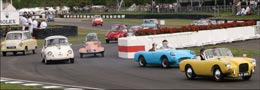
Berkeleys lead the parade of Magnificent Microcars
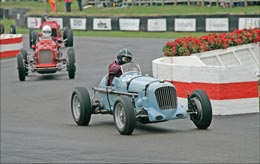
Goodwood Trophy – Richard Last in the 1936 Parnell MG
Making your way to the entrance you become increasingly aware that everyone looks like an extra from a 1950s movie, you may also notice that they are smiling. There is a mood of cheerful anticipation in the air that even the grey skies that threaten rain can’t suppress, and neatly folded brollies are always to hand, so nobody will make a fuss about the weather, after all, this is England. Actually it’s rather more than just England, it’s a recreation of a past that never really existed, a golden age when ladies were always elegantly dressed and men wore a collar and tie even when adjusting their SU carburettors. The Revival is set in a time long ago when all the ‘right people’ drove proper sports cars. Nowadays everyone wants to attend the Goodwood Revival because it embodies so much that is still wonderful about England and historic motor racing.
There were sixteen races over the weekend which began with a lively and incident packed practice on Friday. Adrian Newey after his problems in a GT40 at the Le Mans Classic had another unfortunate off at the wheel of a lightweight E-type in practice for the RAC TT Celebration and in a separate incident Scots CART star Dario Franchitti also in a lightweight E-type left the track, fortunately neither of them was seriously injured.
There were two special parades held on each day of the Revival, a celebration of the Magnificent Microcar and a Tribute to Phil Hill, the first American to win the F1 title in 1961. Phil Hill was also very successful in sports cars and his early racing career and first win was in an MG TC. He drove another MG with great distinction and that was EX181 the Land Speed Record Car which set the unofficial 2-litre world record of 254.91 mph at Utah. The record breaking MG was on display over the weekend. Basil Wales of ‘Special Tuning’ fame worked on the engine for that car and his recollections of Hill appear at the end of this report.
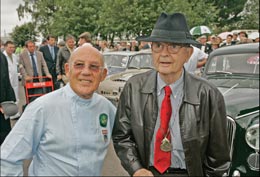
Sir Stirling Moss and Phil Hill
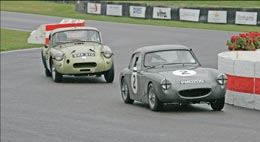
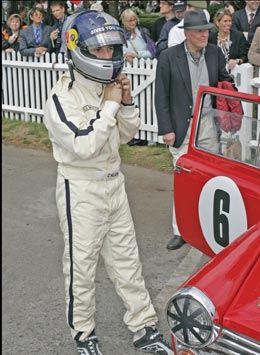
St Mary’s Trophy part 1 – Christian Klien 1960 Austin A40
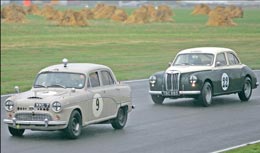
St Mary’s Trophy – Magnette chases Austin A95 Westminster
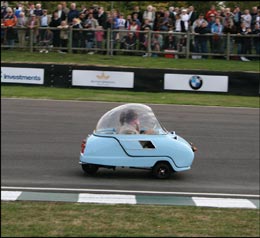
The Peel, the only Manx built motor car
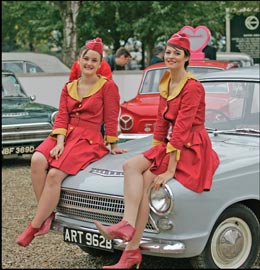
Glamour Cabs with glamourous models that form such an essential part of the Revival
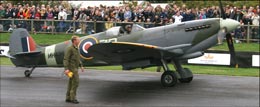
A Tribute to the late Ray Hanna (former Squadron Leader of the Red Arrows) his Spitfire displays played a such a key role at the Revival
The Microcar parade was quite brilliant; whoever comes up with these inspired ideas for Goodwood’s programme of events is to be congratulated yet again. Those of us who can remember these wonderful little cars buzzing around in the 1950s & 1960s couldn’t help but be moved by the sight and sound of them making their furious way around the Goodwood circuit to put in the slowest laps ever recorded. Leading the field were the splendid Berkeley T60 on three wheels and the B105 on four, these motorcycle engined cars built in Biggleswade were incredibly light which gave them lively performance. They were followed by a bizarre assortment of microcars with wonderful names; Kleinschnitter, Zundapp Janus, Rollera Francaise, Bond, BMW Isetta and 600, Messerschmitt, Googomobil, Heinkel and Trojan. Among these diminutive vehicles I was delighted to see the Peel on track, as this was the only car built in the Isle of Man where three wheels seem most appropriate. Power was from a 49cc engine, it was a real pleasure to observe it running as I’ve only ever seen one in a museum. This parade was an imaginative celebration of those long gone days before the Morris Mini Minor/Austin Mini Seven arrived and swept all these delicate alternative micro cars to one side.
On the Circuit
It’s the motor sport that excels at the Revival and every race was exciting. I won’t attempt to cover all the races, just the ones with MGs in the field. There was an MG on the grid of the first race, the Goodwood Trophy, which ran on Saturday morning, sadly Richard Last’s Parnell MG did not finish but managed seven laps.
The Fordwater Trophy which followed featured a wonderful collection of Austin-Healey Sprite GTs, Sebrings, Speedwell and WSM MGB and Sprite specials, also a Jacobs Midget Coupe, Le Mans MGA Twin Cam and an MGB Berlinette Coupe. In keeping with the special aerodyne bodied theme were Morgan SLRs, Harrington Alpines plus a Triumph SLR and TRS Le Mans. Among the distinguished pilots of this race were Barry Sidery-Smith in the MGA Twin Cam and Sir Stirling Moss in an Austin Healey Sebring Sprite and they both started from row 8 of the grid. Sir Stirling and Barry had an exciting tussle and finished 11th and 12th respectively, Barry was ahead of the racing legend for several laps but as the wet track dried out Moss got ahead. The race winner was Keith Ahlers in a Morgan Plus 4 SLR, Adrian Van Der Kroft in another Morgan was second and Trevor Groom in a lightweight Jaguar XK140 was third while the best placed MG was James Willis in his Jacobs MG Midget Coupé. It was wonderful to see so many of these rare and fascinating special bodied cars racing together.
The St Mary’s Trophy was held in two parts, each car with a team of two drivers, the first to take the wheel on Saturday afternoon were the guest drivers. This was a race for production saloon cars that competed between 1950 and 1959 and among them were two MG Magnettes, a ZA driven by Michael Salmon on Saturday and by Bruce Chapman on Sunday and a ZB driven by Alec Poole and Grahame Bryant. Also in the race was Barry Whizzo Williams and Russell Martin in a Morris Minor and Tony Jardine and Rae Davis in the Team Castrol Classic Oils Austin A35, other BMC products racing were an Austin A40, Austin A105 Westminster and a Riley One Point Five. St Mary’s is always a great spectacle, in particular the battles between the big Jaguars and the little A series engined Morris and Austin saloons. On Saturday F1 driver Christian Klien had delighted the crowds with a spirited drive in an A40 but it was Derek Bell who won in a 1959 Mk II Jaguar. This was Bell’s first Goodwood win since the track was closed back in 1966 but it was not an easy victory and only came after a long struggle with Tony Jardine in the A35 and John Fitzpatrick’s Westminster.
The Brooklands Trophy on Sunday morning had a splendid line up of pre 1939 racing cars with three very special MGs on the grid; Mark Piercy’s 1935 MG R-type, Tom Dark’s 1935 Q-type and Peter Green’s 1933 K3. These cars are always a joy to see racing because their open cockpit design gives a clear view of the driver working away at the steering wheel. The chain driven Frazer Nash models were particularly entertaining to watch as they made their way around the track sliding sideways from one bend to the next. Mark Hales in a 1927 Bugatti type 35B took the chequered flag with Andrew Bell in a 1938 Aston Martin Speed Model Monoposto second and Mark Piercy in the MG R-type was third after a great drive.
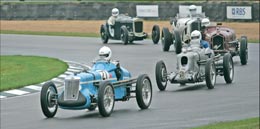
Brooklands Trophy- Mark Piercy 1935 MG R-type followed by Tom Dark 1935 Q-type
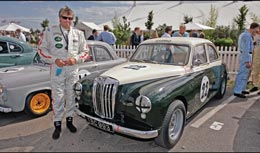
Grahame Bryant – 1958 MG Magnette ZB Varitone awaiting the start of the St Mary’s Trophy
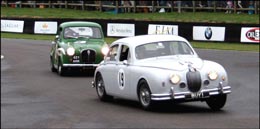
St Mary’s Trophy part 2 – Rae Davis’ A35 closes in on Grant Williams’ Jaguar Mk1
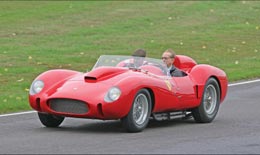
Phil Hill in the special parade driving a 1958 Ferrari Testa Rossa
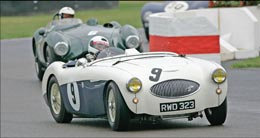
Freddie March Memorial Trophy – Jonny Herbert 1955 Healey 100S
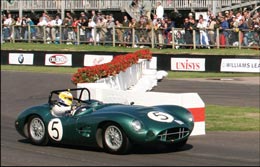
Sussex Trophy – Jean-Marc Gounon on his way to second place in a 1957 Aston Martin DBR2
The second part of the St Mary’s Trophy on Sunday featured a duel between the 2.4 Jaguar of Grant Williams and Rae Davis’ A35 which was a great fun to watch as the little A35 progressively closed on and gradually began overhauling the big Jaguar. There was also plenty of action midfield with the ZB of Grahame Bryant dicing against Julius Thurgood in a Volvo Amazon. Despite Rae Davis catching and just getting ahead of the Jaguar the race was red flagged after eight laps. Jim Woodley in the Austin 105 Westminster had attempted to carry on despite a deflated rear tyre, his inevitable spin brought the race to a stop and the final positions were taken from the previous lap, so the winner was Grant Williams in the Jaguar with the popular Rae Davis second. The ZB Magnette finished 9th just behind the Volvo Amazon while the Bruce Chapman MG Magnette ZA was 17th overall.
I have only touched lightly on the MG aspects of the weekend but there was so much more action. Jonny Herbert’s drive in a Healey 100S in the Freddie March Memorial Trophy was inspirational, the race was won by Derek Hill, Phil Hill’s son. Juan Barazi and Michael Vergers won the one-hour, two driver Royal Automobile Club TT Celebration in their lightweight E-type. The Sussex Trophy was very closely fought as Jean-Marc Gounon made his way from last on the grid to finish second in Anthony Bamford’s beautiful Aston Martin DBR2. Gary Pearson in a Long-Nose Jaguar D-type took the chequered flag for his second win of the day after coming first in the Richmond Trophy that morning.
If you have not yet sampled the unique pleasure of the Goodwood Revival be sure to book early next year and take part in an unforgettable weekend of nostalgia and excitement.
Richard Ladds
Photos by Richard Hampson
www.racingpics.net
The Revival, EX181 & Phil Hill
The Goodwood Revival meeting this year honoured the career and achievements of American racing legend Phil Hill with a special parade of his most famous race cars. Phil Hill started his racing, as many Americans did, with an MG TC and finished it with a Chaparral-Chevrolet 2F when he won the BOAC 500 race at Brands Hatch in 1967, the only race the fearsome car ever won. Both cars were shipped over from the ‘States along with a number of lesser known cars, together with examples of the various Ferraris he drove, including the car with which in 1961 he became the only American ever to win a World Championship. Each lunch time over the Revival weekend a parade featured all these cars driven by relevant contempory drivers, allowing them all to reminisce about that period of history that Goodwood recreates so uniquely.
However, my particular interest was that British Motor Heritage were encouraged to bring out the MG EX181 ‘Roaring Raindrop’ record-breaking car from its plinth at Gaydon. This was particularly significant because the speed record credited to Stirling Moss was in fact broken first by a young Phil Hill during the run-up testing, partly to assess whether the final drive ratio of 1.941 was more suitable than the 1.825 ratio. Moss only had a small window of availability between (winning) the Italian grand Prix in a Vanwall and another racing commitment. When Moss drove the car he was not so delicate with the accelerator and stripped the gears in the Riley RMA gearbox, which was the strongest box available to BMC in those days. However he did manage to establish five records in the 1500cc class, the best being 245.64 mph over a flying kilometre. This enabled the wound-up publicity machine to use the combination of Moss and MG in their advertising. My involvement at this time had been with the building and bench testing of this 1500cc engine with its mammoth Shorrock mounted alongside and driven of the front of the extended crankshaft. The fuel used was a mixture of Shell premium, Benzol and methanol in equal quantity, which was fed to the twin 2 3/16” carburettors under pressure from a compressed air system that we primed with a foot pump. The degree of richness required had not been anticipated and I recall repeatedly filing down the needles in a lathe to increase the flow before we could even eliminate the back-firing. The final power achieved from this basically production engine was an amazing 290 bhp at 7,300 rpm, well above the target requirement of 280 bhp, giving maximum torque at 5,600 rpm of 216 lb ft. I think the spare engine delivered slightly more but this one did the job, using the 1.825 ratio axle.
The design of the car was conceived by Syd Enever and boldly executed by Terry Mitchell, packaging the driver and bulky power unit into a ‘tear-drop’ aerodynamic shape. The resultant drag coefficient of 0.000292 was quite remarkable and is about as near to perfect as can be achieved whilst staying on four wheels. This shape needed only some 145 bhp to achieve 200 mph and 240 bhp to get to 245 mph which was the target speed required. Unlike earlier record cars the main structure was not based on an existing chassis but had two large diameter longitudinal members taking the MGA type of independent front suspension but unique De Dion rear suspension sprung by quarter-elliptic leaf springs and radius arms. The main body structure was only 2ft 6in high or 3ft 2 1/4in to the top of the bubble above the driver’s head, giving a rather claustrophobic driving position, this being ahead of the engine.
After the excitement of the testing, the engines were sent down to Abingdon where the final installation and necessary preparations were undertaken. As a young apprentice of only 22 I had no expectation of going to America with the car and my foreman Johnny Law had this honour. However my manager and ‘guiding light’ Eddie Maher arranged with Marcus Chambers, Manager of the Abingdon Competitions Department, for me to go on the famed Liege-Rome-Liege rally that year with the team of four MGAs. Having never been abroad before I had to get a passport hurriedly and then spend a week at Abingdon getting to know the cars under the guidance of Chief Mechanic (an honoured title in those days) Doug Watts and foreman Tommy Wellman, but that’s another story. Not very long afterwards I was called up for National Service and missed the launch of the production Twin Cam, unexpectedly bored out to 1600cc, and in a later role inherited the problems associated with that last-minute change.
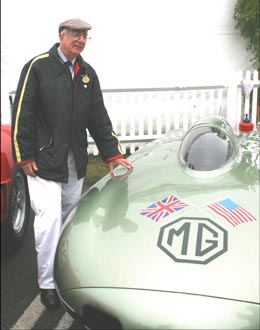
Basil Wales with EX 181 at Goodwood’s Tribute to Phil Hill
by Basil Wales