2005 Model MG TF
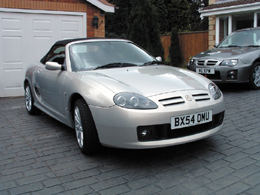
It may seem a pointless exercise to describe the changes MG Rover made to the MG TF for the 2005 models, but there are several good reasons to include this now. Firstly we had been loaned a 2005 model TF 160 for a longer period than normal, mainly due to the fact the TF arrived two days before the company went into administration and so went back a little later than would have been the norm. This did allow getting on for a 1000 miles over a wider range of journeys and conditions and from this comes a number of useful observations.
Secondly there are just over 600 2005 model TFs in total, that is all, so with their positive changes I feel that it will become a sought after variant. Thirdly at the moment there are a number of new and unsold cars coming through and it is valuable to provide some feedback for those who may be thinking of buying one. Fourthly there is a message to send out to those who are looking to restart the TF production and it will be useful for them to have some assessment of the last changes and how it affects the range.
Softer Suspension
If you line up a 2005 model against an earlier one the only visible difference will be in the hood and the glass rear window, and in the case of the 135 a new alloy wheel design. Drive one though and you will notice immediately how much more compliant the suspension is. This is one area that has always been less than ideal since it was such a competent area with the MGF. Indeed when I went on the TF launch and drove both standard suspension and the lowered Sportpack 1 versions I found little difference in the ride, so for my own car I decided to go for the Sportpack 1 set up and benefit from the lower stance. Many MGF owners have been disappointed to the point of not buying a TF when they experienced how firm the ride was.
Smooth lines of the 2005 TF
MG Rover certainly followed the same route with the ZT range and 12 months after introduction and once the ZT was established as a stand-alone model they softened the suspension yet retained 90% of the handling.
The previous harder ride set up was then moved to an option and labelled ‘Sports Suspension’. The surprise here is that the same process took so long to apply to the TF, yet the changes are equally beneficial.
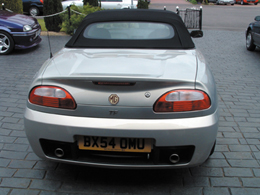
Hood rear window is only obvious change
The March Enjoying MG covered the details of the changes, but essentially the front springs are 20% softer, the rears 30% softer and the front anti-roll bar is 2mm thicker. There are bush and other modifications to suit but this is the essence of the changes. The effect is immediate and very well received. The ride now is much closer to that of the MGF and like the changes made to the ZT range, there appears to be about 90% of the handling still available. Indeed on our roads this softer and more compliant ride is to my mind a means to actually improve the handling, or put another way, you will find yourself more comfortable going faster over rougher roads that previously grated! Several drivers, all with experience of the MGF and TF range all commented in the same way.
It is worth noting that 15” wheels are now fitted with Continental tyres whilst the 16”, as fitted to the test car remain Goodyear’s Eagle F1, and all MGF and TF owners please note that this is still the GSD2, which some tyre outlets say is no longer produced, it is, just ask Goodyear. I mention this as GSD3 versions make the MGF and TF handle like a jelly and are definitely not suited.
All of the suspension changes are most definitely very welcome and should the TF production resume than this is a very good base line to recommence with.
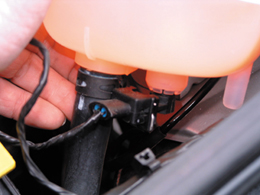
New low coolant level warning light sensor in the base of the header tank
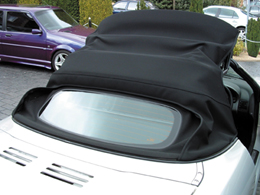
Lowering the hood reveals the neat fit of the new rear window
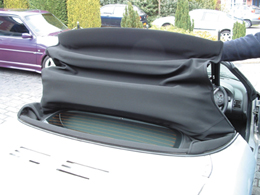
Rear window sits on recess when hood is lowered
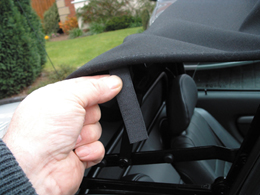
Hood restraint straps
Hood with Glass Window
The other 2005 aspect that has a considerable impact is the glass rear window in the hood. This is accompanied by a number of small additional changes to the hood to reduce the instances where the hood material can become ‘scissored’ as the hood frame folds, plus there are adhesive covers on the ends of the hood frame outer stays to reduce abrasion when the hood is raised. A point well worth noting and probably adopting on all earlier MGFs and TFs, as the hood material on some cars has shown some damage.
With the hood raised the shape of the glass window seems quite odd with the distinct curve on the lower edge and that edge seemingly set high. I felt that less tall drivers of the TF would notice this and it could be a restriction to rear vision and indeed this was confirmed, but the degree of loss is fortunately small and less so for taller drivers. The smaller overall window when compared to the preceding model’s plastic one does reduce your wider view slightly, but the bonus in clarity through glass more than offsets this.
I did have a couple of occasions when the benefits of the standard fit heated element in the rear window provided saloon car convenience to achieving clear rear views within a couple of minutes of starting off, thus negating the previous need for manual wiping of the plastic window, or blasting air from the two facia centre vents.
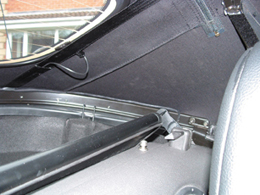
Heated rear window remains connected
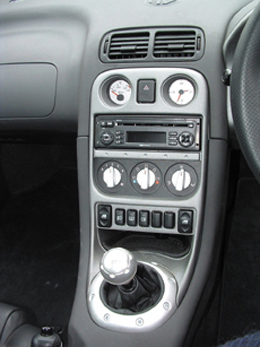
New illuminated controls
The reasons behind this odd shape and positioning become clear once you start to lower the hood and see how perfectly shaped the glass is to drop into the available space behind the T bar trim and lie flat on top of the engine cover. A different shaped window with a larger glass area would fit the hood, but when lowered this would not sit square on top of the engine cover carpet and this would lead to instances where it could get broken. At £430 plus VAT plus fitting you do not want to damage the window.
Glowing Heater Controls
Another useful change is the illumination of the heater controls so that at night you can actually see where the controls are set. This is a small change, but being able to compare old and new at night shows the effort is justified. It is a shame, but perhaps quite understandable in view of events, that the quality of the knobs is really cheap and nasty.
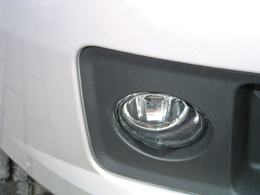
In this model a neat join has been achieved around the blacked out sections in the front and rear bumpers
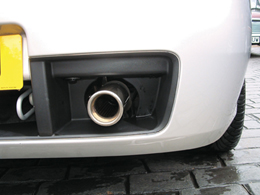
In all other respects this TF was much the same as I had with my own 2002 car, other than now items such as front fog lamps and Alcantara trim for the seats is standard rather than a cost option. Another positive development was in the neatness of the blacked out sections in the front and rear bumpers. This was a bone of contention with my car as these were painted and clearly not perfectly masked so that a clean line between the black and the body colour was not achieved. The design of the bumper has changed to enable this to be achieved and a clear knife-edge line was present. In fact a couple of other things showed improvements in quality. The retrograde change since the TF’s introduction to a single horn that emitted a weak and feeble ‘excuse me’ for a sound, has been replaced this time with the same specification powerful twin horns I had on both my MGF and TF. A small but important change.
Returning to a TF160 after a 12-month break from daily contact certainly drew attention to the seating position. In my MGF, with the Heritage leather, the seat was higher than in the TF yet the F didn’t feel that high and the TF definitely felt lower. Interestingly the test TF had the same clearance between legs and steering wheel as I had on my TF, but it definitely felt as though I was sitting on the car rather than inside. This is a oft repeated comment from road tests and this time around I can understand where they obtain this view. I didn’t find this a problem as you adapt to the car your driving and as expected it was the flexibility of the left leg needing a couple of days before the clutch foot could be easily rested on the specific footrest that is a little offset.
Overall the remaining experience was much as has been the case with all TF160 models. This performance was easy to access, although to really set the car moving you need to stir the VVC into action with higher revs, one reason why in the real world of daily driving the TF 135 is just as quick as a 160. The standard AP sourced 304mm front brakes with their distinctive red painted four pot calipers reminded me how strong and sensitive they were.
I also noted another small but useful change that occurred in 2004. This was the addition of a low coolant level warning light. The reputation the MGF carved itself for failed head gaskets is well known. The fact that by the time the TF arrived many changes had occurred to reduce the model’s susceptibility to this had been introduced. Indeed the 2003 changes to include a new pressure relief thermostat just about put the crown on the changes that have transformed the K series into something completely different to what it was in the early MGF. It’s then almost ironic that the low level warning system has been applied to the later TFs. It is certainly something that owners of the earlier cars, MGFs especially could well benefit from copying.
Overall the tenure with this car was far more pleasurable than I had with my previous TF160, and this is all down to the suspension and the simple fact that this impacts on you 100% of the time your in the car. The other changes are there for you to use and benefit from at specific times, but that suspension improvement is worth pursuing. If you’re thinking of buying a TF then now is the time to look into grabbing one of the 600 odd 2005 model year examples, as at the time of writing there were no signs that TF production will be resumed.
Roger Parker