A TC – one-eighth full-size!
For those keen on MGs there was an interesting exhibit at the Model Engineering Exhibition held at Sandown Park at the end of 2004. This was the seventy-fourth such event and the first was staged at the Royal Horticultural Hall as long ago as 1907. Amongst engineers there has always been a close affiliation between those working on full-sized subjects and the people making models; the latter were often used to demonstrate a new piece of machinery or vehicle to potential customers before they took the plunge and placed an order. Designers and stylists used models, both full-size and scaled down, to try out new ideas or to convince decision makers to proceed with a new design. With MG, there are numerous examples scaled-down models to be seen at Gaydon.
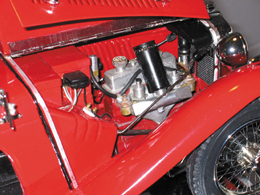
The engine bay on this model TC has in miniature most of the components found on the full-sized car.
The MG model on show at Sandown was of a TC that was constructed entirely from scratch one-eighth full size. Stephen Atkinson built his superb model and had travelled from far-distant Belfast in order to attend the Surrey show. Stephen is no stranger to such shows and has, on five occasions, won gold medals for his models at the Engineering Exhibition. One of these successful models was of a Mini-Minor built entirely of wood that looked superb, judging by pictures he showed us. He has also built and exhibited railway locomotives and other examples of engineering models.
The dual inspiration for the TC was the car owned by a friend living close by and his long-held ambition to own a full-sized example of the marque, especially a TC. Although the model he has built is no substitute for the real thing, it will be cheaper to maintain and takes up a lot less space. Having access to the TC whenever he wanted was a huge advantage and he spent many hours measuring, photographing and making drawings of every part so that the model would be as accurate as he could possibly make it.
The techniques used followed much along the lines suggested by master model-maker, Gerald Wingrove in his various publications, although that is not to say that having had training as both a jeweller and in tool-making that Stephen actually needed to consult books for advice. Being eighth scale the total length of the model is just under seventeen-and-a-half inches, 443mm, and this means that even some of the smallest details of the prototype need to be represented for the result to look at all convincing.
As with the full-sized TC, work on the model commenced with the chassis construction. The rails, cross-members, etc. were fabricated from metal and assembled into an exact copy of the ladder frame so familiar to modern restorers of these popular cars. The springs, axles, etc. were similarly made, after careful reference to way the original vehicle was assembled. The engine, gearbox, rear axle casing, etc. were machined from solid material and each comprises a number of separate components that were constructed and painted before being attached to the finished chassis frame.
The wire wheels and rubber tyres posed particular problems and are often an area where even experienced modellers come to grief. Stephen’s solution was typically painstaking, but extremely effective. The tyres were moulded from a silicon rubber solution that meant purchasing a minimum quantity of materials at the cost of no less than one hundred and fifty pounds. To initially make the mould a solid ‘tyre’ was first turned on a lathe from a piece of Perspex and the tread pattern of the full-sized tyre was machined around the circumference of the pattern. Details, like the makers name and tyre size, were then painted on before a mould was made from which to cast the set of tyres for the model. The results speak for themselves.
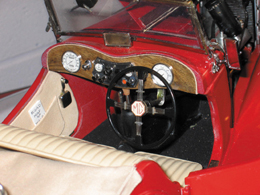
Seats, instruments, trim, steering wheel and all the other details are carefully represented. Note the road map in the door pocket!
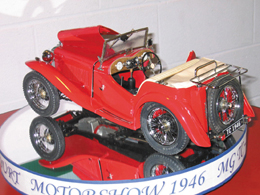
The delicate shape of the swept TC wings were produced by forming sheet metal over wooden formers, much as is now done by metalworkers making reproduction parts for full-sized cars
Wheel rims and centres were made on the lathe and holes to the correct pattern were drilled around them to take the spokes. A jig, again machined from clear Perspex, was made to hold the centre and rim in the correct position before fine flexible stainless steel wire was threaded backwards and forwards between the rim and wheel centre, reproducing the correct lacing pattern. The completed wheel is remarkably strong and very realistic.
Where Stephen’s jewellery training was most useful was when it came to making the bodywork, wings, running boards, etc. Here he carefully made wooden bucks over which brass sheet was carefully beaten into shape, some parts being made from a number of sections soldered together. The bonnet is a work of art. Tiny hinges and minute catches allow it to be opened exactly as the prototype so that the miniature XPAG power unit, complete even down to details like the carburettors, air cleaner and wiring for the spark plugs, can be examined.
The cockpit is exceptionally well modelled. There is a veneered wooden dashboard of the correct style fitted to early TCs. The instruments were made by first drawing them to a conveniently large on a sheet of paper and then reducing this down on a copier to the correct size. The Brooklands steering wheel was fabricated from a number of pieces and the seats carved from wood before being painted the correct colour. As with everything else on this superb model, the colours, fittings, etc. were copied from the car measured.
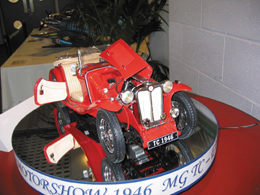
Overall, the proportions of the model are right and at first glance this could be a full-sized car
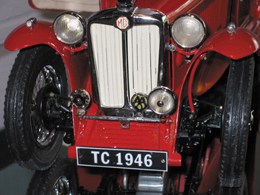
The radiator surround, grille and the badge bar and fittings are correctly proportioned and modelled on those fitted to the car that formed the inspiration and pattern for this superb model
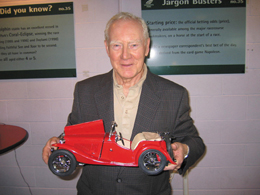
Stephen Atkinson with his superb model TC
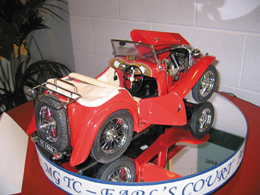
The spare wheel and fuel tank are important styling features on the TC and the correct representation of these is important in reproducing a convincing model
The headlamps are worth a careful look. The bodies were turned from sold but the lenses are domed watch glasses that have been etched with the correct lens pattern. The spot lamp and horn on the miniature badge bar were made to match those fitted to the full-sized MG. The radiator shell and grille are very effective and add to the convincing overall appearance of the model. Pictures hardly do this full justice and on display at Sandown it attracted a lot of attention and much favourable comment.
Given his previous record, Stephen had hoped for another gold medal to add to those already collected. However, as in the concours so familiar to classic car owners, when it comes to judging it is the smallest detail that separates one superb example from another. Unfortunately, opening and closing the bonnet to show off the engine had worn some of the paint on the hinges and this defect, along with what the judges thought was too much paint on the radiator grille, relegated him to the silver medal category. A disappointment, maybe, but nevertheless one hoped that the favourable reception the MG model received from visitors was some compensation.
Malcolm Green