Missed Opportunities?
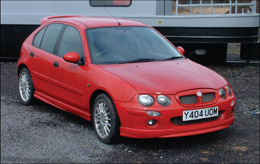
ZR Development Car
The complexity and fallout from the MG Rover collapse continues to produce many a twist and turn. Whilst the headlines naturally focus on the situation relating to Nanjing’s progress towards manufacture of MG cars, and the equally strong hunt for scalps in respect to the failure of the company, there are many interesting asides that would simply not have surfaced but for the collapse.
ZR appears standard from the outside
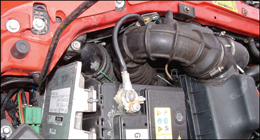
MGF ECU located in ZR engine bay
One is the fact that the Administrators have seen fit to allow many non-standard ex-development cars into the public domain that would normally have been broken up or crushed. Many people regard this as a foolhardy thing to do since these non-standard cars have no one to provide any back up, because they are manufacturer one offs, fall into the category of modified cars and carry the associated problems of insurance as well as maintenance. Buyers of these cars may not appreciate exactly what they are buying and that bargain car may soon become a millstone of immense proportion. On the other hand being able to save an interesting piece of automotive history is an opportunity not to be missed.
A recent telephone call to the Club revealed one of these interesting pieces of MG Rover development history. It was bought at a Midland car auction almost by accident when its age was misinterpreted by an initial misreading of the number plate and seeing the car as a cheap 04 (2004) plate car, not the Y (2001) plate car it actually is. This initial error was soon to be turned around when opening the bonnet revealed an array of odd features and extra wiring. Closer examination revealed more than just additional sensors, but a complete turbo K series engine.
This far from pristine red five door MG ZR, with a variety of non standard features and signs of a fairly hard life has many Rover 25 features. It is however a genuine very early MG ZR 160, built at a time when there was not a full supply of MG parts. A hint of the early nature of this car is the fact that it was registered on 15th March 2001, some four months before the official launch of the Z range of MGs.
The car’s VIN confirms its authenticity as an early MG ZR and whilst displaying mixed cosmetic features, the hardware it runs is pure 160 specification which is perhaps just as well in view of its present capabilities. This is because under that rather unkempt surface is a full MG ZT 1.8 K series turbo engine. The standard turbo engine delivers an on paper 160ps and with extensive experience of this engine in MG ZT and ZT-Ts I have previously described how impressively this engine moves the heavy ZT, except under 2000rpm where the engine is off boost and shows its relatively small capacity.
The performance of the ZR 160, indeed any VVC engined car, is good, but to achieve the best you have to tie the throttle cable tight around the engine’s neck and squeeze until you get to the rev limiter in order that you’re on the boil for the next gear up. Whilst there is some scope to modify the engine to improve this area, this gets nowhere near what a well engineered turbo installation achieves.
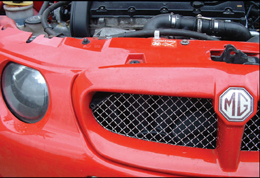
Modded grille mesh for ZR
A common question is why the 1.8 turbo engine was not slotted into either the ZR or ZS, or both, especially since it was apparently an easy conversion. In the meantime there are a growing number of owner derived turbo conversions and commonly the T16 engine is the source of power. As good and robust as this engine is with an ability to produce scorching power, and I used to do a lot with these engines, it remains a very heavy engine and in the ZR or ZS degrades the car’s handling.
Anyone wishing to experience this first hand, just needs to drive K series engined ZR or ZS back to back with a diesel version and feel the weight wash out the front end. Then add about 10 kgs to the diesel’s front weight and you’re pretty close to what the T16 offers. In time may we understand some of the detailed internal politics that kept the K turbo so limited, but in the meantime this is a snapshot into what could have been.
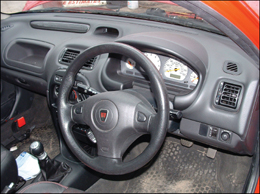
The development car’s interior was put together before a full range of MG ZR parts was available
The case for a ZR with more performance than the 160 has been much stronger in recent years as the relentless climbing power with ZR (and ZS) competitors, averaging around 190bhp and with 2 litre engines had eroded the ZR market position. Good as the VVC engine is, it could not hold station with those competitors and being an older design had fewer other supporting attributes to fall back on. Using the proven 1.8 K series turbo engine would allow a small to medium increase in bhp, but the boosted engine’s torque would be more than a match for the competitor’s naturally aspirated engines.
Wires and sensors abound…
MG Rover may be criticised in certain areas, but there were many people and aspects within the organisation that were far from slow and tardy, plus they had a clear view of the world outside. Many of the development cars now seen outside Longbridge is testimony to this, and this specific ZR is no exception.
Looking around the car shows its recent development heritage with sensors, wires and gauges dotted around the engine bay and a separate loom to the boot where various data gathering equipment was housed. Asking former Longbridge people about this, they confirm it was an emissions development car.
Driving the ZR confirmed that this was far more than just a simple engine change, with the gearing clearly correct for this engine with the lower rpm power band, peaking at 5500rpm rather than 7000rpm of the VVC. The car was also very tight in terms of handling showing no torque steer, body twisting (even though this was a five door car) and displaying a very sure-footed feel on the road. It actually felt more solid and secure than other production ZRs I have experience with, yet was not go-kart solid, just the comfortable side of firm.
Performance of the ZT 160 with this engine is impressive so the performance expectation of a ZR with the same engine after slicing off 400kgs was very enticing. Indeed it came up to expectations, just like fitting an engine with a 50% bigger capacity. I have previously reported that the ZT turbo is quicker than the similarly powered ZT 160 V6 and gives the 190 a run for its money. Feedback from those in the know at Longbridge has indicated that the standard turbo engines do generally give a little more than the stated outputs. A later rolling road run confirmed that this ZR followed suit with a recorded 175bhp.
Performance was delivered in a completely different way to a ZR 160 with very strong solid torque from almost idle. The lower weight of the ZR did not show the sub 2000rpm off boost flatness the heavier ZT does. In bare terms it means that a standard ZR 160 being driven flat out would see this turbo car being driven in a far more relaxed way, yet keeping up with ease. Yes it is also clearly quicker if fully extended, but that would be missing the main point, which is the ease and availability of performance. However, there is not too much power to overcome traction and give torque steer, common on many other Turbos.
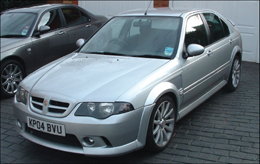
Roger McBride’s ZS showing the facelift style, with bodykit of the 2004 model to good effect
This car is what many 200/25/ZR owners would like to create and which some have. It is far better than T16 Turbo conversions purely from the much lighter K series engine’s positive effect on handling, outweighing any power deficiency of the T series for normal road use. It is just a shame this is a one off.
VVC ZS
As soon as the ZS was announced it was obvious that there was a big gap between the 1.8 litre ZS 120 (120ps) and the 2.5 litre V6 ZS 180 (177ps) models. The logic would have been to have a 140bhp model in between and the TF 135 (136ps) engine appears to fit the description, or a VVC engine. However, torque has more impact than the differences in bhp, so with the 120 and 135 delivering 165Nm and the VVC with 174Nm, there is little difference, but a big gap to the 240Nm of the 180.
On that basis there seems no real advantage in having an intermediate spec naturally aspirated engine, and that just leaves the K Turbo. That delivers 160ps and 215Nm but experience with the ZT range shows that the turbo would be far too close in performance terms to the KV6, plus being lighter it would offer a handling advantage – just look at the difference between K4 and KV6 British Touring Car engined ZS.
So whilst the case is made against an intermediate model there is a certain cache for such a model and VVC engined cars already exist and actually work very well. I have built one with my son, and with a few simple tweaks it goes very well indeed and much closer to the 180.
I am certainly not the first to go along this route and neither will I be the last. Another recent car I experienced was a facelift ZS 120 owned coincidentally by another Roger, Roger McBride from Birmingham. This car has the full 180 body kit and is finished in silver, one of the colours that I think gives this car a stunning appearance. The conversion to VVC was complete and straightforward and the finished look is one of a factory production car.
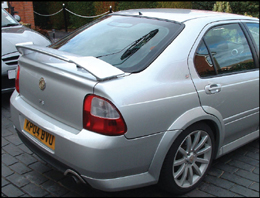
The rear of the facelift cars has been the one area attracting most varied comment, but the addition of the big spoiler rather than a lip spoiler works better here
Being standard 160 spec engine, complete to engine management mapping, I approached the opportunity to drive it with greater interest than normal, as I was anxious to compare this standard spec VVC to the modified one in the car we built. With plenty of experience of all models of ZR and ZS, I expected the car to be less sharp than a ZR 160 and indeed to my wife’s ZR 120, and this was the case. Having to haul around an extra 100 plus kgs of weight has such an effect, and for comparison the ZS 180 is another 100kgs heavier still, so comparisons there need to bear that in mind too.
Indeed the car was less lively from standstill but once on the move the VVC comes into its own, hauling the car to higher speeds than a 120 with clearly reduced time, yet being completely tractable at all rpms, showing the benefit of being able to use standard engine mapping. Incidentally the gearing was identical so the comparison was quite valid. What was also interesting was the performance was clearly falling short of that of our modified engine. Interesting in that the modifications are subtle, with a ZR ITG Maxogen, Piper cat back exhaust and 52mm throttle.
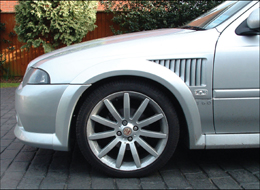
One of the most distinctive features of the facelift style bodykit is the side vents, which can easily be made fully active to relieve engine bay hot air
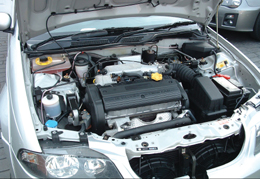
Standard factory look engine bay showing how easy and right a VVC engined ZS would look. Most observers would not spot that it’s a VVC
The manifold was an early Euro III spec mated to a downpipe and cat which I made up from bits in the garage, including the pre and post cat lambda sensors so that a full Euro III spec engine management map could be used in the late spec MEMS3 system. This also has an added 2 degrees of ignition advance, a dealer diagnostic equipment T4 facility for the later VVC specs where one two or three extra degrees of ignition advance can be added. Having tried two degrees on this engine to very good effect another has gone the full three degrees to slightly better effect, especially with Optimax.
What these experiences show is that the use of a VVC engine in the ZS works in much the same way as you find in the ZR, with worthwhile performance benefits that are compensated for by the greater engine efficiency so fuel consumption is not hurt to any significant degree. This engine efficiency indicates how with some simple bolt on tuning parts the VVC will be producing the same sort of bhp as a 2.5litre KV6 engine and whilst it won’t have the same torque, the lower weight and gearing fills the gap, and yes, I think it is worth it.
The red MG ZR development car is currently up for sale and anyone with an interest should ring Stuart at Alex Simmons Car Bodies, Solihull, 01564 702569 or 07850 227063.
Roger Parker