Original MGA
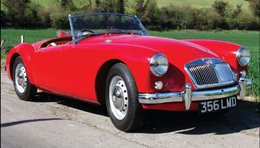
I bought my 1957 1500 MGA in August 1998 after many months of searching for a decent example. It was just what I wanted, a very original British car with a good history and steel wheels (I’d spent too many years cleaning the wire wheels on my old MGB). It was in excellent condition with the original engine, interior and chromework and had only done 45,000 miles from new. The previous owner had covered just 6,000 miles in 17 years. From an earlier owner I managed to find out about its history which included being fitted with a Nordec supercharger and racing at Brands Hatch. This was Ken Roe, a lovely chap and thorough MG enthusiast who owned the car for 23 years. He told me a lot about the car’s early history which included quite a bit of success on the concours circuit and Ken can take a large slice of credit for the car’s survival in its present state.
The MGA’s design has really stood the test of time and still looks fabulous
Since buying the MGA I have carried out a number of improvements including fitting a new wiring loom, reworking the cylinder head for unleaded fuel and fitting a five speed gearbox (after the original disintegrated into a pile of bits). What I haven’t done is ‘over-restore’ it as I like a car which looks like it’s been used and no amount of money can buy the patina that a car takes on after a lot of years of use and careful ownership. I have therefore purposefully left things like the original seats, carpets and door seals which although worn add to the appeal (for me at least) of the car
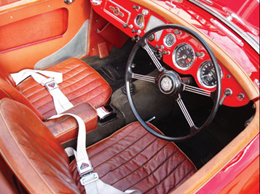
Interior is attractive and original and retains the elusive patina that only comes after many years of active use
An MGA in good condition is a great car to drive and although the 1500 isn’t the fastest thing on four wheels it can still put a large smile on your face. The roadholding is excellent and you would have to be very careless indeed to get into trouble. My car still has Dunlop cross-ply tyres fitted (it has never worn radials) but I have never felt unsafe even in the wet. It was, of course, made for the smaller roads of the 1950s but is more than able to cope with motorways – especially with a five speed box fitted. We have taken the car over to Jersey for the MGOC Rally for the last few years and there is nothing like driving it over there, even though there is a 40 mph limit!
When I look at an MGA it amazes me that it is now over 50 years old. The design has really stood the test of time because it looks fabulous even now and still turns heads. However, you soon find out that this is a product of an earlier age. There are no locks of any kind, no door handles, no wind-up windows and no you can’t put the hood up in 15 seconds going along at 10 mph. In reality security can be improved by fitting cut-off switches for the battery and the fuel pump and because the handbrake is of the fly-off type nobody can work out how to release it anyway. Likewise with the hood up there aren’t many people who can figure out how to open the doors and even to open the boot you have to know where the release is, so things could be worse. You’ve probably seen that most people drive an MGA with the hood down at all times and there is a reason for this – getting the hood up is a real pain and you need at least five minutes. So when you hit that unexpected downpour you have a choice of driving through it or heading for cover. Personally I don’t like driving the MGA with the hood up as I find it both noisy and claustrophobic.
You may see different types of sidescreen on MGAs. The original 1500 type were vinyl covered with a flap at the bottom so you could stick your arm out to give hand signals! These early sidescreens are, to put it mildly, a pain as there is no way of getting ventilation which with the hood up adds to feeling of being very closed in. However, I have also got a pair made from aluminium which have sliding windows, designed I think for use with the optional hard top. A vinyl covered set to this design was standardized on the 1600 model. No MGA had seat belts fitted at the factory but the 1600 Mk II has anchorage points ready to accept belts. The workshop manual gives good diagrams and instructions as to how seat belts can be fitted and it is a fairly straightforward job.
Boot space is a little cramped as a lot of it is taken up with the spare wheel but it is not too bad. We have been to Jersey with all our luggage for a week and to Le Mans with camping gear and haven’t had too much trouble. Because of this lack of space quite a popular accessory is a luggage rack that fits on the boot lid. Unfortunately though this is a permanent fixture and for me spoils the lines of the MGA completely.
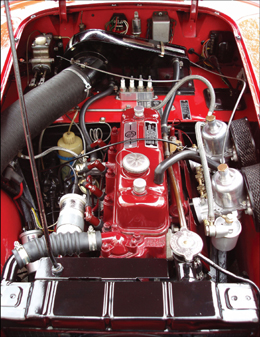
Engine bay provides adequate access although engine removal and replacement is still a challenge
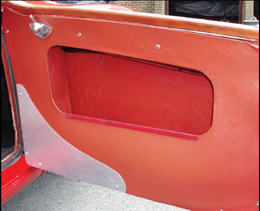
Removable side screens allow space for door pockets which provide useful extra storage
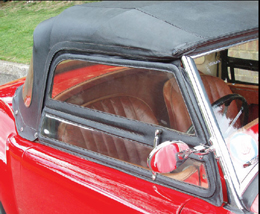
Early side screens have a flap for hand signals but no facility for ventilation, so the interior becomes stuffy when the hood is erect and the side screens are fitted
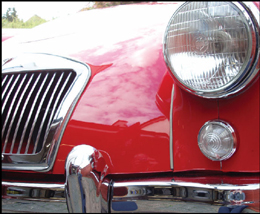
MGA 1500 grille and sidelight
Routine servicing is fairly straightforward and can easily be undertaken by the average owner. Engine bay access is good (except for engine removal) with all serviceable parts within easy reach. This is definitely not the case with the Twin Cam though, but more of that particular model later. Spares availability is excellent and I don’t think that there’s anything that can’t be obtained either from a large company such as Moss or smaller specialists like NTG or Bob West. However I think that the MGA is the kind of car that you’ve got to enjoysplit light at the front – a white section for the side light and an orange section for the indicator and similarly at the back a separate orange indicator was provided. The 1500 set up can be a bit of an issue in modern traffic as most drivers would think something was wrong if a red rear light suddenly started flashing. For this reason I have fitted a pair of reversing lights underneath the rear bumper fitted with amber bulbs and these are wired up to the indicators. The 1600 also sported disc brakes as opposed to the all round drum brakes of the 1500.
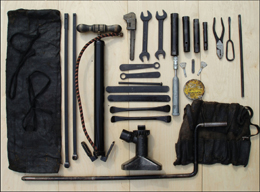
Comprehensive MGA toolkit even has a starting handle
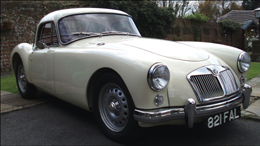
Twin Cam Coupe with distinctive Dunlop knock-on wheels
The 1600 Mk II was introduced in 1961 (and by the way the first 1600 is not called the 1600 Mk 1). This model is easily identified as the grille bars do not follow the line of the car but are vertical with the bottom of the bars recessed in, leaving a kind of shelf at the bottom. Whether you think this is an improvement or not is a matter of taste. Also differing on the Mk II is the rear light cluster which was a new horizontal set-up fixed not to the wings but to the body each side of the rear number plate. The engine capacity was increased from 1588cc to 1622cc.
In 1956 a coupe version of the 1500 was working on because there will always be something to do. If the thought of getting your hands dirty doesn’t appeal then it’s probably best to look somewhere else.
The MGA was introduced in 1955 as a replacement for the ageing T series MGs and its sporty looks ensured its popularity. The 1500 was the first model and it was produced until 1959. 52,478 1500’s were made, making it the most prolific model. Of these only 1,859 were for home consumption, 43,663 going to North America. The MGA has a separate body and chassis, with all steel construction apart from the door skins, the boot lid and the bonnet which are of aluminium. The separate toe, heel and floorboards are made from plywood.
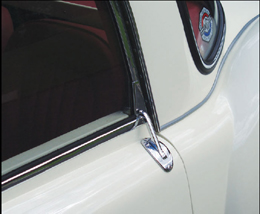
Coupe door handles are particularly stylish
The 1600 appeared in 1959 and looked very similar to the 1500 except for the front and rear lights and some additional 1600 badges. On the 1500 the front side lights were combined with the indicators and at the rear the single red light served as the side light, the brake light and the indicator. This did not conform to new American regulations and so the 1600 had a larger introduced. This had wind up windows and lovely chrome door handles and proved very popular. Thereafter each model was also produced in a coupe version.
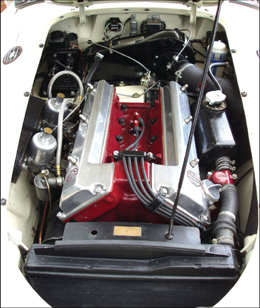
Twin cam engine with distinctive cylinder head and alloy cam covers takes up most of the available space in the engine bay
In 1958 came the infamous Twin Cam. Although looking very similar to the push rod engine cars (the only outward differences were special Dunlop centre-lock disc wheels and some Twin Cam badges) it was a very different car underneath. When you lift the bonnet you can see straight away that this is no ordinary MGA – every spare inch is taken up by that huge twin cam cylinder head and almost nothing can be reached easily. Of course at the factory they had no trouble getting it in – it was fitted before the body was lowered onto the chassis from above! The story of the Twin Cam’s development is a long and complicated one and very interesting (read about it in Graham Robson’s ‘The Mighty MGs’). Space does not permit its telling here. Suffice to say that the car soon got a reputation for poor reliability, including very high oil consumption. It was very sensitive to ignition timing and needed to run on 100 octane fuel. The problems were finally sorted out but the solutions came too late to save the car and after just 2 years and 2,111 cars the model was shelved. Today, however the MGA Twin Cam is a very sought after car that commands a high price. It is not for the faint hearted though and probably not a good model to choose for your first MGA.
There is one other MGA to consider and that is the De Luxe, a model shrouded in some mystery. Basically I think it’s safe to describe it as a Twin Cam with a push-rod engine. The first ones were produced just before the end of Twin Cam production. After the demise of the Twin Cam the model was continued to use up Twin Cam parts such as the Dunlop wheels and disc brakes and parts like competition de luxe seats and close ratio gear sets were later offered as part of the package. The De Luxe was never listed as a separate model and there is some doubt if it was ever referred to by that name at the time. It is certainly one of the rarest models with only about 395 cars being produced. The rarest MGA of all is the 1600 Mk II De Luxe coupe with a total of only 23 cars being made, and only 13 of these for the home market.
So, how would you set about buying one of these great MGs? My advice would firstly be to get someone with a good knowledge of the cars to go with you unless you’re really confident. There’s no real shortage of MGAs but for every good one offered for sale there will be another 10 that are, what shall I say, not very good. The MGA is a difficult car to restore properly and many have been well and truly ‘bodged’ over the years. The most important areas are the chassis and the bodywork – look for corrosion in these areas particularly where mud can become lodged such as between the chassis and the body behind the sills. Check the door gaps and those around the bootlid and bonnet – on a car that has not been restored properly these will be all over the place. Buy the best you can afford – at the moment I would say that you need to pay at least £10,000 for a good car and up to £16,000 for a really nice one and of course Twin Cams will be even more (over £20,000 for a good example). Seek as much advice as you can from other owners and learn from their mistakes.
Books such as ‘Original MGA’ by Anders Clausager and Malcolm Green’s ‘MGA Restoration Guide’ are a good source of information.
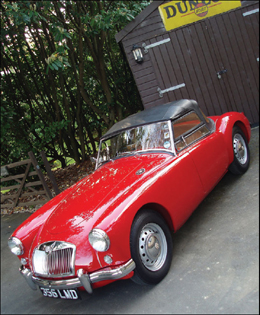
Sleek lines of the MGA
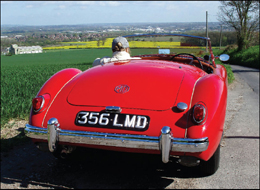
Rear profile is smooth and uncluttered