British Motor Heritage Ltd an Insight
Ask MG enthusiasts if they understand the connection between British Motor Heritage Ltd and MG and some will not know. However, ask the same group the connection between a Heritage body and MG and there will be a much greater correct response. Such is the understanding that connects an MGB or Midget with a Heritage body. Most of them will know immediately that a Heritage body means a brand new body, one of the products of British Motor Heritage Ltd.
BL Heritage was formed in 1975 and was a wholly owned subsidiary of BL (British Leyland). The aim of the§ company was to provide genuine original quality parts for the large numbers of classic British cars that sat under the BL family umbrella, and quite simply to keep this valuable motoring heritage alive. It has seen many fluctuations in the way of corporate changes and owners, but in 2001 British Motor Heritage was acquired from BMW and became an independent British owned company.
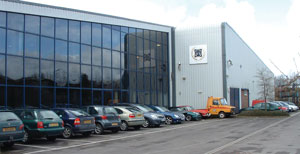
One end of the BMH facility
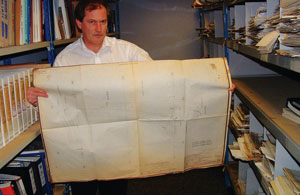
British Motor Heritage’s John Yea with original drawings
British Motor Heritage is not only involved in body manufacture, but supplies a myriad of body parts for many classic British motoring icons from MG, Triumph, Morris and Mini and caters for cars from Morris Minors to the recent MG TF. British Motor Heritage owns many familiar brand names including the Heritage trademark, MOWOG, Nuffield, and others including Steelcraft marks and the Heritage Motor Parts brand, and is licensed by the trademark owners to use MG, Mini, Austin-Healey, Triumph, Rover, Austin, Morris, Riley, Vanden Plas, Wolseley, the Special Tuning and BMC trademarks and logos. Ownership of these brands is currently attracting attention in the newspapers. Incidentally MOWOG is an historical Nuffield organisation acronym for MOrris, WOlseley and mG and seen on many mechanical components, especially A and B series engine castings.
British Motor Heritage’s profile really took off in the late 1980s when they reintroduced new MGB bodies at the May 1988 Classic Car Show at the NEC. This was a world first, still envied by many today, in the reintroduction of complete brand new bodies for a long out of production car and opened up a completely new chapter for owners of MGB considering restoration of their cars, and created the ‘Heritage Bodies’ term.
These achievements were far from an easy and saw the need to recover thousands of pieces of lost tooling, jigs etc, set up a new manufacturing facility and find the skilled people to man it. David Bishop has been rightly credited with responsiblilty for all this and deserves his place in MG history. David has very recently retired from the company and has earned a long and relaxing retirement. The company though remains in good hands with John Yea at the helm.
The body of any car is a complex structure and once the MGB shells were again being manufactured the next logical step was to make a complete car. This led to the MG RV8 and which re-launched MG sports cars onto the world some 13 years after the demise of the MGB. This also paved the way for the MGF, consistently the UK’s best selling sports car in each full year of its production, a mantle carried in the same way by the TF.
Moving back from the headline areas saw Heritage body production not just continue in a cottage industry style, but grow at a steady rate by making use of the continuing search for and gathering up of other models body tooling. The original chrome bumper MGB Roadster body first seen in 1988 was then joined by GT and rubber bumper versions, the Midget was not forgotten and its various guises in chrome and rubber bumper formats were catered for too. Triumph TR6 owners then gained the benefits offered in a new body and more recently when the Classic Mini ended production at Longbridge, BMH took the tooling for that and now produce various spec Mini bodies, including the almost forgotten Clubman version.
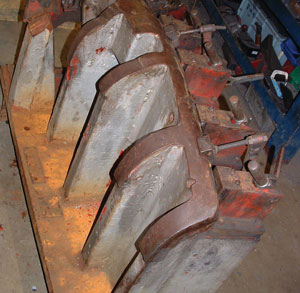
Front wing tooling before refurbishment
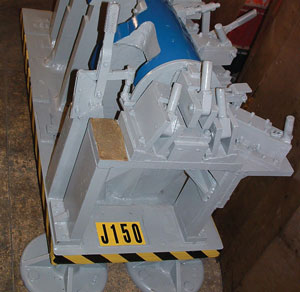
Refurbished front wing tooling
Back to MG versions and there has been considerable growth in the number of detailed variations that can be bought under the basic MGB and MG Midget title, and considerably greater than just chrome or rubber bumper, Roadster or GT. Looking at the MGB Roadster and you see variations to cater for all models from the 1968 model year mark 2 all synchro gearbox versions to the end of MGB production, including left hand drive and US spec cars. Midget has less coverage, but still includes many variants within that same time period.
However, various helpful special body specifications are also offered. Firstly the early MGB with 3 synchro gearbox owner can, subject to some special conditions, obtain a brand new body, even with the early pull handle doors, but they do have to provide a good serviceable condition transmission tunnel as the original tooling for this no longer exists. Fortunately as B series engine and gearboxes invariably leak oil, rust is rarely a problem in that area.
Next, V8 converters have the option of ordering roadster shells in either chrome and rubber bumper formats but specify the original MGB GT V8 underpinnings. Additionally chrome bumper shells can have RV8 underpinnings. While GT shells come in either the original MGB GT V8 format or chrome bumper with the same RV8 underpinnings as for the roadster option.
A less well known option is a special body providing a rubber to chrome bumper conversion. Here you buy a chrome bumper body but with rubber bumper underpinnings, thus saving the conversion complications. Rubber to chrome bumper conversions are common enquiries and many are not aware of the substantial amount of cutting, welding, paintwork and other work needed to convert a rubber bumper car to chrome spec.
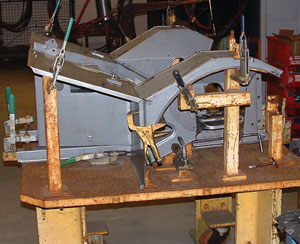
MG Midget front section
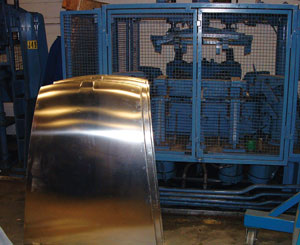
No prizes for guessing what type of bonnets these are
All new bodies benefit with the use of zinc coated steel in many rust prone areas and are electrophoretically primed. This priming process is more recent and seen in the newer bodies finished in a dark brown coating rather than the previous light grey. The process involves submerging the entire bodyshell in an electrically charged dip tank of special anodic etch primer. This process ensures superior corrosion resistance and is the same as that used by most major motor manufacturers today. The benefit of the zinc coating is already quite obvious as serious corrosion, common in original MGB and Midgets, is absent in either early heritage reshelled cars or the MG RV8.
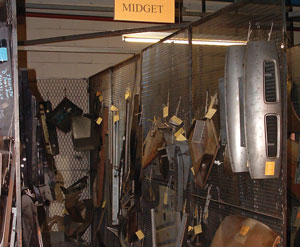
MG Midget master panels
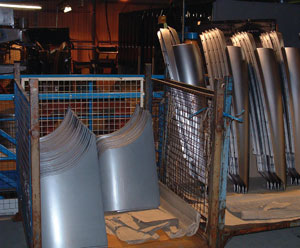
MGB lower front wing repair panels with the complete front wings in the background
Manufacturing the range of bodies and panels involves the use of up to 3000 specific press tools that weigh over 2500 tonnes, then the pressed panels have to be assembled on jigs, using original assembly data and needing space and facilities to do this. Most of the tools and dies are original and this raises several points. One is that wear is already present and so a constant programme of refurbishment is on-going to keep the tool able to produce panels to the original standards.
Another very important point is that the original production standards date from the 1950s and 1960s whereas today, over 40 years on from the introduction of the MGB and Midget, some restorers coming into, or returning to classic MG ownership have modern production expectations. It is important to appreciate that older MGs were never built to the close tolerances expected today and to achieve a modern level of build quality on classic shells would be nigh on impossible, and certainly completely unrealistic in cost terms. This doesn’t mean that genuine production problems that may arise have to be accepted, but simply that many perceived poor aspects are normal and how the cars were originally built.
The original premises occupied by BMH in Farringdon were fragmented and so the move to the current premises at Witney, Oxfordshire, allowed all to be combined into a single main site. Here most of the manufacturing is completed, although subcontractors provide a supply of pressings using BMH owned tooling. Because of the weight and bulk of tooling careful planning is needed to make for efficient batch production as changing a tool usually involved heavy lifting gear and can be quite costly.
BMH Ltd does far more than make complete bodyshells although this tends to overshadow perceptions. In body panel terms where you have a complete bodyshell that is made up of so many individual panels and sub assemblies then many of these panels and even complete sub assemblies are available to buy separately. This can be invaluable to the restorer who has a desire to retain an original body, but has sections that are really beyond reclamation.
There is also an exclusive relationship between BMH and Steelcraft, another name synonymous with MG restoration with their range of steel repair sections, so here are the two main suppliers of steel bodies and panels providing products and services the envy of almost every other classic marque around the world.
Overall the range of products is huge and all are accessed through a network of Heritage approved suppliers, including of course MGOC Spares and MGOC Workshop, a system engineered to provide a level of quality service to the classic car owner. To appreciate the extent of the product ranges and where they can be obtained a visit to www.bmh-ltd.co.uk is advised.
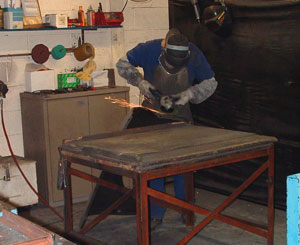
Finishing an MG Midget front wing
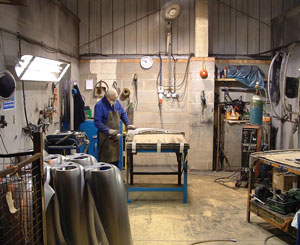
The final finishing bay
Roger Parker