Driving the MG SV-R
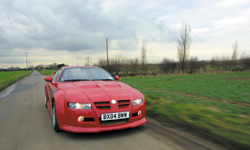
Driving the MG SV-R
In the April and May 2004 issues of Enjoying MG we provided one of the most detailed breakdowns on the MG SV done anywhere to date. We left that feature with just one unknown and that was actually driving the car on public roads. In February we were privileged to be able to provide an answer after the loan of an MG SV-R from MG Rover.
The SV-R at speed
The MG SV-R, you will recall, is a very high performance coupe with an advanced carbon fibre body built on a super strong lightweight steel chassis. The car is rear wheel drive and is powered by a Ford supplied 4.6 litre quad cam all alloy V8 in standard 320bhp format or in tuned form by Sean Hyland of Canada with 5.0 litres and 385bhp as fitted to the test car.
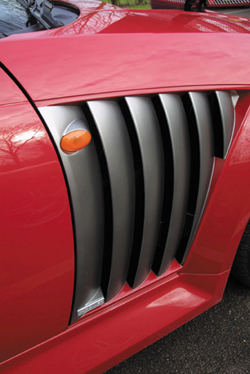
Engine vent grilles
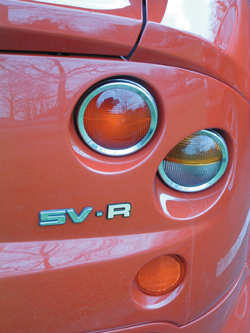
SV-R badging
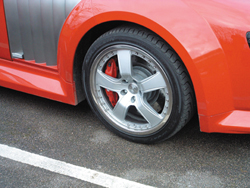
Massive discs all round
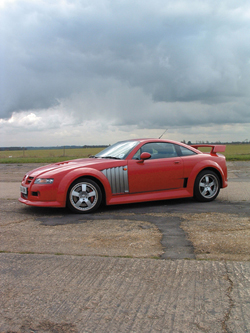
SV-R briefly at rest on a local airfield
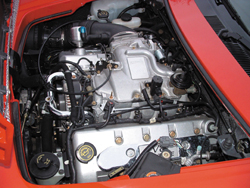
Ford quad cam all alloy V8 in tuned form by Sean Hyland of Canada with 5.0 litres producing 385bhp
Our last feature dealt with the SV’s specifications which is of interest but how it all works on the road is another aspect altogether. From my perspective the recipe works very well and I experienced a wide variety of road and weather conditions during my tenure and several hundred miles, including daylight and night-time driving.
My daily use car is the superb MG ZT260 that uses a less developed version of the same 4.6 litre engine, exactly the same Tremec gearbox, and a similar differential, that provides over 10,000 miles very useful background experience. I also grabbed an opportunity a couple of weeks before the SV loan to borrow a nearly new Porsche Carrera 4S and drive this around on some familiar roads, as clearly in performance and price terms the two cars sit in the same ball park. The clinical efficiency of the Porsche was very apparent, not unlike the scene inside a hospital operating theatre awaiting use. All very bright clean and focused, but somehow a little uninviting and leaving you rather cold. Performance of course was right on the nail.
The SV is now a familiar sight to me as I visit Longbridge reasonably frequently, which is obviously the world’s ‘hot spot’ for these cars. The SV appears physically big, especially in width, but this is largely an illusion, a trap I also fell into. When dimensions are compared to other current MGs the SV is approximately the length and width of a ZS saloon, and a touch lower. Clearly the style generates this impression and to confirm the car was not as big as it seems, I could actually fit it in my garage easier than I can the ZT. Interestingly getting back into the ZT after the loan period it felt small and I had the impression that I was sitting ‘on’ it.
Driving the SV-R is the subject of this report, an experience that is indeed very special from the moment you step over the wide sill. The leather covered Recaro seats have what appears to be a limited range of adjustment. The reality is you don’t need much as the driver’s seat is already set up for the optimum driving position and is superbly comfortable and supportive. The four point inertia belts take a short while to fit by adjusting out free play but once this is done, the combination of racing seat and harness integrate you fully into the car, a very competition orientated set-up.
Starting extends the SV-R experience, requiring the key to be turned for ignition, but to start requires, full clutch depression before pressing the alloy start button on the centre console. Starting was then instantaneous, followed by a few seconds settling down to a level idle speed. Only a slight lumpiness betraying that this was not the standard 320bhp pussycat engine.
The clutch travel was quite long and in this car and the weight was heavier than in the ZT, but handling an extra 25% torque may have had something to do with that. This condition was to become more obvious a short time later when caught up in a long tailback. The stop and start, creeping along progress was not a problem for the car, but a little tiring on the left leg. However, once away from the tailback the clutch was simply not a problem. However, the gearbox was less smooth than all other Tremec gearboxes I have experienced, perhaps the result of all those ‘doughnut drivers’, that you see so often on TV’s motoring programmes, burning up a set of rear tyres in the quickest time.
The initial SV-R driving experience is one of ease, just like any other modern MG. The layout of controls is such that all fall easily to hand, and in normal urban road conditions driving is hassle free. The engine may deliver a maximum of 385bhp but at 5 litre capacity it’s not at all stressed and indeed is only giving 2 bhp per litre more than a current TF 135. It will trickle along in traffic, but as soon as you demand more by opening the throttle the response is instant. I also found it interesting that the car dealt with speed humps more easily than a TF.
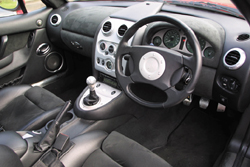
Interior with excellent supportive bucket seats
When cruising at sub speed limit speeds on dual carriageways the SV-R gathered a ‘bubble’ of cars around it with other car occupants looking and pointing. This is OK but it can make changing lanes or passing slower traffic a hazard as the rapt attention of the SV-R’s admirers distracts them away from the prevailing road conditions.
The SV-R’s latent performance is always clearly present but completely controlled. However, the general competence of the car is such that speed has to be read, not guessed, as normal perceptions become somewhat distorted. The best illustration is the speedometer that has numbers up to 210 and calibration marks to 220. Normally seeing this you will mentally assume Kph, but you have to remember this is calibrated in Mph. The other point here is that when glancing at the speedo you usually have several mental assumptions for the needle position equating to approximate speeds. For example if the needle points to around 11 o’clock you will usually expect to see a speed of 60 to 70 mph, but in this SV-R it is 110mph. The SV-R swoops along so easily you have to drive it with very high levels of concentration and remember to give the MG the respect it deserves.
Now I come to performance and clearly this is what this car is all about, and yes it certainly does deliver. In bare figures the acceleration to 60mph from rest is around five seconds and it can go onto a restricted maximum of 175mph, should you find the correct road and feel the need. However, with a car like this it is not the raw performance that impresses most, as lesser cars can be made to accelerate a fast, but the way that performance is delivered, with complete competence and composure.
Another vital aspect of performance is how the rest of the car handles it. The easiest comment is to say that the current engine performance does in no way stretch the capabilities of the chassis or brakes. Both these items are simply stunning and clearly demonstrate how some of the exotic power levels envisaged for some future variants will be accommodated.
The chassis deserves more mention as it’s truly a work of art in the way that such massive grip is so easily controlled and that even the most familiar of twisty roads effectively become straight. The front mid engine layout focusing all weight between axles genuinely gives that ideal balance, and this percolates fully into the driving experience. Another accolade goes to the ride, which whilst firm, provides a high degree of comfort at a wide variety of speeds and over a range of surfaces. The competence of the suspension clearly comes from such a rigid structure and you can feel that rigidity in the first few yards of driving, and whilst not all noise and vibration is isolated, it is surprisingly insulated. I did note that tyre noise on some surfaces can be a little intrusive, but in the main, it is no different to other cars.
The brakes look impressive inside the wheels, uprated on SV-R with 355mm discs and bigger Brembo calipers up front, and in use just soaked up everything I threw at them. Driving in urban condition with soft braking, wet and dry, they were progressing and perfectly normal in feel and response. Then when asked to provide repeated stops from over 100mph on an old airfield here they simply remained progressive and perfectly normal in response. Their ability, along with the physical grip on the road by the chassis, enabled some amazingly short braking distances. Very much a case of worrying more about following vehicles being able to stop without using the back of the SV-R as their final braking medium.
The varied driving conditions that I experienced did not demand great changes in driving style. In the wet traction was reduced, but not massively as is the case with many high powered V8 rear wheel drive cars, which become monsters at the first hint of dampness. The biggest clue of reduced grip on the road surface often came from the traction control light appearing a little more frequently and for longer periods on the dash. I must also mention that the traction control was very well integrated into the SV-R as initial illumination of the warning light was often the only indication of tyres losing grip. Adopting a brutal driving approach could raise the level of work that the traction control was doing but it always retained its progressive nature. Something I would like with my ZT where the traction control is more abrupt in its operation. Traction control was also switchable for those occasions when you prefer to do the work yourself.
The MG SV-R is a focused performance car that is perfectly practical for today’s roads, rather like a grown up MGF Trophy SE. That focus is clearly towards some form of track or competition use and for road use this creates some of its rougher edges. An aspect that a potential Porsche buyer would probably find unacceptable, but then I have always found the Porsche recipe to be slightly sterile and characterless. The SV-R is far from sterile and has character by the barrow load. I suspect it will be the sort of car that you would want to go and drive for the pleasure of experiencing that wonderful feedback, rather than just picking up the keys to travel to a specific destination.
With total build numbers for the full production cycle set at circa 840 the SV will be a much rarer sight than the MG RV8 of which there were over twice as many built. That rarity and the ‘in your face’ aggressive styling will always ensure that the SV is at the very centre of attention.
Roger Parker
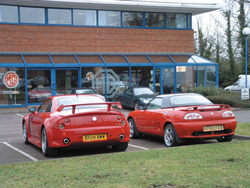
Outside the MGOC HQ