RV8 Prototype and Project Adder
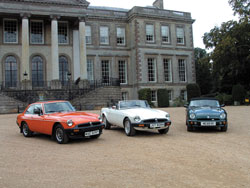
Alan Torbett, the current owner of JGT 808N the MG RV8 prototype invited me to take a look at his special MGB and he also offered me the chance to get behind the wheel, an ideal opportunity to experience this unique car at first hand. The story behind the creation of the RV8 prototype goes back to the late 1980s when Rover decided that they would like to return to the more traditional two seater sports car market and wanted to test the water with a limited run of a new model based on the MGB.
History
In the July of 1989 John Towers chaired a meeting of Rover’s senior managers to consider the possibility of introducing a future MG sports car. Also at the meeting was David Bishop the Managing Director of British Motor Industry Heritage Trust who took along the first Heritage reshelled MGB, a last of the line bronze MGB from the BMH collection and Roger Parker’s MGB V8.
Roger’s V8 was particularly interesting because it was more technically advanced than the Abingdon built MGB GT V8 as it was fitted with a fuel injected Rover V8 and ably demonstrated that such a project was a practical proposition. Although the MGs had been brought together to provide inspiration and a talking point, the assembled Rover executives had the opportunity to sample Roger’s V8 at first hand and hear it running. Their reaction was very favourable and the stimulus was there to go ahead with a new V8 roadster and the RV8 became a distinct possibility. Also present was a TVR 280 to provide a reference to what was felt to be the modern version of a British high performance open top two seater.
Three stages of Rover V8 powered MGBs, MGB GT V8, Prototype RV8 and MG RV8
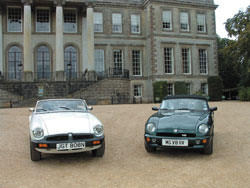
The power and chassis similarities are not so apparent from the external appearance of the Prototype and the RV8
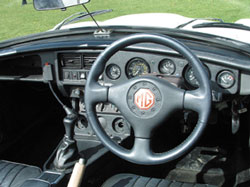
Prototype dash with familiar RV8 steering wheel
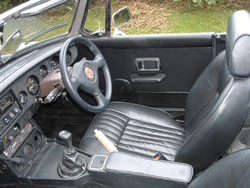
Comfortable and supportive leather seats
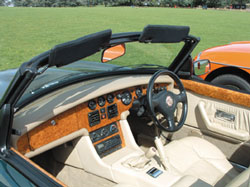
High quality and well crafted production RV8 interior
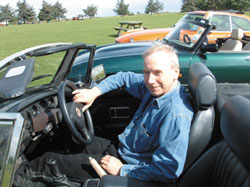
Alan Torbett has owned the prototype for over eight years
The broad outline was to build a new model around an updated MGB shell modified with new font wings, new bumpers, an enhanced interior and powered by a Rover M16 or V8 engine. British Motor Heritage could build a modified MGB bodyshell that would incorporate all the appropriate changes. The new car would be aimed at a more affluent buyer and would need to combine modern high performance with classic style and traditional quality. The first goal would be to get the engineering right and whilst it was initially a British Motor Heritage project, it was felt that this was not the core business of Heritage and so the project was passed to the newly formed Rover Special Projects and called Project Adder This inspiration came from the suggestion that an adder is Great Britain’s equivalent to a cobra, in deference to the AC Cobra, a snake with a powerful bite!
John Yea was Project Manager for Project Adder, one of the first programmes instigated by Rover Special Products upon its formation in early 1990. Mark Gamble a Heritage technician built the first prototype in great secrecy and it was used for initial unofficial dynamic assessment by Rob Oldaker and Andy Smith who were two of Rover’s chassis engineers. This first V8 was basically an MGB with aftermarket enhancements and although it was great fun it needed more development before it would be acceptable. Meanwhile a style model was also produced although this was not well received as it looked too much like a kitcar. A second car for dynamic testing was built by Mark Gamble this was based on a new MGB shell and bore the registration YWU 486S from its BGT donor vehicle. This became known as DEV 2 and in the autumn of 1991 it was taken to Scandinavia for cold climate testing and upon its return it was used primarily for cooling tests.
John Yea was now in a position to draft a Product Design Specification and to formulate an outline Marketing plan. Appreciating that access to engineering resources were limited they decided to contract an outside Design and Engineering company, ADC, to carry out a feasibility study and to look at the key sourcing issues. They were also asked to look at the interior and exterior styling, they modelled a restyled interior and looked at the possibility of changing the windscreen angle however any change from the original size and angle would have called for re-homologation of the screen which would have involved major changes.
The prototype car in our feature, JGT 808N, was MGB based and constructed at Cowley by Mark Gamble with the help of Adrian (Stan) Stansfield. Built on a brand new shell its donor vehicle had been a BGT which had belonged to Stan’s daughter. JGT 808N was assigned to Dave Peers who was in charge of the chassis design and development and was the first prototype to be fitted with the revised front and rear suspension. Most of the development work was carried out by Dave Peers and Ernie Coburn of ADC with occasional involvement of engineers from British Koni importers. Rear suspension was reasonably straightforward but the most obvious change was a new axle from GKN, which slightly increased the track and had a larger and heavier differential housing. The increased rear track and 15 inch alloys required the fitting of rear wheel arch extensions, which on Alan’s car are attached with rivets and painted in body colour.
The front suspension carried over the MGB cross-member but this was modified to take the revised damper arrangement. JGT 808N was used for all the early chassis development during 1991 including management assessment. When more representative vehicles became available it remained with chassis engineering where it was used for brake development, mainly durability testing.
Driving Impressions
As I took position behind the wheel I had to admit to a number of preconceptions about the RV8 that ultimately developed from this car. I have rather mixed views about the RV8, it is certainly an impressive car, although built as a traditional classic, it also has some very modern underpinnings and this makes it a difficult car to put into an appropriate context.
As a modern roadster it had some shortcomings, but it had great merit as the ultimate development of the MGB. Although the RV8 gained enormously in power and had a luxurious and beautifully crafted interior, it is quite a different animal from the original MGB. Despite the many improvements, something of the simple purity of the early MGB was lost and the RV8 seems more of a long distance luxury cruiser rather than a nimble sports car.
Climbing into the prototype’s cockpit I was intrigued by the interesting mixture of interior fittings, the dash was mostly late MGB with a modern heater assembly. However the prototype’s most important areas of interaction with the driver are very good indeed. The thick leather rimmed RV8 steering wheel is a pleasure to hold, although the rest of the column appears to be a mixture of Metro and Land Rover. The seats are excellent, trimmed in black leather and very supportive which is vital in a car that can hold the road this well. The gearlever is a rather chunky affair, sourced either from a Land Rover or large Rover saloon, but it still provided an excellent and positive, if rather firm change.
As I fired up the car via its awkwardly placed late MGB steering column mounted ignition switch the engine burst into life instantly and ran perfectly. Like the RV8 the clutch is quite heavy and those big tyres mean that you have to haul on the steering at parking speed, however as soon as the car is underway everything quickly becomes lighter and more manageable. It took a few miles to acclimatise but the more I drove the prototype the better I liked it. The impression was not really like driving an RV8 nor was it the same as being behind the wheel of an MGB, this vehicle was closer to a beautifully set up race car. The steering on the move was light, sharp and positive and although much of the test drive was on poorly surfaced country roads the feel of steering was completely unaffected by pot holes and camber. The MG held its line perfectly with just the lightest touch on the thick rimmed wheel, while none of the shocks from the road surface irregularities were transmitted through the column. This V8 prototype rides firmly, very like a good chrome bumper MGB and there is no great drama, it does not bang and crash over the bumps nor bounce around excessively, it remains firm, smooth, comfortable and confidence inspiring. The impression from the driving seat was that this car has been thoroughly engineered and that the suspension has been set up carefully to combine sharp handling with a pleasant ride.
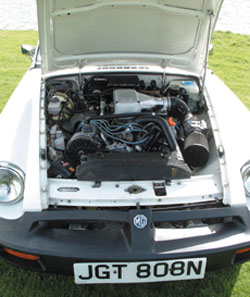
Prototype engine bay looks almost exactly the same as the RV8
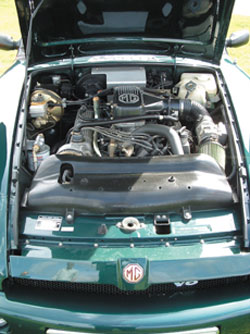
RV8 engine bay
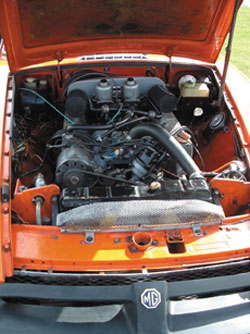
Late model MGB GT V8 engine bay with rear mounted twin SU carburettors
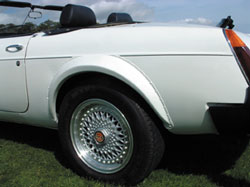
RV 8 rear axle too wide for the standard MGB bodyshell rear arch extensions to accommodate the extra track
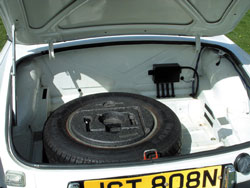
MGB prototype boot
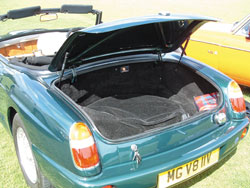
Luxuriously trimmed RV8 boot, full size spare wheel leaves little room for luggage
Obviously with a fuel injected V8 under the bonnet bulge, performance from this prototype is quite outstanding and acceleration times are only limited by the driver’s courage. Whenever there was a clear stretch of road ahead I could not resist dropping down a gear and pressing the throttle firmly just to hear that instant induction roar and feel the tremendous push in the back as the MG swept forward. This combination of performance and crisp handling gives the V8 prototype an edgy, sharp feeling that is less apparent in the RV8, it feels more like a precision instrument albeit with an over abundance of power and torque. I certainly couldn’t claim to have pushed this car anywhere near its limits but it felt safe and predictable in all normal road conditions and I’m sure it would react well when under pressure. A car with this much vigour will always need to be treated with respect but this V8 is by no means a brute, the overall impression is of a well engineered and thoroughly sorted sports car.
From the outside the special nature of this car is not apparent, it would pass as an ordinary late model MGB to the unobservant. However, should you take a second glance, you will notice the RV8 style bulge in the bonnet and the spats or wheel arch extensions covering the increased track of the rear wheels. Then the distinctive alloy wheels themselves with their lattice spoke design that have now become so familiar on the production RV8.
On Location
Alan had arranged for us to photograph his MG at Ragley Hall in Warwickshire, he also arranged for his friend John Saunders who owns an immaculate RV8 to join us, while Alan also brought along his factory built MGB GT V8 allowing me loose in his RV8 prototype. Ragely Hall is the beautiful family home of the 9th Marquess and Marchioness of Hertford. The house was designed in 1680 by Robert Hooke the genius inventor, who developed the constant velocity joint among many other innovations. Hooke was also a gifted architect and friend of Sir Christopher Wren. Ragley is one of the earliest examples of an English Palladian house and is set in beautiful grounds. The house is dramatically decorated and extensively furnished while the gardens are a pleasure to view, Ragley makes a very worthwhile destination if you are touring Warwickshire and is also a popular venue for Classic Car shows.
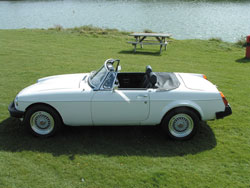
Distinctive alloys
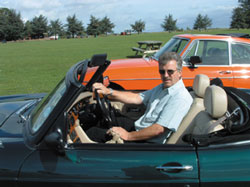
RV8 body style certainly enhances MGB lines
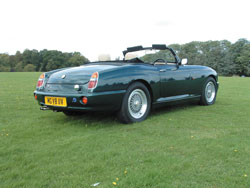
John Saunders with his immaculate RV8
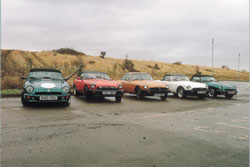
YWU 486S or DEV 2 the second development car, a BGT V8 bought for comparison and JGT808N
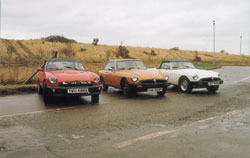
JGT 808N the third development RV8
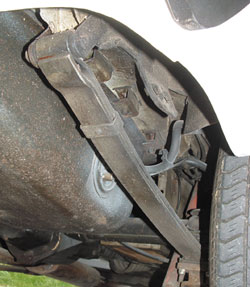
Full RV8 suspension underneath JGT 808N
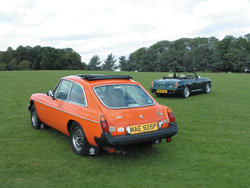
From MGB GT V8 to RV8
For further information please contact Bryan McDonald, General Manager at Ragley Hall 01789 762090 ext 167 or email bryanmcdonald@ragleyhall.com. Also, visit their website www.ragleyhall.com
RV8 Development
Having the three cars together gave ample opportunity to compare the development of the Rover V8 as fitted to MG sports cars. The under bonnet shots show the engine bay of each model, the factory BGT V8 is apparent from its rear mounted SUs, while the similarity between the prototype and the RV8 is very clear, even down to the location of the ancillaries. In respect of its mechanical components and the layout the prototype’s engine bay is very close to the final product. It is the same story underneath where the chassis specification is also the laid out as the RV8.
The prototype’s experimental nature and configuration combined with its dynamic abilities greatly adds to its charm and appeal. Of course it would be possible to trim it out to a more luxurious specification and generally upgrade the dash and interior to create a very special MGB V8 and I’m sure the result would be an attractive and well-engineered car. However, at the same time it would be a great shame to lose what must be a vital link in the story of the RV8’s development. This MG is unique and I believe it deserves to be kept in its original condition. It is great fun to drive, safe, predictable, undoubtedly quick and extremely addictive, I was very sorry to have to surrender it back to Alan at the end of the day. Alan has owned the car for eight and half years and he bought it with 8,000 miles on the clock and to this he has added a further six thousand miles, so in all respects this prototype is an almost new MGB. Alan has an extensive collection of MGs and he has decided that some of them will have to go to make way for new projects, so the RV8 prototype could be up for sale if you are prepared to make him a substantial offer. If you want an MGB V8 that is perfectly engineered, a joy to drive and a unique to own then give Alan a call 01905 381947. I’m very grateful to Alan and John for bringing their cars together for this feature and to Ragley Hall for their hospitality and co-operation with our photo shoot.
Richard Ladds