2004 MG ZR
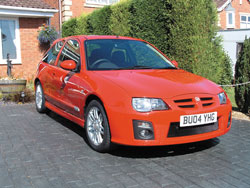
2004 MG ZR
Roger Parker tests the new look MG ZR 120
Updating any car is a difficult task but when that car is Britain’s most popular sporting hatchback car, the job becomes far more problematic. Many will say why change something that is doing well, but unfortunately it can take a very short period to fall from this position as rivals update their product line up and responding with your own changes is not a five minute job. That means you have to try and anticipate what future design trends are going to be favoured in order to ensure your product stays on top.
New look ZR
The whole of the MG saloon range has been updated during the first half of 2004 with the MG ZR (and Rover 25) ranges last to be given their 2004 update. The actual model was launched on May 18th with deliveries starting in July, but it was fairly well known some time before the announcement that the 2004 model change was going to be quite comprehensive. This has the unfortunate side effect of hitting sales as some buyers hang on for the almost inevitable run out deals of what would soon be old models, and other buyers keen on having the updated model wait for it to become available.
A July start to deliveries also meant that it became quite obvious that there would be a slow beginning to sales of the new models. This is because most people would wait to have their cars after 1st September in order to gain not just a 54 plate, but stronger future residual values. I mention this to provide a little more background into the headline ‘Sales Crash’ that many of you will no doubt have read, in the national press. Plus as the ZR (and Rover 25) are the main volume models in the MG Rover range, sales figures for these impacts heavily on overall MG Rover sales.
The external cosmetic changes are clear for all to see and were described in June 2004 Enjoying MG. Liking or disliking the new look is a personal choice, but let me repeat a comment I have said before with other model changes. Do look at the cars in the ‘flesh’, so you can appreciate the detail changes that you can’t fully be aware of from photographs. This was quite evident in comments of many people after they first had a good look round the test car, with remarks along the lines of, ‘Although I didn’t like what I saw in the pictures, but I actually quite like this’. Generally, most of the observations were very positive.
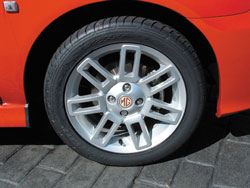
The 120 was fitted with the optional and attractive new Gridspoke 16″ wheels fitted with 205/50 tyres
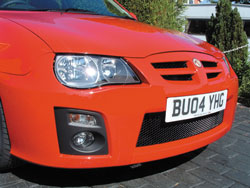
Cosmetic surgery, the ZR gets a new headlight arrangement
Personally, I like the changes and feel that whilst the old model is still a very attractive design it already has a hint of datedness about it. That is not a criticism, but more of an reflection of the classic design, which I think will become an even more positive attribute over time, leaving the new model to continue to develop on its own path. Anyway, there is much greater depth to the changes than just a cosmetic nip and tuck.
New facia
Inside the car, changes involve a completely new, very stylish, bold dash moulding with pronounced sculptured air vents. Each has a silvered trim ring that not only looks good, but is functional, as they are airflow regulators. The centre two air vents straddle a new deep recess in the dash, which resembles the entrance to a classic Great Western Railway tunnel or NORAD! Nevertheless, this is a stylish but also very functional feature. Set back in shadow most of the time is the clock display (plus the optional and very useful Trafficmaster display) and here is the real benefit is you can read the display even on the brightest of days.
I could, like others, make mention of the dashboard plastics having a hard feel and perhaps not quite the same apparent quality as on some competitors, but to me it looked good, fitted well and matched the other plastics in the cabin well. As I don’t make a habit of caressing the dashboard the feel issue is rather superficial, plus the general interior ambience was good and value for money.
Integrated into the new dash is a striking centre console that is projected into the car more than the previous model, and carries the minor switchgear, heater and audio controls. This does help drivers with shorter reach, reach these controls, but would also then impact on taller drivers with less leg room. Here help is on hand with the lower part of the console cut away to present space. This space also has a recessed storage area with two cup holders to the front. The console then extends rearwards between the rear seats, encompassing the electric window switches, handbrake and a single cup holder for rear passengers, a design first seen in Streetwise.
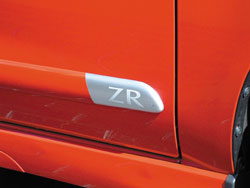
ZR door badge
Not only is this space useful, but I found it provides legroom for when the clutch wasn’t being operated. The effect of these improvements is actually more surprising when comparing actual console measurements of Rover 200 through 25, old model ZR and onto the new ZR. Surprisingly I found very little difference in overall measurements showing how carefully worked out minimal deatils can make a quite noticeable difference
Clutch pedal moved
Mention of the clutch brings me to one of the dynamic improvements mentioned in the launch information, but which doesn’t immediately seem to be of significance. The older models were often criticised for the brake and clutch pedals sitting at different heights, with the clutch being higher than the brake. I didn’t really notice this until returning to an older model after driving the new ZR160, when having got used to the natural position of the pedals being level in the new model I found the old model’s high clutch a little awkward to re-adjust too.
Seating in a ZR has attracted comment of ‘sitting on’, in that the seating position is too high, even when the (usually optional) height adjustable seat is in the lowest position, a problem I have never found issue with, perhaps because I have usually squashed the seat to a more suitable height! However, I have noticed a difference between the base specification seats in ZR and ZR+ compared to the half leather standard fit of ZR160. This manifested in a feeling of sitting higher and on top in the half leather seats rather than sitting in the seat. By contrast, the base seats appeared to be not only lower but also more supportive.
The steering column only adjusts up and down with no fore and aft adjustment, but that didn’t prevent comfortable driving positions being achieved by a range of drivers of different heights and reach. It was also of interest to note that the column switches for the indicators/lights/wipers have been changed to a smooth matt finished type. Interesting, in the fact that the previous high gloss type seemed to attract negative comment in various reports for being outdated and clumsy, yet these new ones retain the same shape and design except they have a matt finish and feel softer, but do not seem to have attracted any comment. The bottom line is that these and their predecessors do a perfectly efficient job.
On/off air conditioning is now a standard feature for all + models, not just the 160, and proved effective and welcome during the tenure with both the 120 and 160. Air con has become one of those luxury features that is now regarded as necessary standard equipment by most buyers. This demand almost certainly stems from wider availability and the scenario of having experienced the extra comfort in very hot weather, then you don’t want to live without it.
New security and remote locking features
The new ZR models feature useful additional security measures, firstly the new speed locking function allied to a Master Locking switch on the centre console. Speed Locking is automatic all door locking once the car is driven off and the speed reaches approx three mph. The doors remain locked until the car is stopped and the ignition is switched off, when doors automatically unlock. Prior to this, doors can be unlocked by using the Master Locking switch located on the centre console. Another feature of this switch is the activation of the car’s alarm with flashing indicators and sounding horn, if the button is pressed and held for more than two seconds. This brings me on to the horn which sounds so weedy, an unfortunate side effect of cost cutting. Many new car owners have voiced their disapproval of this move, as there is a common belief that a quality sounding horn reflects the quality of the car.
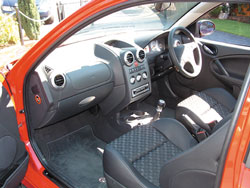
A completely new, very stylish, bold dash moulding with pronounced sculptured air vents
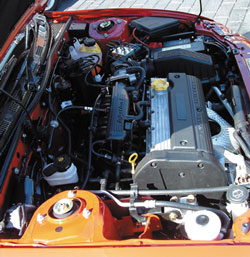
ZR+120 1796cc engine produces 117ps @ 5500rpm and 160Nm @ 2750rpm
Another useful change is deleting the external release button on the tailgate and the provision of a remote release via a dedicated button on the key fob. Whilst this is a great bonus when approaching the car from outside the lack of an internal release button within the passenger compartment means that having to find and operate the button on the fob is far less convenient than having a fixed button. Safety is catered for here though in that the remote release is disabled as soon as the car exceeds three mph, so inadvertent opening on the move is eliminated.
On the Road
Whilst many buyers are swayed by external appearance and interior fittings a car like the MG ZR also has to perform on the road and the old model certainly was able to deliver in this area. With few changes to the overall mechanical specification, it is reasonable to expect the same sort of dynamics as before, however the small changes do seem to have made a quite noticeable difference. I have already mentioned the clutch pedal changes but the neighbouring brake pedal provided a different response too. In the ZR160 the brake performance with the larger discs and calipers was stunningly good and sharper than I have found in previous cars. Likewise, the 120 with the smaller discs and calipers, still an all round disc set up, also provided a sharper brake response. ABS and EBD are now standard across the whole range.
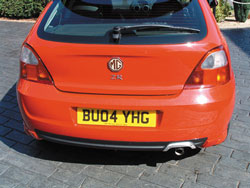
New rear end treatment
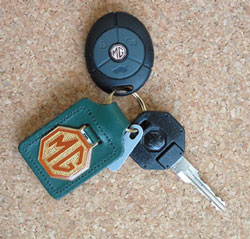
Key fob with remote operation for the rear hatch
Throttle response has always been good with all K series engines and both the 120 and 160 displayed typical eager responses. Initial driving impressions indicated a refined well built car and during the test period little changed this impression. The 160 seats were unhappy with my weight on them and over some surfaces generated a minor squeak. This applied whether I was driver or front seat passenger. Interestingly the 120 seats made no such complaints, so I wonder if the leather bolsters of the 160 were the cause? I also noted a minor rattle being generated in the optional sunroof in the 120, again only over certain types of road surface. Neither was intrusive, just noticeable.
Driving the old model hard was always fun but when pushing things there was an increasing nervousness in the feedback to the driver leading in severe cases to the back end breaking traction. Driving the new model in both wet and dry conditions enabled a good comparison to be made. In dry conditions there is a reduction in this twitchiness and the overall confidence that the car gives is similar to that I felt with the very competent ZS chassis.
The 120 was fitted with the optional and attractive new Gridspoke 16” wheels fitted with 205/50 tyres. It also had side skirts and rear bumper extensions as part of a £300 optional kit. Whilst the 160 was equipped with the familiar 17” Straights covered by 205/45 tyres, carried over from the previous model. The 160 had the edge on steering turn in and ultimate grip, but suffered from a harder ride and on balance for normal driving the 16” is a better all round choice. Not that you get this choice with the 160, but you do have an option to spend another £450 and have the side skirts and bumper extensions with the 17” wheels. Many will no doubt also ask why the new 11 spoke slightly wider still 17” wheel from the ZS180 isn’t also offered on the ZR and the answer is simply that the extra half inch of rim width puts too much tyre outside the body line to be legal. However, I expect many younger owners of ZRs will not let that stand in their way!
Driving the 120 in the wet there isn’t the same depth of confidence as generated with the ZS and that twitchiness can be felt again, but not as early as in the older ZR models. Wet conditions still demand a greater degree of respect, but the test car had Dunlop SP9000 tyres and I haven’t experienced these before, so they may have had some greater input.
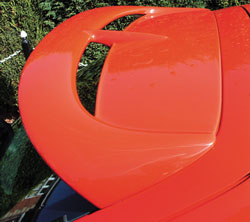
Sculptured rear spoiler
Performance is an interesting and a high profile area and is much the same as with the outgoing models, not surprising as engines and transmissions remain as before. The 160 delivers all that is claimed of it, although the test example had too few miles under its belt to be able to give that zinging feeling of a well run in VVC engine. Being at the top of the ZR performance range the 160 creates a rather odd situation despite delivering all that is promised it still feels as if it’s under performing, perhaps from the need to ‘wring its neck’ to achieve that claimed performance.
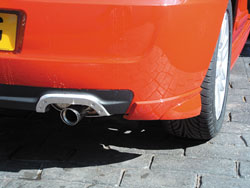
Exhaust trim
On the other hand the 120 is a model that does not carry the performance crown of the range and so sits in the shadow of the 160 and so expectations are less. It then comes as a pleasant surprise to feel that it is as quick as it is, although this is still only delivering the claimed levels of performance. Much of this is down to the way the performance is delivered, in an easy laid back happy way. The standard 1.8 K series is a gem, and in this application has a low rpm torque peak, yet enough top end power to not lose out too much, and not feel too strained. In bare figures these experiences are quite well explained when it can be seen that the 30 to 50mph and 50 to 70mph 4th gear acceleration times show the 120 to be faster than the 160, although both are eclipsed by the diesel version’s mid range grunt.
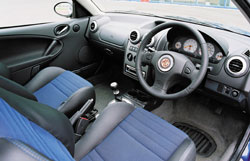
MG ZR 160 Interior
Economy is a strong point of K series engined cars and shows up well with the official fuel consumption figures. However transposing these figures to an individual’s real life fuel returns can often lead to some difference, but then this should be quite visible with whatever vehicle is used. My use is biased to longer journeys, but often in heavy traffic so the road conditions are mixed. As a result I have usually managed to achieve a level of consumption that is very close to the official figures, or in fact slightly better. Whilst the tenure with both the ZR 160 and ZR 120 was each only over a few days I was able to get a clear indicator of the fuel returns which fell very much in line with the official averages which in the case of the ZR 160 is approx 37 mpg and with the 120 approx 40mpg. In the case of the 120 on one 90 mile run I was able to push to 50mpg yet still see a cruising speed of an indicated 70 mph.
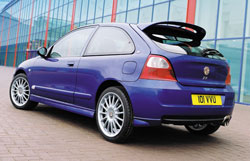
Overall, ZR sales focus around the 105, 160 and the diesel models. The 105 caters for the insurance sensitive buyer with group 7E classification. It gives good economy, has the looks and handling to entertain, but with only 103ps struggles once out on the motorway and other trunk roads. The diesels provide economy and mid range grunt to give quite stunning mid range acceleration. The heavy engine does hurt the handling slightly, but it is the roughness of the engine that intrudes most. The 160 is a focused performance machine that is also efficient in its use of fuel, however it needs to be taken by the scruff of the neck to get full performance and the insurance man is not so kind as it’s placed in a highish insurance group 15A.
This leaves the 120 in the shadows in the middle. It has the looks and for little extra can look exactly like the 160. It has the smooth and sweet 1.8 litre engine that provides very strong performance close to the 160 and a mid range close to the diesels, yet delivers economy in the same street as the 105, and with a little restraint not that far behind the diesel. Also the insurance man also likes it with a Group 9E rating, which overall makes the MG ZR 120 the Cinderella of the ZR range, and in my view the best all round model, and deserving much greater attention than it receives.
Roger Parker
Technical Specifications
ZR 105
1396cc 4 cylinder K series petrol engine
Power – 103ps @ 6000rpm
Torque – 123Nm @ 4500rpm
0 to 60mph – 10secs Max speed – 111mph
Economy…
Urban – 31.1mpg Extra urban – 51.1mpg
Combined – 41.3mpg CO2 – 164g/100km
ZR+ 120
1796cc 4 cylinder K series petrol engine
Power – 117ps @ 5500RPM
Torque – 160Nm @ 2750rpm
0 to 60mph – 8.6secs Max speed – 119mph
Economy…
Urban – 29.0mpg Extra urban – 51.1mpg
Combined – 39.8mpg CO2 – 169g/100km
ZR 160
1796cc 4 cylinder K series petrol engine with VVC (Variable Valve Control)
Power – 160ps @ 6900rpm
Torque – 174Nm @ 4700rpm
0 to 60mph – 7.4secs Max speed – 131mph
Economy…
Urban – 27.1mpg Extra urban – 48.7mpg
Combined – 37.6mpg CO2 – 179g/100km
ZR TD
1994cc – 4 cylinder L series turbo diesel.
Power – 101ps @ 4200rpm
Torque – 240Nm @ 2000rpm
0 to 60mph – 9.7secs Max speed – 114mph
Economy…
Urban – 39.2mph Extra urban – 68.3mpg
Combined – 53.8mpg CO2 – 150 g/100km
ZR TD115
1994cc 4 cylinder L series turbo diesel
Power – 113ps @ 4200rpm
Torque – 260Nm @ 2000rpm
0 to 60mph – 9.1secs Max speed – 116mph
Economy…
Urban – 36.7mpg Extra urban – 67.3mpg
Combined – 51.5mpg CO2 -150 g/100km