Real World MG
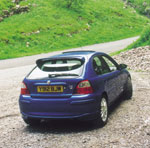
The MG ZR Diesel is only the third MG Rover road test car that we’ve had at the ‘Enjoying MG’ Office in the last six years, so it was a real privilege to have the opportunity to asses the car over several days.
It is an interesting concept for MG Rover to take a hot hatch, which has already established itself as a nippy little sports saloon and then fit it with a diesel engine. The resulting model must the first production diesel powered MG. The image of diesels has changed in recent years but they still carry distinctly agricultural overtones for many drivers; who still imagine that they will have to put up with the attendant noise and smells normally associated with heavy lorries, tractors and trains.
Diesel power
The ZR Diesel carries no extra badges to denote its motive power and really the only give away is the different engine noise and perhaps the down turned tail pipe on the exhaust. The engine is by no means loud but is quite distinctly a diesel. However the engine note can barely be heard from inside the cabin when the windows are closed. There are two other more subtle signs of diesel power, the instrument panel features dedicated amber warning lights for glow plug and the diesel engine management when you turn on the ignition and then there is the excellent fuel economy. I managed to return over 50 mpg over a mixture of long distance driving with some short haul work in traffic congested Cambridge. However, I have to confess that whenever I drove the little MG it was in a spirited manner because the willingness of the engine and the sure-footed road holding encourage the driver to exploit the massive torque of the ZR to the full. However it must be said that it took me a little while to acclimatise to the ZR’s diesel engine and learn how to use the power band to the best advantage, the 0-60 is claimed at 9.7 seconds and the ZR certainly pulls away swiftly. However, good as the 0-60 time is, what impresses most is the rapid pick up at higher speeds, where the torque of the diesel engine really shows. The power comes in around 2,000 and then pulls (like a train) to 4,500 rpm. I noted that in 5th gear on our local test track that at just over 3,000 rpm the ZR was indicating 90 mph and would still accelerate cleanly from that speed with instant pick up.
Economy
It happened by chance that I had a long trip to make down to Exeter which from my Cambridge home is a round trip of 550 miles. On this journey, which is mostly busy motorway driving, the ZR returned 52 mpg. I achieved this figure while much of the time I was keeping up with the speed of the traffic and generally cruising just above the limit (cameras permitting) with just the occasional longer burst at higher speeds. However, if one drove the ZR sensibly with economy in mind and also kept all the windows closed then I’m sure that you could still considerably improve even on the 52-mpg figure.
Comfort
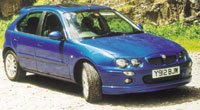 By taking the ZR on a long journey I discovered how ideal it is as a serious workhorse. After spending most of the day behind the wheel I emerged without any aches or pains and did not even feel particularly tired. The front seats are excellent, being very well shaped with good lumbar support. I have suffered from back pain in the past and have become particularly aware of the different quality of seating design in various car models. The ZR driver’s seat is adjustable for height as well as rake, height adjustment is by a crank handle, rather like a door window winder and although slightly unusual this was effective in operation. In addition the steering column can also be raised or lowered to suit most tastes. A decent driving position is fundamental to enjoying a car and the ZR scores well in this respect. Less agreeable were the plastic/stainless steel embellishers in the cockpit. While adding little to the style of the interior the panel on the dash top caused a really annoying glare, which on a bright sunny day was so bad we were obliged to cover it with a sweater. Similarly the plastic/stainless gear knob top was very unpleasant to touch becoming sticky and for me it spoilt the quality feel of the gear change. The leather steering wheel by contrast was excellent, with just the right thickness, it was a pleasure to hold and it complemented the ZR’s positive and well weighted steering. The test car had a Kenwood CD/radio, which performed very well with good reception including those vital RDS traffic reports. Sound quality from the CD was excellent but the little unit was quite complex to operate with micro sized buttons (I had to resort to my reading glasses) however my twelve year old son understood it perfectly and explained its operation to me.
Although build quality appears to be very good on the ZR I did note when washing the car that the side repeater flasher lens set in the front wing was coming loose which suggests that it requires a more substantial securing device.
Road holding
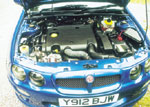 The dynamics of the ZR are impressive, the road holding is particularly limpet like and you can treat roundabouts with almost the same abandon as an MGF/TF driver, the brakes are excellent and begin to bite immediately which also inspires confidence. The only slight down side is that ride is very firm and can be quite choppy over poor road surfaces or the now popular ‘sleeping policemen’ and other speed reducing measures. The enthusiastic driver will gladly put up with the stiffer ride and enjoy the benefit in improved road holding.
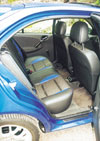 The ZR’s front and rear spoilers tend to attract the attention of a new generation of boy racers who want to see how well their car can compare with the MG. On one occasion I was pursued by a Saab driver who kept up with me quite easily, looming behind me menacingly until we came to a roundabout, whereupon he found the ZR’s cornering ability to be more than effective and he disappeared from sight in my rear view mirror. This little ZR is quite capable of living up to its racy livery and will provide considerable entertainment for the keen driver.
Verdict
For anyone in the market for a small sports hatchback with exceptional economy, good performance and also capable of long distance work then it would be hard to find a better proposition than the MG ZR. There are other benefits, in particular the low CO2 emissions puts the MG ZR in tax band A at £110 per annum and an ABI insurance rating of 8D. The test model came with electric front windows, electric glass sunroof, Kenwood CD/stereo, front fog lamps, leather steering wheel and gearknob, remote central locking, and 16″ ‘Hairpins’ alloy wheels with 205/50 R16 tyres. The ‘on-the-road’ price of the model tested was £13,325 but remember with your MGOC members Privilege Purchase discount this figure can be reduced by a substantial amount, talk to your Rover dealer for the current offer. The MG ZR proved to be as equally at home cruising on the motorway as it is nipping around twisty country lanes. Don’t be put off by its diesel engine, this practical MG sports saloon is well worth a test drive but take it for a decent run and give yourself time to get used to the dynamics of the car. Here is a hatchback built for today’s motoring conditions, makes good economic sense and yet is still fun, a ‘real world’ MG.
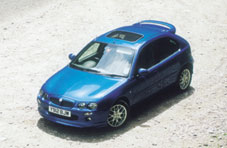
MG ZR Diesel
At this point in this feature I expect that we will have lost a proportion of readers. Gone first are those who only choose to read road test reports from the likes of Autocar. Shame since by the time we saw the car it had done 12,000 plus ‘press miles’ and so, 1, is well loosened up and 2, it had seen enough use/abuse to show up any rough edges which can be of real use to any prospective buyer. Next we will have lost those to whom any reference to diesel is ‘of another world’, and who hold very firm preconceptions that sporting and diesel can never mix. Once again this is a shame because of the massive developments seen in the last 10 years and which has accelerated in the last 3 or 4. Anyway to those still here, please stay a while longer.
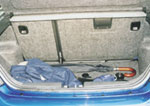 I see no point in repeating the same observations that Richard has already described, however, I would add a couple of comments. The engine used is the proven L series 2 litre diesel, production of which is as I write this is being transferred from Land Rover to MG Rover’s Powertrain division. This will reduce the costs associated with this engine and allow development that would not be economically feasible if the engine remained as a ‘bought in’ unit.
The engine is quite a bit heavier than the petrol K series by approximately 70 kgs. This extra weight over the front axle line does bestow the car with a greater degree of front suspension movement, slightly slower steering response and a degree of ‘pendulum’ effect. Not bad by any means and average when compared to other cars, but the exceptionally low weight of the K series makes this more obvious.
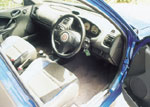 One very important point that seems to go unnoticed is the performance of the ZR Diesel. As usual, the major focus is on top speed and 0 to 60mph times, both of which are more than competitive with 114mph and 9.7 seconds. However, it is the other aspect of the car’s ‘real’ on road performance that often isn’t immediately realised, that is until driven!
If the ZR Diesel, ZR 160, ZS 180 and ZT 190 were to be lined up together and then you were to be asked to put them in a performance orientated order, it is clear that the ZR160, ZS 180 and ZT 190 would be chosen first, with the ZR Diesel following along shortly! Now ask the same group to reappraise each car’s performance when actually on the move and a similar result is likely.
However, this is where preconceptions start to mask fact. Look at the 4th gear acceleration figures between 30 and 50 mph and see the eyebrows raised. It is a fact that of all the Z range currently on sale, only the ZS 180 is faster than the ZR Diesel. Move the speed range up between 50 and 70 mph and the same applies, except that the lower geared ZT 190 just squeezes in between the ZS 180 and ZR Diesel. Hardly the picture of a smoky oil burning slug ripe for carrying business people in unofficial trains of like cars along lane three of out motorways!
If this doesn’t generate more interest for the ZR Diesel then 150 grams of CO2 per kilometre and £110 road tax (UK) may help. However of course, economy is the usual pinnacle for diesels and here the combined official 53.8mpg has been confirmed as Richard found with a variety of urban and longer runs.
OK now let us go off at a slight tangent for a few moments. How many MGB owners are still here? On the face of things an odd question perhaps. However the connection lies with the L series diesel engine that powers the ZR Diesel and it’s forbears. The O series family, which was originally developed for the MGB but never fitted, spawned a couple of 16 valve petrol derivatives, which I used with a great deal of success in several MGBs, and a diesel version. Here the diesel version of the O series engine was further developed to the L series. With the O series family connections, it is quite a feasible proposition to attach the L series to an SD1 series 5 speed or later R380 gearbox. The use of these gearboxes is a well trodden route with V8 MGBs.
MGBs have previously been fitted with the 1800cc B series diesel for various reasons and with varying success. Performance with this engine though, has never approached that of the petrol version. Now take a closer look at the potential of an L series conversion. A standard MGB has 84 bhp and the L series produces 100. The MGB produces 148Nm of torque against the L’s 240Nm. Fitted to an MGB the L series in standard form, and plug in conversions can give another 25 bhp and 10% more torque, can be calculated to push the MGB to 112mph and see acceleration in that over emphasised 0 to 60mph dash, drop to approximately 9.5 seconds. However, it is in the mid range where the differences will be a comfortable 30% faster. In other words we are talking V8 mid range go, but covering twice the distance on the same amount of fuel!
Lastly let me make the point that as the L series is fitted to a production MG any transplant is using an MG engine in an MG, which in reality has more validity than when the V8 was first being fitted to MGBs! Now who is going to be first to do one?
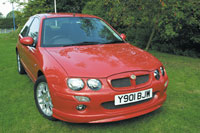
Having experienced the ZR Diesel, it seemed logical that we compare it to it petrol stable mate. Both these cars sit at the bottom of the MG Model ladder and will potentially feature on many shopping lists. The availability for a back-to-back test should provide those considering these cars a helping hand.
There is no point repeating descriptions and functions of common items so lets just cover the nitty gritty!
The ZR 105 is powered by the familiar 1396cc 16 valve K series petrol engine as seen in a variety of Rover cars since 1989. In the current guise it produces peak power of 103PS, not 105 as intimated in the product title. This compares well with the Diesel’s 101PS. Peak torque on the 1.4 is 123Nm, which compares far less favourably with the Diesel’s 240Nm. Gearing is not able to compensate for a difference of nearly 100%!
These figures translate into performance which favours the Diesel in all respects, 0 to 60mph – 0.3 seconds advantage and top speed – 3mph. This on paper advantage of the diesel is something that is patently obvious in any driving condition. Take the 30 to 50mph times where the diesel takes 6.3 seconds, a full 3.3 seconds faster than the 105. Higher up the speed range the 80 to 120km/h (50 to 75mph) time for the diesel is 11.3 seconds, whilst the 105 is a full 8.4 seconds adrift.
On the road these differences do not have the impact that the figures paint. This is mainly due to the different driving style you adopt. Drive along in traffic following the inevitable heavy truck overtaking another at half a mile per hour speed differential and you sit patiently (patience is a virtue often forgotten here!) in 5th at the mandatory 56mph. When the road opens up and the traffic in front accelerates you often feel the lack of acceleration and so you soon learn to drop into third and then your progress is perfectly adequate.
Refinement was superb in this 12 month old base model with nearly 11,000 hard miles under its belt. Certainly there were no rattles and squeaks that have been reported by some owners. This goes to show that rattles and squeaks are not a standard feature and can be solved should they manifest themselves!
During our tenure with this car we covered just short of 500 miles over a mixed bag of roads in much the same format as we did with the Diesel. Comparisons of fuel economy are therefore interesting. Overall consumption for the 105 worked out at 44.3mpg, a creditable result; in fact, at the first fill the average was nearly 47mpg. 9.5mpg deficit in favour of the Diesel then so game set and match to it? Well not quite a match winner if we look at other aspects. Take cost of fuel into account and the slightly cheaper unleaded used in the 105 narrows the gap, slightly! Every petrol mile cost 7.45pence against the diesel model’s 6.19pence per mile. More representative would be a 10000 mile projection where fuel costs for the 105 will be approx £745 against the Diesel’s £619, a £126 advantage to the Diesel. This is not a huge difference and is easily offset against the higher initial cost of the Diesel.
The 105’s handling does display the advantage of that 70kg lighter engine with a very precise steering with instant response to input, with the car following immediately. While the pendulum effect experienced in the Diesel was not present in the 105 and this certainly helps to liven up the whole handling aspect. The chassis balance and competence is excellent which surprised some drivers with no previous experience of the ZR. I actually liken the 105 chassis to the Lotus Elise, where the chassis capabilities far exceed the available engine power. A far better balance than a car with far too much power which is far less pleasurable to drive, except in straight lines.
Not only is the handling affected by the front-end weight difference, but the steering and other controls feel similarly lighter in the 105. Many drivers will prefer this along with the faster throttle response of the petrol engine and since this is their main ‘interface’ with the car I can see they will chose this route. Others with an eye on fuel consumption, mid range performance and a desire to be different will choose the Diesel. Irrespective of personal preferences, both models provide a great deal for entry-level cars, with plenty of scope for owners to add options at the time of order or consider other ways to tune and personalise. These cars represent good value at retail prices but with MGOC Members having access to the MG Privilege Purchase Scheme the overall package becomes super value. I do suggest you rattle the doors of your nearest dealer and try both, as judging from the feedback from those who already have you may well be very pleasantly surprised.