MG ZS 180 running report
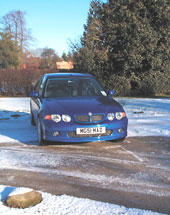
Over two years of almost daily use and all’s well. A heartening statement that is sure to tempt fate, but such is the confidence I have in this car that I’m sure it will shrug this off and continue as it has over the last two years.
Registered on 1st September 2001, ‘MG51 MAD’ has accrued miles at the average rate of 1000 per month (over 26,000 at the time of writing) not a super high mileage, but enough to reveal faults, if it was so inclined. Not that I’d wish it to be any other way of course!
The fact is that this car has been almost boringly devoid of faults and in the last 12 months has only visited a dealer for the purpose of the annual service. In this case a two year or 30,000 miles one, efficiently carried out by Trinity Motors in Hinckley, Leicestershire at a cost of just under £199.
Daily driver, the ZS 180 during last winter’s snow
The car remains as attractive to drive today as it was on that first eye opening drive out onto the Brecon Beacons at the Z range model launch; this was just before the hillsides lost all their sheep to foot and mouth. That is not to say it is perfect and with no room for improvements, but on balance the negative points, that have been well documented, remain minor when compared to the exhilaration from the moment the engine starts and you move off.
The car lives outside and so has been exposed to the ravages of weather over two winters, and in this respect the Trophy Blue paint has stood up very well indeed, and apart from the inevitable stone chips at the front there has been no noticeable degradation. Touching up these chips in this car’s ‘Pearlecent’ paint finish has not been simple, as the correct colour touch up pencils tend to give a much deeper colour finish. The way round this is to apply the paint very thinly and over several coats. The front grille badge also succumbed to a stone impact that de-laminated it. Eight pounds later and a new plate restored the status quo, although the original was obviously trained by a limpet and needed some persuasion!
Keeping the wheels clean is an ongoing chore as the front brakes do generate large volumes of brake dust. The secret here is frequent washing to ensure that the brake dust doesn’t get a hold and become engrained into the wheel lacquer. I also use specific wheel cleaner and a pressure washer that makes the job much easier. It is worth noting though that as wheel cleaners are usually acidic and carry a warning not to leave them on wheels for any length of time otherwise wheel finish can be damaged. This will also extend to the bare metal components on the brake and suspension and as a result you may see an accelerated rate at which surface rust can build up. On two of the wheels a couple of chips have appeared over time on the inside sharp edges of the alloy spokes where small stones have managed to get inside the wheel centre. By comparison, the exposed outer surface has proved to be very resilient. I have touched these chips up to ensure that corrosion is delayed from getting under the finish.
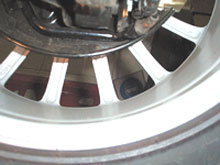
Wheel inside view – made in Poland
The front tyres finally reached around 2 to 2.5mm tread depth, although they looked considerably more worn than that, and I changed them at just over 21,000 miles. Shopping around I found a huge range of prices for the original Michelin 205/45ZR17 Pilot Sports, ranging from around £130 to nearly £200 each! It is worth noting that mail order shopping for tyres leaves you with attractive pricing, BUT you have to take into account additional charges relating to fitting and old tyre disposal, so the base delivered price is usually misleading. Most people accept that buying tyres from a mail order house and having someone else fit them will incur a fitting and balancing charge. Now there is also an individual environmental cost for disposal of tyres. Where a tyre outlet supplies and fits your tyres they will usually absorb the environmental costs, but they will add this up front when you arrive with a boot full of new tyres. That may mean as much as £15 to £25 fitting charge per tyre, which can seriously erode the discount price of the mail order house.
Other running costs have essentially been restricted to fuel, and with my predominately open road travelling I have seen a very respectable average of just over 31mpg overall in the last 12 months with the recent months several runs peaking near to 36mpg. A very acceptable level that didn’t require pussyfoot driving styles. Oil consumption that has been an issue for some in the past, especially during the first few thousand miles, and a minor issue for me has simply reduced to a level that required a single half litre of oil in the 12,000 miles before the last service.
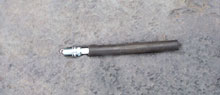
Using a length of hose to refit sparking plug – to prevent damage by cross threading
After the 24,000 mile point I noted a couple of cool early morning starts seemed to indicate the engine down on one cylinder for a second or so. This is a situation I have experienced with MGF VVC engines and is related to a spark plug misfire. Like the VVC and other K series, the KV6 uses the long life platinum spark plugs that are changed at the four year/60,000 mile service point. As the VVC problem is often solved by a plug change I adopted the same principle and renewed them. The problem has not returned and the following mileage has seen those better fuel consumption returns, an interesting coincidence, or perhaps not! Replacing the plugs is simple for the front bank of cylinders, as there are standard HT leads and easy plug access. The rear bank is somewhat different as here there are individual coils over each plug aperture on top of the head and these are bolted to the head. Leaning over the engine adds to the difficulty factor.
I also use a straight length of hose that I can push over the end of each plug once it has been loosened with the socket. This makes for easy removal and most importantly when the new plug is being replaced the grip of the hose on the electrode porcelain of the plug is tight enough to allow you to screw the plug in, but not enough to allow you to cross thread it. With this restricted access of the rear bank of cylinders this is especially important as cross threading when you’re stretched over the engine is all too easy to do.
I would point out that the standard long life plugs do last for the periods they are supposed to and provide an adequate level of efficiency, but as the miles tick by there is a slow but relentless loss of that efficiency. This is small and for most people not something that will cause any problem at all, but I want to see the best efficiency I can and I have never let a set of spark plugs stand in the way of achieving the best that is reasonably available.
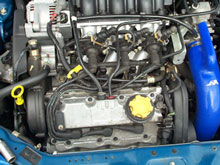
Front coils and plugs KV6
The ITG air induction system is another aspect of looking for improved efficiency and has followed the example of the rest of the car in just getting on with the job in hand and not creating any problems. The filter draws its cool air from the same position as the original system, which is from behind the left indicator area and therefore it hasn’t drawn in any additional dust or debris. This can be a problem for some sports filter set ups and requires more frequent cleaning. Some oil contamination can be seen in the standard air filter with the draining of oil drawn through the engine breather system and then dribbling downhill to the filter still applies, but with an oiled type of air filter, and the amounts involved, this doesn’t cause a problem.
This issue of oil draining back down the inlet pipe from the throttle body breather attachment was, in my opinion; central to the issue I had experienced in the first year with a sticking throttle. I reported upon this in the previous running report, and the cure being a good clean out with the carburettor cleaning spray and compressed air. It is interesting to note that the problem hasn’t returned and the degree of oil contamination in the inlet hose has been less, no doubt also connected to the lack of oil consumed overall.
Having the full MG Rover diagnostic facility in the Club workshop is handy to confirm aspects of the throttle operation. Specifically in respect of that over sensitive annoyance when in a lower gear at more than about 1500rpm on a very light throttle in slow traffic, which I have mentioned before. Even the smallest of throttle pedal movement can’t avoid an ‘on’, ‘off’ switching action and a slight lurch each time it occurs. It is not apparent with the same throttle movement at lower rpms, nor is it present when cruising at light throttle at normal open road speeds in 5th. A check using T4 diagnostics firstly showed no fault and then in detail I was able to confirm the range and values seen with throttle movement is perfect. Confirmation, not that I needed it, that the issue is one relating to the mapping in the ECU. The beauty of the T4 system is that by having the same updates as dealers, I was able to confirm that the software version loaded in my ECU was the most up to date. Owners of the MGF and newer MG (and Rover cars) may well wish to remember that this equipment is in the Club workshop if they need to have any diagnostic assessments done.
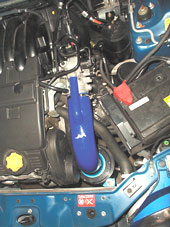
ITG performance air filter system continues to perform well
One impressive point about the car has been the continued superb handling and the lack of ingress of any slop or looseness. Because the suspension is set on the hard side of comfortable, the degree of road shock transmitted through the car would often be expected to cause items to loosen or wear faster. The almost silent cruising and continued feeling of complete composure shows that the car is well screwed together, a point that seems to have been replicated by most other owners I have contact with. Where owners have reported problems they have usually been minor failings dealt with by dealer action.
The problem reported last time was the driver’s window not lowering fully when using the ‘one shot down’ control. This was sorted at the first service, but has not only returned but also got worse. When conditions are damp, the window works fine and reaches the point most new cars seem to get to, with the window still about two inches short of the bottom. Otherwise there is clearly much more friction in the runners and the system sometimes stops the window every inch or so. This is easy to relieve by treating the glass runners with a dry lubricant. I suspect many cars suffer this problem.
Another niggle has been a weakening of the rear boot springs, so now the ‘Madam Guillotine’ action by the boot lid on the back of the neck is somewhat more frequent. (Big spoiler fitted!) However, familiarity means that you’re prepared for it and you don’t allow the ‘chop’ to occur!
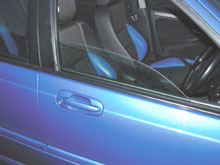
Driver’s window not lowering fully when using the ‘one shot’ down control
A general point that owners moving into ZS ownership ask me quite frequently is about the ‘floppy’ right side of the rear bumper panel. There is a very marked difference between the left and right side and this is something they usually find when they are washing their cars. It is not a fault or worry as it is a condition created by the MG exhaust being set higher towards the underside of the body and the MG bumper panel has to have a deeper cut out for the exhaust. This then allows more flexibility and so you see a marked difference between the right side where the exhaust cut out and the left side where with no cut out the panel is more rigid. In use the panel doesn’t flap about and it simply isn’t a problem. I suspect that if the twinned tail pipe with an exit either side of the car I suggested previously, was to be adopted this would remove the rigidity difference and no one would notice.
So two years on and the pleasure of that first drive into the Brecon Beacons remains almost as strong now as it was then. The inevitable question has to be whether I would buy another? If there wasn’t so much exciting activity with the MG model range, that is now the widest in MG’s 80 year history, then the answer would be a simple yes. However, with exciting models like the ZT 260 V8, then that question becomes difficult to answer, other than it will be another MG.
Roger Parker