Playing the Right Tune B Series Engines part B
In the first part of ‘B Series Engines’ we looked at quite simple modifications that could achieve up to about 40% increase in power throughout the normal engine rev range. Before we continue gaining altitude let us just take a break for a breather, reflect on some of the basics covered in the early features and ensure that our feet remain firmly on the ground.
Up to this point the modifications suggested will have been carried out on engines that are in very good condition, but which remain firmly bolted into the chassis. Adding any extra load to an engine also adds stress to it, but the modifications suggested so far can be easily accommodated if that engine is in ‘good condition’. As a rough guide I would suggest that the term ‘good condition’ applies to engines that have covered less than 40,000 miles, have at least 60psi oil pressure when hot at 3000rpm, and are not displaying any obvious defects.
Camshafts
Camshaft changes are often high on the list of owner priorities, yet the fact is that the standard MGB cam is a very good profile and almost without exception, the alternative profiles will have quite an effect of the character of the engine. The common result is to lose low to mid rpm power and torque to offset the gain in power and torque at higher rpms, and to raise the point where maximum power is produced. Often the claims of suppliers of ‘up to X or Y bhp increases masks the fact that, a) this is rarely possible without other changes, and b) the power gains at higher rpms rarely cover the losses at lower rpm.
Looking at some basic head flow characteristics show that the rate of flow increases rise rapidly as the valve opens up to around 250 thou lift and by 350 thou it has almost peaked. To illustrate this, the increase in flow between 200 and 250 thou valve lift is around 20%, yet between 350 and 400 the lift increase is a minute 4%. The point here is that the standard MGB engine was very carefully calibrated by the designers, as in standard form the maximum valve lift is 364 thou. Thus, the designers set the head breathing capacity and cam profile and valve lift to match each other.
Different cams tend to provide greater lift and overlap to open the valve more and keep it open longer. Keeping the valve open longer will show benefits at higher rpms, but at lower rpms the contamination effect of flow between inlet and exhaust can cause the engine to falter and run poorly: a condition known as ‘dropping off the cam’, with ‘coming on the cam’ applying the opposite way as revs rise.
Opening the valve more than the standard cam when the standard head has effectively reached its peak flow at a lower lift is rather ineffective. However, look at the flow rates for a well modified head and you will see those flow rates are improved over the standard head from the very lowest lifts, (circa 20%) to much higher valve lifts. Now the maximum flow rates are not reached until around the 450 thou lift point and beyond. At this lift the flow rates are again around 20% greater than the standard head. Now a different cam that lifts beyond the standard lift will actually be tapping into the released head flow potential, and power gains can be far greater.
Fitting a cam is not a simple operation and most will regard this as a job only suitable when the engine is removed from the car. Of more importance though is to ensure that the extra lift of a different cam profile can be safely accommodated, in fact this consideration applies to the high lift rockers mentioned last month too. With standard bore sizes if you lift the exhaust valve too much it will hit the block at the edge of the bore. This is why all 18V series engine had a cut out at the edge of each bore. There is no hard and fast rule that can be used to say whether a certain cam lift over the standard range will not see exhaust valve to block contact. Only actual measurement will confirm this.
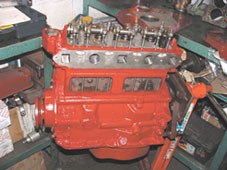
A fully built modified engine. Valuable power gains can be made by reworking components but balancing is essential
Not only is there the problem of the valve lift causing exhaust valve to block contact, but not knowing if the cylinder head has been previously skimmed adds to the need for checking clearance. This is because a skimmed head brings the valve closer to the block and reduces clearance. If this isn’t complicated enough there is always a similar risk of the inlet valve contacting the pistons, AND, with greater valve lift you get a risk of the valve springs becoming coil bound. If this happens it results in such rapid wear of the camshaft that you might think it has been in a lathe! Thought I was finished here? No, as there are modified cams that have characteristics suited for SU carburettors, and those suited for Weber and similar carburettors. Essentially this once again illustrates the need to carefully plan and choose matching components for the full engine specification and try to avoid choosing and doing a bit at a time as you go along. At times like this, you can be relieved to reflect on how good the original cam is for road use!
With non-standard camshafts causing potential problems it is best that the engine is removed to solve any contact issues. This then presents the opportunity to work on the engine and consider reconditioning work especially as performance tuning is usually fatal to an unsound engine. This then opens the door to another range of common options. The first is added capacity, which in almost all circumstances is a win-win situation.
However, there is a capacity limit to any engine and that limit will vary depending on the intended use of the car. For the 3 main bearing B series in 1489 to 1798cc capacity ranges the general rule will be to stick with the standard range of service oversize pistons available. Ideally, a plus 0.060″ (sixty thou) oversize piston adds a small but very useful extra capacity of around 3.5%, that with a modified head adds most to the mid range rpm area of engine performance, just in the sweet spot for normal road driving conditions. I am aware that these 3 main bearing engines have much more latent strength to take greater power, but as they are likely to be in pre 1964 cars there is a much reduced owner demand for them to become road rockets.
Five main bearing engines have greater reserve of strength and perhaps more importantly, the MGB into which these engines are mostly fitted, has a massive capacity to take huge increases of power and torque. Thus, the demand is far greater from owners of these later MGBs.
To start with, follow the same route of standard overbore sizes, ideally start looking at the plus 0.060″ to see similar mid rpm gains, as for the 3 main bearing engines. Whilst seemingly small in numerical terms at around an extra 70cc, the greater capacity gives a noticeably stronger feel with additional pull in the operating area that most road engines live in. Of course this comparison is only valid between like-condition engines and usually owner’s experience a massive change from an old worn out engine to a sparkling powerful new one! One thing I can certainly recommend is having the engine balanced. The B series is a little rough at the best of times and balancing is certainly beneficial. This will also match the cylinder head work that helps balance the flow of fuel/air into each cylinder that then provides more even firing pulses and smoother operation.
Bigger Bores
Next comes a specific option of going even larger in capacity. In the heyday of the Works MGB’s competition career there was the option of going to plus 0.080″ (1892cc) using expensive forged pistons from the Competitions Dept. Then in 1967, the Competitions Dept developed an even larger variation in the MG GTS prototype racecar entered in the May Targa Florio road race. This was actually an MGC being run in the public view some months before the MGC announcement. For that reason it featured both the MG GTS name and a 2004cc bored out B series engine, which sparked many minds about much larger capacity MGB engines.
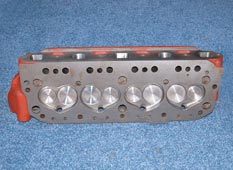 Well prepared MGB cylinder head, modified combustion chambers using 1.69″ inlet valves offer considerable power increase potential |
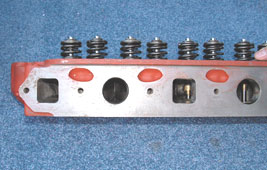 Smoothing out the inlet and exhaust ports is just a part of preparing an effective performance head |
One big bore conversion that followed on from this, and which became popular in the mid 1970s was a 1948cc conversion, which is commonly known as the 1950 engine. This is a very big overbore of the standard block of plus 0.130″ (130 thou or 3.25mm bigger). This is not a straight forward overbore due to a number of considerations, as many home tuners have found out with scrapped blocks! Sometimes, even specialists who are experienced in this conversion find that the block being worked upon can’t take the overbore when boring breaks through into water galleries or cracks the block. However, if the work is done correctly the result is quite effective for certain applications.
The 1950 was created by adapting a piston originally intended for the old 1558cc Lotus Ford twin cam engine. With that piston at its standard bore it gave c.1900cc and at plus 0.020″ it gave c.1924cc, however, as most B blocks could take it, the common size was to go to plus 0.040″ and achieve 1948cc. A negative aspect of this piston was the piston crown height and shape, the former requiring a fair amount to be machined off the top face of the block to allow the piston at TDC to reach anywhere near the top of the bore and achieve a decent compression ratio. In recent years specific 1950 pistons have been produced for use by some professional engine builders, but any specially made piston adds cost.
Rolling road testing in the ’70s and early ’80s with several engines that I built using Aldon Automotive half engines with standard cylinder heads, showed that this nominal 8% increase in engine capacity could achieve around 15% more power in the mid range using an otherwise standard engine and between 10 to 12% more at peak power rpm. The advantages stopped there though, as the dampening effects of the extra capacity lowered the power band rev range and also made the engine very lethargic and noticeably less responsive than a standard MGB, even though it was clearly quicker in almost all normal driving conditions. Peak power for example is seen at around 4600 to 4700rpm and peak torque sees a similar rpm drop, which in effect is not dissimilar to a diesel engine. This does point to a need for additional modifications as a standard part of this conversion.
With Aldon and Peter Burgess modified heads my engines really started to deliver impressive power as they were able to not only deliver the added torque, but the lost enthusiasm to rev was largely overcome. Certainly, the added breathing potential ensured that the engine didn’t start to fade until 5000rpm, still a lower rpm than seen with a standard bore engine, but the gains in power and torque usually masked that in normal use. Mid range power was the main benefactor but the upper rpm area still felt capped, especially when you have experience of standard bore engines with the same head modifications. This is not a serious failing though.
The capped effect comes from the way increased capacity ‘softens’ the cam characteristics, so that the larger capacity engine character has clear benefits for a heavier A60 or 1800 saloon, if the only change from standard is to be the larger capacity. To restore a more ‘sports car’ like character needs a cam change to something that has a duration of between 270 and 280 degrees, from the original 252. With the capacity increase softening the effect of the longer duration, the effect will be to restore the peak torque and peak power rpms points to much the same as they are with the standard MGB, plus of course the added benefits of tapping into the flow gains of the modified head.
If you were to change the cam after you have been running the 1950 capacity then you would notice a small loss of torque at lower rpms, but quite a pleasant increase in the mid to upper rpm power and a more enthusiastic response. 1948cc with a cam and well modified head, air filters and exhaust, makes for a very powerful engine and consequently a very good A to B car as it is the mid range where you spend most of the time. The character of the engine though is still not quite as sharp or responsive as seen with the tuned standard bore engines, which when set up right has an infectious character that makes you want to drive them as much and as hard as conditions allow.
Now with 20 plus years further development these basic characteristics haven’t changed although the top end power has seen further gains through constant detailed improvements. There has, though, been additional development with further capacity increases, firstly with an even larger bore to add another 50cc to mimic the bore stroke ratio of the later O series engine, and then with the original 1950 bore and a stroked crank to reach 2100cc.
The issues that made it difficult to reliably get to 1948cc are amplified with an even bigger bore 2000cc engine and I suggest it is not an ideal route to follow. Taking the 1950 bore and adding a longer throw crank doubles the original 150cc gain in capacity to 300cc, or near 17%, which has quite significant effects on both character and output and inevitably more additional changes to ancillaries to ensure they match the new capacity.
Raising the capacity of an engine by nearly 17% interestingly is the equivalent of what is seen in the Rover V8 rising from 3.5 to 4.2 litres. The 4.2 Rover sees significant changes including a longer throw crank that makes this a less desirable capacity than the overbored 3.5 that made the 3.9 litre V8.
Applying this theory to the B series engine provides the best overall efficiency with the plus sixty thou overbore. Beyond this although the power and torque rises, the efficiency of the engine against the capacity reduces, for this reason you need all the extra changes to ensure that all together they really do increase efficiency.
This is why a full 2100cc engine package demands such extensive extra work and investment way beyond what is applied to smaller capacity B series engines, just to be able to approach the base efficiency level of a mildly tweaked standard engine. It also shows why its costs are not far short of the price of a new V8 engine, and this starts a completely new ball game! Make no mistake, when embarking on this extent of engine change you really do need to cross all the ‘t’s and dot all the ‘i’s. You must cover every single part of the engine’s specification if you are to get anywhere near its potential and gain a real advantage over smaller capacity engines.
A good way to illustrate why the specific efficiency is reduced is to remember that this extra 300cc is having to breathe through the same induction and exhaust as the smaller capacity engines. An analogy would be to stick your head under water in a swimming pool with a length of garden hose to breathe through, then change the hose for a drinking straw, you really can’t expect to maintain the same breathing flow rate in the same time period.
Another consideration when removing material from a block when you over bore for larger pistons is that it will reduce the inherent stiffness of that block. Whilst the block remains a very heavy lump of cast iron that really would spoil your day if it dropped on your toe, it is now much more likely to display small degrees of twist and distortion in use. This condition affects the efficiency of the seal between the piston rings and the bore walls. This is why some big bore engines can be termed ‘heavy breathers’, and why more big-bore engines suffer than standard overbore sizes.
Heavy breathing can also be caused by the immediate use of high quality engine oils, especially synthetics. Using this type of oil in a new engine is often a reason why rings do not bed into bores for inordinately long periods and many, many thousands of miles, sometimes not at all. I can refer to identical build engines all giving within 3% in power terms, bar one which was losing 15% power, due to the owner’s misconception that the best oil from new is going to be good for the engine. That engine was glaze busted, fitted with new rings and run in with a specific running-in oil. It immediately lost the oil smoke, and within 1000 miles was able to compete on power terms after the first oil change to a normal, but not super high quality mineral oil. High quality oil (Mobil 1 in this case) went back in at the next oil change.
One again I have left the rails on a tangent of information, so let me return to the increased movement and flexibility of a big bore block. Not only will this reduced sealing result in heavier breathing, but it is also going to lose combustion pressure and so less torque/power will be developed. Internal losses will also increase through greater friction from the distortion and the engine having to work harder to breathe. The degree of loss will increase as the revs rise, so here the intended use of the engine has a bearing on whether a given route of tuning mods will be suitable for a particular car. If the use is of a ‘relaxed’ nature, that is to say that you prefer not to change gear, yet you want to be able to achieve reasonable acceleration, then the largest capacity engine will match that driving style. It would also match longer gearing well, so the MGB’s 22mph per 1000rpm in OD top could quite easily be raised to around 24mph per 1000, making a very long legged easy cruiser.
With engine capacities up to 1948cc and using standard or mild camshaft profiles I have indicated that the original 1.5″ SU, as originally fitted, has more than enough reserve to adequately provide air and fuel for these engines. With 2100cc, this is not the case and an increase in the capacity now creates demands where the standard carbs can be coming up short. The obvious choice is to change to a pair of 1.75″ HS6 or HIF6 carbs with its specific manifold to match. Here greater gains will be made than is common with the smaller capacity B series engines, with less lower rpm losses to trade against mid to higher rpm gains.
You could also use the common Weber 45 DCOE kit but in my view, it does not suit a road engine’s characteristics as well as the SUs. There are other alternative carb set ups that I should mention as they exist, including the even bigger Weber and similar side-draught 48 and 50 DCOE carbs. Then there are the twin 2″ HS8 SUs, that were featured on some of the very highly tweaked Competition engine specs and sold on during the Leyland Special Tuning days. I do wonder though with the slightly greater efficiency achieved with HIF series carbs over HS carbs, whether the optimum is to use a pair of HIF6 or HIF44 carbs on the specific 1.75″ SU manifold. Note again the need to match carbs with camshaft characteristics mentioned earlier.
Another aspect that reflects the much wider range of ‘off the shelf’ options for the B series compared to the A series, is the fact that new cast iron B series heads have been made and are often referred to as County heads. They are identified by a much heavier casting than a standard B series cast iron head and have been based on the better original B series head design. Even so, as cast there isn’t any performance advantage in fitting one, but they do offer a solution to replace a cracked head if finding a good second hand unit is seen as a problem. In fact whilst second hand supplies are much tighter now, there remains a good enough supply for the foreseeable future. Also, the same modifications can be applied to these County heads to make them work as well as the originals.
Alloy Cylinder Heads
Not only is there a remade cast iron head but there are several replacement alloy heads seen in two basic forms. Firstly, there is an alloy five port original design, supplied from a couple of suppliers, that again offers a solution to a cracked original head, plus this alloy head can be modified to the same pattern as the cast iron heads. The use of alloy brings thoughts of benefits from being able to run higher compression ratios. Which is true, but the reason behind this, is that the alloy conducts heat away much faster and reduces combustion temperatures and cylinder pressures. This means that to compete equally with the cast iron head, the alloy headed engine needs to run with a higher compression ratio. On the other hand, engines that run in very hot conditions may gain benefits from this extra efficiency and additional heat loss. A neat touch is that the casting has the earlier head oil port for the rockers, yet the casting is extended so that either type of rocker post can be used.
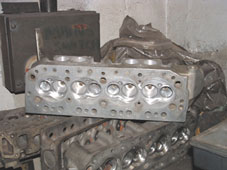
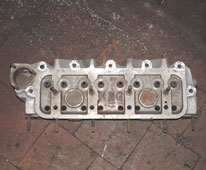 HRG Derrington seven port, crossflow, alloy cylinder head |
 HRG Derrington alloy heads were a popular modification in the early 60s |
The other well known alloy head is the seven port cross flow one. Perhaps the best known is the HRG Derrington head with the three exhaust ports remaining in their familiar position while the four inlet ports were moved to the spark plug side of the head. These four ports provide a single port per inlet valve, rather than the siamesed arrangement of the original design. This removes flow interference between cylinders and allows for an individual carb choke per cylinder. In these days of volatile petrol and excess heat, moving the carbs away from the exhaust provides positive advantages. Originating in the late 1950s the HRG was by a vast improvement comparison to the standard head. For an MGB on test in 1963 with just a change of head and inlet manifold there was approximately a 22% power increase. More impressive was the fact that between 2000 and 6000rpm figures indicated that torque with the Derrington head was higher than the standard car’s peak torque. It is obvious that such increases would show up well but remember at this time the Special Tuning advice was to start with polishing the standard head and see just a 2 to 3 bhp increase (3%).
Not only this but the additional ports enabled a wider range of carbs to be fitted and most interestingly twin 40 DCOE Webers. In 1967, an MGB with just 1000 miles was performance tested and recorded a time of 18 seconds to go from zero to 70mph. With the Derrington head and specific SU inlet manifold, but the rest of the spec being standard, the car now achieved this in 14 seconds. With a pair of 40 DCOEs the time dropped to 12 seconds and with a 714 cam and free flow exhaust it came down to 11 seconds. (Source: ‘BMC B Series Tuning and Modification’ by J.D. Hansen and published by Haynes in the 1960s).
It is also worth mentioning that the best modified five port alloy and cast iron heads today can beat the Derrington head in respect of flow and maximum power produced. However, the Derrington design’s separate inlet port arrangement still provides a low to mid range advantage, which can only be beaten by forced induction. Unfortunately, although there was a period during which the original design HRG Derrington seven port heads and the specific inlet manifolds were remanufactured in the UK, but it seems the supplies have dried up, apart from one in Peter Burgess’s stock.
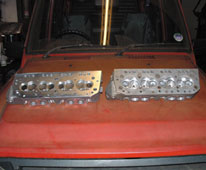 HRG reborn in the 90s, the examples shown were made by Pierce Manifolds from the USA |
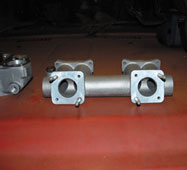 However good the cylinder head, manifold design is critical to exploiting the potential. Here the Pierce 7 port SU manifold shows an ‘unusual’ internal design |
An alternative seven port head is still available, made in the US by Pierce Manifolds, and is identified by ‘MSX’ cast into the top face of the head. This follows the pattern of the Derrington heads, although there are some detail differences in dimensions. Under careful examination the base head casting proves to be rather disappointing but it would provide plenty of opportunity for a head specialist cylinder head tuner to show his skills!
As with the Derrington design there are inlet manifolds for twin SUs and twin side draught Weber type carbs, plus an option for a Weber type down draught twin choke carb. This down draught style has never been a popular choice in the UK, being very much more common in the US. The twin side draught manifolds are very similar to those used with the Derrington heads but the twin SU version is somewhat different! The design is not dissimilar to the ‘log’ manifolds seen on the twin carb six cylinder MGC, Healey and Jaguar. In performance terms these have been found to be less effective than designs that follow the Derrington SU style on other applications. Not having had the opportunity to do a back to back test or flow bench test on the Pierce and Derrington manifolds leaves this question unanswered.
One common factor against the alternative alloy heads, irrespective of the original maker, is cost. Another, which may be source related, is quality and the relationship this has to how much work is needed, firstly to match the power output of a good standard cast iron head before approaching the effect of a well modified cast iron head. Add the cost of a seven port head and manifolds to the cost of an engine and when balanced against the results that can be reasonably expected, then you may well be better spending the same amount of money on an alternative engine. A seven port head on an MGB engine certainly looks different and attracts attention, which can be regarded as some compensation.
Supercharging
One effective alternative to fitting an alloy seven port head is supercharging, although this is not something I suggest should be mixed with an alloy head! During the heyday of the HRG Derrington head, supercharging was not uncommon nor was it unusual for B series engines to be supercharged. Whilst this topic is going away from my original stated aim of the KISS principle for this guide, I will mention that supercharging seems to be having a bit of a renaissance and kits are once more becoming available. The cost of these kits from around £2000 may seem very attractive against the cost of a new modified engine, but remember that just bolting a supercharger kit onto an engine is sure ways to create a ‘grenade’ if that engine is anything other then in really tip top condition. It is prudent to rebuild the engine to provide the assurance that the significant power and torque increase expected can be reliably accommodated and so real conversion costs can be very much higher.
The aspects of tuning the B series engine are similar to the A series and in fact many engines in that basic format of tuning should follow a set pattern for specific uses. However, when it comes down to detail, there are always various different routes that can be followed and the end results can be equally impressive. This guide is intended to put some meat on the bones of the subjects’ common areas without being all encompassing. For further detailed reading I suggest that Peter Burgess’s book ‘How to Power Tune MGB 4 Cylinder Engines’ will provide considerable additional information. The Club’s Regalia dept has stocks of these (Cat number 3342) and it would make an ideal Christmas present and provide a good read for dark winter evenings.
Roger Parker